Monitoring invertebrate pests on cowpea crops across China using eDNA metabarcoding

IF 3.8 1区 农林科学 Q1 AGRONOMY Pest Management Science Pub Date : 2025-03-27 DOI:10.1002/ps.8789
Qi Chen, Jun-Xian Lv, Wen Xie, Xing Wang, Shu-Jun Wei, Guo-Hua Huang
{"title":"Monitoring invertebrate pests on cowpea crops across China using eDNA metabarcoding","authors":"Qi Chen,&nbsp;Jun-Xian Lv,&nbsp;Wen Xie,&nbsp;Xing Wang,&nbsp;Shu-Jun Wei,&nbsp;Guo-Hua Huang","doi":"10.1002/ps.8789","DOIUrl":null,"url":null,"abstract":"<div>\n \n \n <section>\n \n <h3> BACKGROUND</h3>\n \n <p>Monitoring arthropod pests and their natural enemies provides essential information for pest control decisions in agricultural production. Traditional monitoring methods, such as trapping and visual surveys, have practical limitations because of their time-consuming preprocessing steps and the need for knowledgeable taxonomists. We tested the environmental DNA (eDNA) metabarcoding approach for monitoring cowpea (<i>Vigna unguiculata</i>) arthropod pests and their natural enemies across seven climatic sub-regions of China, comparing it with traditional sample collection and morphological identification methods.</p>\n </section>\n \n <section>\n \n <h3> RESULTS</h3>\n \n <p>We showed that eDNA metabarcoding reveals a higher species richness of cowpea arthropods than the traditional visual method. The eDNA method detected 163 species, of which 72, 33 and 57 were pests, natural enemies and other insects, respectively, whereas the traditional method only detected 70 species. There were significant differences in alpha- and beta-diversity for arthropods on cowpea in different climatic sub-regions. We also found that longitude, altitude and geographical distance are associated with species diversity, but latitude, mean air temperature and temperature range are not.</p>\n </section>\n \n <section>\n \n <h3> CONCLUSION</h3>\n \n <p>This study represents the first use of eDNA metabarcoding to investigate cowpea arthropod communities, providing a novel method for pest monitoring. © 2025 Society of Chemical Industry.</p>\n </section>\n </div>","PeriodicalId":218,"journal":{"name":"Pest Management Science","volume":"81 8","pages":"4286-4299"},"PeriodicalIF":3.8000,"publicationDate":"2025-03-27","publicationTypes":"Journal Article","fieldsOfStudy":null,"isOpenAccess":false,"openAccessPdf":"","citationCount":"0","resultStr":null,"platform":"Semanticscholar","paperid":null,"PeriodicalName":"Pest Management Science","FirstCategoryId":"97","ListUrlMain":"https://scijournals.onlinelibrary.wiley.com/doi/10.1002/ps.8789","RegionNum":1,"RegionCategory":"农林科学","ArticlePicture":[],"TitleCN":null,"AbstractTextCN":null,"PMCID":null,"EPubDate":"","PubModel":"","JCR":"Q1","JCRName":"AGRONOMY","Score":null,"Total":0}
引用次数: 0

Abstract

BACKGROUND

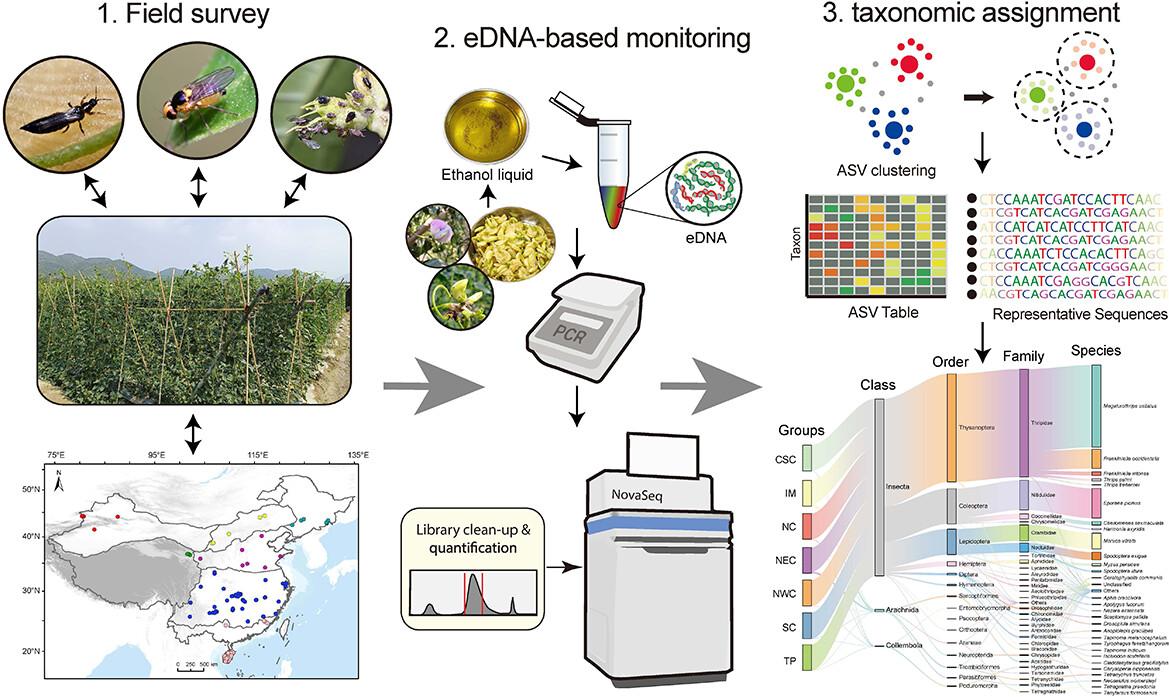
Monitoring arthropod pests and their natural enemies provides essential information for pest control decisions in agricultural production. Traditional monitoring methods, such as trapping and visual surveys, have practical limitations because of their time-consuming preprocessing steps and the need for knowledgeable taxonomists. We tested the environmental DNA (eDNA) metabarcoding approach for monitoring cowpea (Vigna unguiculata) arthropod pests and their natural enemies across seven climatic sub-regions of China, comparing it with traditional sample collection and morphological identification methods.

RESULTS

We showed that eDNA metabarcoding reveals a higher species richness of cowpea arthropods than the traditional visual method. The eDNA method detected 163 species, of which 72, 33 and 57 were pests, natural enemies and other insects, respectively, whereas the traditional method only detected 70 species. There were significant differences in alpha- and beta-diversity for arthropods on cowpea in different climatic sub-regions. We also found that longitude, altitude and geographical distance are associated with species diversity, but latitude, mean air temperature and temperature range are not.

CONCLUSION

This study represents the first use of eDNA metabarcoding to investigate cowpea arthropod communities, providing a novel method for pest monitoring. © 2025 Society of Chemical Industry.
Abstract Image

Abstract Image

Abstract Image

Abstract Image

Abstract Image

查看原文
分享 分享
微信好友 朋友圈 QQ好友 复制链接
本刊更多论文
利用eDNA元条形码技术监测中国豇豆作物无脊椎害虫
节肢动物害虫及其天敌的监测为农业生产中害虫防治决策提供了重要信息。传统的监测方法,如诱捕和目视调查,由于其耗时的预处理步骤和对知识渊博的分类学家的需要,具有实际的局限性。在中国7个气候亚区对豇豆(Vigna unguiculata)节肢动物害虫及其天敌进行了环境DNA元条形码(eDNA)监测,并与传统的采样和形态鉴定方法进行了比较。
本文章由计算机程序翻译,如有差异,请以英文原文为准。
求助全文
约1分钟内获得全文 去求助
来源期刊
Pest Management Science
Pest Management Science 农林科学-昆虫学
CiteScore
7.90
自引率
9.80%
发文量
553
审稿时长
4.8 months
期刊介绍: Pest Management Science is the international journal of research and development in crop protection and pest control. Since its launch in 1970, the journal has become the premier forum for papers on the discovery, application, and impact on the environment of products and strategies designed for pest management. Published for SCI by John Wiley & Sons Ltd.
期刊最新文献
Potential of endophytic Beauveria bassiana against Coraebus (Coleoptera: Buprestidae) oak borers. Artificial shelters as dual-purpose tools for monitoring natural enemies and providing microhabitats in orchards. Residue dynamics and metabolic pathways of sulfoxaflor in Cirsium japonicum var. maackii and Olea europaea L. Molecular co-assembly engineering towards natural tea saponin-based nanopesticides for synergistic enhanced foliar affinity. Cytochrome P450 and glutathione S-transferase may confer bensulfuron-methyl resistance in Cyperus iria.
×
引用
GB/T 7714-2015
复制
MLA
复制
APA
复制
导出至
BibTeX EndNote RefMan NoteFirst NoteExpress
×
×
提示
您的信息不完整,为了账户安全,请先补充。
现在去补充
×
提示
您因"违规操作"
具体请查看互助需知
我知道了
×
提示
现在去查看 取消
×
提示
确定
0
微信
客服QQ
Book学术公众号 扫码关注我们
反馈
×
意见反馈
请填写您的意见或建议
请填写您的手机或邮箱
已复制链接
已复制链接
快去分享给好友吧!
我知道了
×
扫码分享
扫码分享
Book学术官方微信
Book学术文献互助
Book学术文献互助群
群 号:604180095
Book学术
文献互助 智能选刊 最新文献 互助须知 联系我们:info@booksci.cn
Book学术提供免费学术资源搜索服务,方便国内外学者检索中英文文献。致力于提供最便捷和优质的服务体验。
Copyright © 2023 Book学术 All rights reserved.
ghs 京公网安备 11010802042870号 京ICP备2023020795号-1