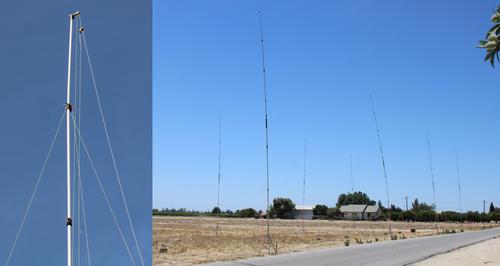
Off-target drift of pesticides from orchard airblast spray applications has potential implications for human health and the environment. A field study was conducted in a commercial almond orchard to generate spray drift data for validating a mechanistic airblast spray drift risk assessment model under development. Pyranine fluorescent dye solution spray was applied in 22 trials at 935.4 L/ha with the sprayer making four passes along the third drive lane upwind from the edge of orchard. Drift was measured with artificial spray samplers distributed in an adjacent open field up to 183 m from the edge of the orchard, which were retrieved and analyzed by fluorometry to generate dye drift deposition data.
Drift data showed downwind deposit decay, indicating the extent of drift under different prevailing weather conditions. Terminal drift amount (in percentage of applied dose) and distances were estimated to be: 6.0 × 10⁻⁷ at 531.1 m for artificial foliage; and 4.0 × 10⁻⁶ at 232.8 m for horizontal string. Weather condition caused variation in drift among spray trials but only wind direction, wind speed, and atmospheric pressure were significant in accounting for the variability.
This new dataset provides opportunities for objective pesticide risk assessment decision-making that will potentially impact regulations affecting the California almond industry. The data will also be useful for confirming and/or updating spray application best practices for promoting efficiency, effectiveness, and environmental sustainability. © 2025 The Author(s). Pest Management Science published by John Wiley & Sons Ltd on behalf of Society of Chemical Industry.





 京公网安备 11010802042870号
京ICP备2023020795号-1
京公网安备 11010802042870号
京ICP备2023020795号-1

 分享
分享
 求助内容:
求助内容: 应助结果提醒方式:
 扫码关注我们
