{"title":"Stereocontrolled Phenol-Yne Click Polymerization Toward High-Performance Bioplastics with Closed-Loop Recyclability","authors":"Wei Chen, Yong-Qiang Teng, Ming-Yang Yang, Tian-Jun Yue, Wei-Min Ren, Xiao-Bing Lu, Hui Zhou","doi":"10.1002/anie.202502416","DOIUrl":null,"url":null,"abstract":"<p>Hydroxyl-yne click polymerization is a highly atom-economic and powerful tool for constructing sequence-controlled and structure-diverse unsaturated polymers. However, the <i>cis/trans</i> stereochemistry remains underdeveloped, thus lacking a stereodivergent synthesis of stereocontrolled polymers. Herein, we first report the organocatalyzed stereocontrolled phenol-yne click polymerization of bioderived diphenols and dipropiolates by judiciously changing the substrates, catalysts, and reaction solvents. Various sequence- and stereocontrolled poly(vinyl ether ester)s were effectively synthesized under mild reaction conditions, in which the <i>trans</i> content in the polymeric backbone can be proportionally altered in the range of 46%–100%. More importantly, the bulk properties of these materials such as thermal (<i>T</i><sub>d,5%</sub> of 329–362 °C; <i>T</i><sub>g</sub> of 48–92 °C), mechanical (ultimate tensile strengths of 41–89 MPa, tensile moduli of 960–1991 MPa, and elongations at break of 71%–242%), and transport properties (oxygen transmission rates of 0.2–0.3 bar and water vapor transmission rates of 1.3–2.8 g mm m<sup>−2</sup> day<sup>−1</sup>) can be tuned broadly. Moreover, the installed dynamic acetal moieties contribute to the excellent degradability and recyclability of these materials. This study provides an efficient and sustainable strategy for synthesizing stereoregulated biopolymers with closed-loop recyclability, thereby expanding the chemical diversity of click polymers with structure-controlled and tailored properties.</p>","PeriodicalId":125,"journal":{"name":"Angewandte Chemie International Edition","volume":"64 23","pages":""},"PeriodicalIF":16.9000,"publicationDate":"2025-03-26","publicationTypes":"Journal Article","fieldsOfStudy":null,"isOpenAccess":false,"openAccessPdf":"","citationCount":"0","resultStr":null,"platform":"Semanticscholar","paperid":null,"PeriodicalName":"Angewandte Chemie International Edition","FirstCategoryId":"92","ListUrlMain":"https://onlinelibrary.wiley.com/doi/10.1002/anie.202502416","RegionNum":1,"RegionCategory":"化学","ArticlePicture":[],"TitleCN":null,"AbstractTextCN":null,"PMCID":null,"EPubDate":"","PubModel":"","JCR":"Q1","JCRName":"CHEMISTRY, MULTIDISCIPLINARY","Score":null,"Total":0}
引用次数: 0
Abstract
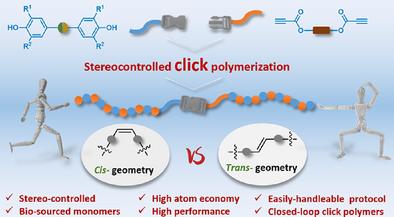
Hydroxyl-yne click polymerization is a highly atom-economic and powerful tool for constructing sequence-controlled and structure-diverse unsaturated polymers. However, the cis/trans stereochemistry remains underdeveloped, thus lacking a stereodivergent synthesis of stereocontrolled polymers. Herein, we first report the organocatalyzed stereocontrolled phenol-yne click polymerization of bioderived diphenols and dipropiolates by judiciously changing the substrates, catalysts, and reaction solvents. Various sequence- and stereocontrolled poly(vinyl ether ester)s were effectively synthesized under mild reaction conditions, in which the trans content in the polymeric backbone can be proportionally altered in the range of 46%–100%. More importantly, the bulk properties of these materials such as thermal (Td,5% of 329–362 °C; Tg of 48–92 °C), mechanical (ultimate tensile strengths of 41–89 MPa, tensile moduli of 960–1991 MPa, and elongations at break of 71%–242%), and transport properties (oxygen transmission rates of 0.2–0.3 bar and water vapor transmission rates of 1.3–2.8 g mm m−2 day−1) can be tuned broadly. Moreover, the installed dynamic acetal moieties contribute to the excellent degradability and recyclability of these materials. This study provides an efficient and sustainable strategy for synthesizing stereoregulated biopolymers with closed-loop recyclability, thereby expanding the chemical diversity of click polymers with structure-controlled and tailored properties.
期刊介绍:
Angewandte Chemie, a journal of the German Chemical Society (GDCh), maintains a leading position among scholarly journals in general chemistry with an impressive Impact Factor of 16.6 (2022 Journal Citation Reports, Clarivate, 2023). Published weekly in a reader-friendly format, it features new articles almost every day. Established in 1887, Angewandte Chemie is a prominent chemistry journal, offering a dynamic blend of Review-type articles, Highlights, Communications, and Research Articles on a weekly basis, making it unique in the field.



 京公网安备 11010802042870号
京ICP备2023020795号-1
京公网安备 11010802042870号
京ICP备2023020795号-1

 分享
分享
 求助内容:
求助内容: 应助结果提醒方式:
 扫码关注我们
