Zhu Yan , Yufei Zhang , Qin Chen , Jing Li , Xiaoying Ning , Fan Bai , Yaqi Wang , Xiaoming Liu , Yale Liu , Mingzhen Zhang , Cui Liu , Yumin Xia
{"title":"Carbon dot superoxide dismutase nanozyme enhances reactive oxygen species scavenging in diabetic skin wound repair","authors":"Zhu Yan , Yufei Zhang , Qin Chen , Jing Li , Xiaoying Ning , Fan Bai , Yaqi Wang , Xiaoming Liu , Yale Liu , Mingzhen Zhang , Cui Liu , Yumin Xia","doi":"10.1016/j.jare.2025.03.049","DOIUrl":null,"url":null,"abstract":"<div><h3>Introduction</h3><div>The accumulation of reactive oxygen species (ROS) in diabetic wounds leads to inflammation and impaired neovascularization. Recent studies have indicated that carbon dot nanozymes (C-dots) exhibiting superoxide dismutase (SOD)-like activity can neutralize excessive ROS and mitigate diseases associated with oxidative stress.</div></div><div><h3>Objectives</h3><div>Our study was designed to evaluate the therapeutic impact of C-dots on the healing of diabetic wounds and to unravel the complex molecular mechanisms through which these nanozymes modulate oxidative stress and inflammatory responses within the wound microenvironment.</div></div><div><h3>Methods and results</h3><div>We synthesized C-dots from carbon fiber and confirmed their structure using transmission electron microscopy. The presence of carbon–carbon double bonds on the C-dots was verified with X-ray photoelectron spectroscopy. We assessed the scavenging capacity of C-dots for superoxide anion, hydroxyl radical, and nitric oxide radical using electron spin resonance spectroscopy. Their SOD-like activity and total antioxidant capacity were evaluated with commercial assay kits. <em>In vitro</em> experiments showed that C-dots effectively scavenged excessive ROS, protecting human keratinocytes, vascular endothelial cells, and fibroblasts from oxidative stress-induced damage. Concurrently, C-dots increased the migratory capacity of fibroblasts. In a streptozocin-induced diabetic mice model, C-dots application enhanced skin wound healing, evidenced by accelerated re-epithelialization and orderly collagen matrix assembly. Mechanistic investigations indicated that C-dots markedly suppressed ROS generation and diminished the levels of inflammatory cytokines in the wound environment. Additionally, C-dots induced an M2 polarization phenotype in macrophages and promoted neovascularization, indicating a transition from the inflammatory to the proliferative phase. Quantitative proteomic analysis was conducted to further clarify the underlying mechanisms of C-dots in ameliorating diabetic wounds.</div></div><div><h3>Conclusion</h3><div>C-dots represent a robust nanomaterial-based strategy for treating diabetic wounds, with the ability to accelerate healing by alleviating oxidative stress, mitigating harmful inflammatory responses, and fostering angiogenesis. This highlights their significant therapeutic potential in the field of biomedicine.</div></div>","PeriodicalId":14952,"journal":{"name":"Journal of Advanced Research","volume":"79 ","pages":"Pages 691-706"},"PeriodicalIF":13.0000,"publicationDate":"2026-01-01","publicationTypes":"Journal Article","fieldsOfStudy":null,"isOpenAccess":false,"openAccessPdf":"","citationCount":"0","resultStr":null,"platform":"Semanticscholar","paperid":null,"PeriodicalName":"Journal of Advanced Research","FirstCategoryId":"103","ListUrlMain":"https://www.sciencedirect.com/science/article/pii/S2090123225002097","RegionNum":1,"RegionCategory":"综合性期刊","ArticlePicture":[],"TitleCN":null,"AbstractTextCN":null,"PMCID":null,"EPubDate":"2025/3/26 0:00:00","PubModel":"Epub","JCR":"Q1","JCRName":"MULTIDISCIPLINARY SCIENCES","Score":null,"Total":0}
引用次数: 0
Abstract
Introduction
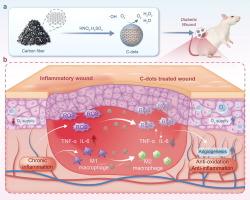
The accumulation of reactive oxygen species (ROS) in diabetic wounds leads to inflammation and impaired neovascularization. Recent studies have indicated that carbon dot nanozymes (C-dots) exhibiting superoxide dismutase (SOD)-like activity can neutralize excessive ROS and mitigate diseases associated with oxidative stress.
Objectives
Our study was designed to evaluate the therapeutic impact of C-dots on the healing of diabetic wounds and to unravel the complex molecular mechanisms through which these nanozymes modulate oxidative stress and inflammatory responses within the wound microenvironment.
Methods and results
We synthesized C-dots from carbon fiber and confirmed their structure using transmission electron microscopy. The presence of carbon–carbon double bonds on the C-dots was verified with X-ray photoelectron spectroscopy. We assessed the scavenging capacity of C-dots for superoxide anion, hydroxyl radical, and nitric oxide radical using electron spin resonance spectroscopy. Their SOD-like activity and total antioxidant capacity were evaluated with commercial assay kits. In vitro experiments showed that C-dots effectively scavenged excessive ROS, protecting human keratinocytes, vascular endothelial cells, and fibroblasts from oxidative stress-induced damage. Concurrently, C-dots increased the migratory capacity of fibroblasts. In a streptozocin-induced diabetic mice model, C-dots application enhanced skin wound healing, evidenced by accelerated re-epithelialization and orderly collagen matrix assembly. Mechanistic investigations indicated that C-dots markedly suppressed ROS generation and diminished the levels of inflammatory cytokines in the wound environment. Additionally, C-dots induced an M2 polarization phenotype in macrophages and promoted neovascularization, indicating a transition from the inflammatory to the proliferative phase. Quantitative proteomic analysis was conducted to further clarify the underlying mechanisms of C-dots in ameliorating diabetic wounds.
Conclusion
C-dots represent a robust nanomaterial-based strategy for treating diabetic wounds, with the ability to accelerate healing by alleviating oxidative stress, mitigating harmful inflammatory responses, and fostering angiogenesis. This highlights their significant therapeutic potential in the field of biomedicine.
期刊介绍:
Journal of Advanced Research (J. Adv. Res.) is an applied/natural sciences, peer-reviewed journal that focuses on interdisciplinary research. The journal aims to contribute to applied research and knowledge worldwide through the publication of original and high-quality research articles in the fields of Medicine, Pharmaceutical Sciences, Dentistry, Physical Therapy, Veterinary Medicine, and Basic and Biological Sciences.
The following abstracting and indexing services cover the Journal of Advanced Research: PubMed/Medline, Essential Science Indicators, Web of Science, Scopus, PubMed Central, PubMed, Science Citation Index Expanded, Directory of Open Access Journals (DOAJ), and INSPEC.




 京公网安备 11010802042870号
京ICP备2023020795号-1
京公网安备 11010802042870号
京ICP备2023020795号-1

 分享
分享
 求助内容:
求助内容: 应助结果提醒方式:
 扫码关注我们
