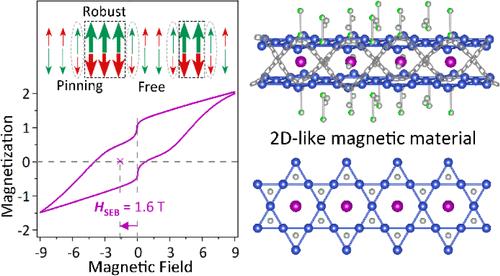
{"title":"Bilayer Kagome Ferrimagnet Exhibiting Exceptional Spontaneous Exchange Bias in TbMn6(Ge,Ga)6","authors":"Hankun Xu, Wenjie Li, Junjie Chen, Sergii Khmelevskyi, Dmitry Khalyavin, Pascal Manuel, Chuanying Xi, Shogo Kawaguchi, Jing Chen, Wanda Yang, Qinghua Zhang, Yili Cao, Chengyi Yu, Yang Ren, Kun Lin, Xianran Xing","doi":"10.1021/jacs.4c17505","DOIUrl":null,"url":null,"abstract":"Manipulating interlayer interactions in two-dimensional (2D) materials has led to intriguing behaviors. Borrowing these 2D signatures to bulk materials is likely to unlock exceptional properties. Here, we report an emergent 2D-like bilayer Kagome ferrimagnet through reducing the interbilayer magnetic interaction to nearly zero. This concept is realized within bulk TbMn<sub>6</sub>(Ge,Ga)<sub>6</sub> compounds, characterized by an isolated and pure Mn Kagome lattice, simply by the chemical substitution of Ge with Ga. Specifically, the targeted compound TbMn<sub>6</sub>Ge<sub>5</sub>Ga<sub>1</sub> exhibits a giant spontaneous exchange bias (SEB) of approximately 1.6 T, which is more than twice that observed in known materials. Field-dependent neutron diffraction reveals the robust nature of the compensated ferrimagnetic (FiM), characterized by almost two-thirds of the moments being pinned and irreversible under fields up to 9 T. Through magnetic and structural analysis, alongside theoretical calculations, we demonstrate that the substantial SEB is related to the intense competition between local robust and weak FiM states within the bilayer Kagome configuration, which are stabilized by an incommensurate spin arrangement. The concept of a bilayer Kagome magnet offers new opportunities for discovering attractive properties in 2D-like materials.","PeriodicalId":49,"journal":{"name":"Journal of the American Chemical Society","volume":"16 1","pages":""},"PeriodicalIF":15.6000,"publicationDate":"2025-03-27","publicationTypes":"Journal Article","fieldsOfStudy":null,"isOpenAccess":false,"openAccessPdf":"","citationCount":"0","resultStr":null,"platform":"Semanticscholar","paperid":null,"PeriodicalName":"Journal of the American Chemical Society","FirstCategoryId":"92","ListUrlMain":"https://doi.org/10.1021/jacs.4c17505","RegionNum":1,"RegionCategory":"化学","ArticlePicture":[],"TitleCN":null,"AbstractTextCN":null,"PMCID":null,"EPubDate":"","PubModel":"","JCR":"Q1","JCRName":"CHEMISTRY, MULTIDISCIPLINARY","Score":null,"Total":0}
引用次数: 0
Abstract
Manipulating interlayer interactions in two-dimensional (2D) materials has led to intriguing behaviors. Borrowing these 2D signatures to bulk materials is likely to unlock exceptional properties. Here, we report an emergent 2D-like bilayer Kagome ferrimagnet through reducing the interbilayer magnetic interaction to nearly zero. This concept is realized within bulk TbMn6(Ge,Ga)6 compounds, characterized by an isolated and pure Mn Kagome lattice, simply by the chemical substitution of Ge with Ga. Specifically, the targeted compound TbMn6Ge5Ga1 exhibits a giant spontaneous exchange bias (SEB) of approximately 1.6 T, which is more than twice that observed in known materials. Field-dependent neutron diffraction reveals the robust nature of the compensated ferrimagnetic (FiM), characterized by almost two-thirds of the moments being pinned and irreversible under fields up to 9 T. Through magnetic and structural analysis, alongside theoretical calculations, we demonstrate that the substantial SEB is related to the intense competition between local robust and weak FiM states within the bilayer Kagome configuration, which are stabilized by an incommensurate spin arrangement. The concept of a bilayer Kagome magnet offers new opportunities for discovering attractive properties in 2D-like materials.
期刊介绍:
The flagship journal of the American Chemical Society, known as the Journal of the American Chemical Society (JACS), has been a prestigious publication since its establishment in 1879. It holds a preeminent position in the field of chemistry and related interdisciplinary sciences. JACS is committed to disseminating cutting-edge research papers, covering a wide range of topics, and encompasses approximately 19,000 pages of Articles, Communications, and Perspectives annually. With a weekly publication frequency, JACS plays a vital role in advancing the field of chemistry by providing essential research.



 京公网安备 11010802042870号
京ICP备2023020795号-1
京公网安备 11010802042870号
京ICP备2023020795号-1

 分享
分享
 求助内容:
求助内容: 应助结果提醒方式:
 扫码关注我们
