Likang Lv, Peiqi Chu, Tong Han, Yunpeng Jiang, Zhiwei Wang, Yuxi Liu, Hongxing Dai, Lu Wei, Jiguang Deng
{"title":"Carbon and Oxygen Double Defects-Enhanced Ru-Based Catalyst for Ammonia Decomposition","authors":"Likang Lv, Peiqi Chu, Tong Han, Yunpeng Jiang, Zhiwei Wang, Yuxi Liu, Hongxing Dai, Lu Wei, Jiguang Deng","doi":"10.1002/anie.202501898","DOIUrl":null,"url":null,"abstract":"<p>Although ammonia is widely recognized as one of the most promising candidates for hydrogen storage and transformation, the catalytic mechanisms involved in ammonia decomposition remain insufficiently understood, and the stability of catalysts continues to present significant challenges. In this study, Ru/CeO<sub>2</sub>-CNTs catalysts with double defect sites were synthesized by a straightforward method, achieving an outstanding hydrogen production rate of 2230 mmol<sup>−1</sup> g<sub>Ru</sub><sup>−1</sup> min<sup>−1</sup> at 500 °C, outperforming most Ru-based catalysts. Experimental characterization and theoretical calculations revealed that the CeO<sub>2</sub>-CNTs interface promotes the formation of oxygen vacancies (O<sub>v</sub>) and carbon defects (C<sub>d</sub>) through carbon–oxygen interactions. These defects enhance electron transfer from the support to Ru nanoparticles (NPs), modulate NH<sub>3</sub> adsorption and activation and modulate the recombination and desorption of adsorbed N species (N*). Moreover, the coating of CeO<sub>2</sub> significantly improved the stability of CNTs, which weakens undesired reactions under high-temperature and hydrogen-rich conditions. The study introduced a rational design strategy that enhances the multiple elementary stages of the NH<sub>3</sub> decomposition by constructing double defect sites and offering new insights into the design of efficient and durable catalysts under harsh environments.</p>","PeriodicalId":125,"journal":{"name":"Angewandte Chemie International Edition","volume":"64 23","pages":""},"PeriodicalIF":16.9000,"publicationDate":"2025-03-27","publicationTypes":"Journal Article","fieldsOfStudy":null,"isOpenAccess":false,"openAccessPdf":"","citationCount":"0","resultStr":null,"platform":"Semanticscholar","paperid":null,"PeriodicalName":"Angewandte Chemie International Edition","FirstCategoryId":"92","ListUrlMain":"https://onlinelibrary.wiley.com/doi/10.1002/anie.202501898","RegionNum":1,"RegionCategory":"化学","ArticlePicture":[],"TitleCN":null,"AbstractTextCN":null,"PMCID":null,"EPubDate":"","PubModel":"","JCR":"Q1","JCRName":"CHEMISTRY, MULTIDISCIPLINARY","Score":null,"Total":0}
引用次数: 0
Abstract
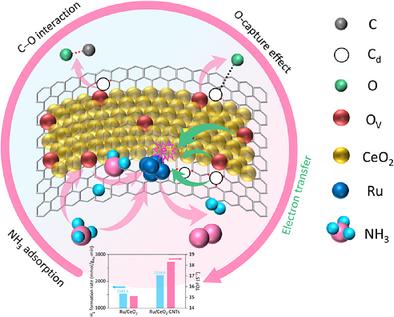
Although ammonia is widely recognized as one of the most promising candidates for hydrogen storage and transformation, the catalytic mechanisms involved in ammonia decomposition remain insufficiently understood, and the stability of catalysts continues to present significant challenges. In this study, Ru/CeO2-CNTs catalysts with double defect sites were synthesized by a straightforward method, achieving an outstanding hydrogen production rate of 2230 mmol−1 gRu−1 min−1 at 500 °C, outperforming most Ru-based catalysts. Experimental characterization and theoretical calculations revealed that the CeO2-CNTs interface promotes the formation of oxygen vacancies (Ov) and carbon defects (Cd) through carbon–oxygen interactions. These defects enhance electron transfer from the support to Ru nanoparticles (NPs), modulate NH3 adsorption and activation and modulate the recombination and desorption of adsorbed N species (N*). Moreover, the coating of CeO2 significantly improved the stability of CNTs, which weakens undesired reactions under high-temperature and hydrogen-rich conditions. The study introduced a rational design strategy that enhances the multiple elementary stages of the NH3 decomposition by constructing double defect sites and offering new insights into the design of efficient and durable catalysts under harsh environments.
期刊介绍:
Angewandte Chemie, a journal of the German Chemical Society (GDCh), maintains a leading position among scholarly journals in general chemistry with an impressive Impact Factor of 16.6 (2022 Journal Citation Reports, Clarivate, 2023). Published weekly in a reader-friendly format, it features new articles almost every day. Established in 1887, Angewandte Chemie is a prominent chemistry journal, offering a dynamic blend of Review-type articles, Highlights, Communications, and Research Articles on a weekly basis, making it unique in the field.



 京公网安备 11010802042870号
京ICP备2023020795号-1
京公网安备 11010802042870号
京ICP备2023020795号-1

 分享
分享
 求助内容:
求助内容: 应助结果提醒方式:
 扫码关注我们
