Jin Lu, Zhaoqian Li, Bo Wu, Zhiqiang Jiang* and Chonghua Pei*,
{"title":"Nanosheet-Stacked g-C3N4 Tubes with Carbon Vacancies for Enhanced Photocatalytic H2 Evolution","authors":"Jin Lu, Zhaoqian Li, Bo Wu, Zhiqiang Jiang* and Chonghua Pei*, ","doi":"10.1021/acsanm.5c00363","DOIUrl":null,"url":null,"abstract":"<p >Graphitic carbon nitride (g-C<sub>3</sub>N<sub>4</sub>) is a photocatalyst that has been extensively investigated. Unfortunately, g-C<sub>3</sub>N<sub>4</sub> suffers from the challenges of insufficient light absorption and rapid complexation of photogenerated charges. Modification methods such as defect engineering and nanostructure reconstruction can improve photocatalytic performance. This is because modification can improve carrier separation efficiency, increase active sites and increase light absorption, etc. Here, we demonstrate a simple approach to fabricate nanosheet-stacked g-C<sub>3</sub>N<sub>4</sub> (M-CN<sub>600</sub>) tubes with carbon vacancies (V<sub>Cs</sub>) and used for photocatalytic water splitting to hydrogen production. M-CN<sub>600</sub> was prepared by the thermal polymerization of precursors. These precursors were obtained through the melem induced by methanesulfonic acid. Due to the nano effect, the obtained M-CN<sub>600</sub> exhibits a significantly higher specific surface area (105.2 m<sup>2</sup> g<sup>–1</sup>) and pore volume (0.391 cm<sup>3</sup> g<sup>–1</sup>) compared to pristine g-C<sub>3</sub>N<sub>4</sub> (B-CN). This creates more reaction sites, which improve the performance of photocatalytic H<sub>2</sub> production. The nanosheet-stacked structure reduces the transport distance of photogenerated carriers to the material surface. In addition, M-CN<sub>600</sub> possesses more negative conduction band positions with stronger photocatalytic reduction ability. Moreover, due to the presence of V<sub>Cs</sub> in the catalyst, the separation of photogenerated electron and hole pairs is accelerated. Under visible light (λ > 420 nm), the obtained M-CN<sub>600</sub> exhibits excellent photocatalytic H<sub>2</sub> evolution performance, which is 21.5-fold higher than that of B-CN. This work provides a method for preparation of nanostructured g-C<sub>3</sub>N<sub>4</sub> with efficient photocatalytic performance.</p>","PeriodicalId":6,"journal":{"name":"ACS Applied Nano Materials","volume":"8 12","pages":"6133–6143 6133–6143"},"PeriodicalIF":5.8000,"publicationDate":"2025-03-13","publicationTypes":"Journal Article","fieldsOfStudy":null,"isOpenAccess":false,"openAccessPdf":"","citationCount":"0","resultStr":null,"platform":"Semanticscholar","paperid":null,"PeriodicalName":"ACS Applied Nano Materials","FirstCategoryId":"88","ListUrlMain":"https://pubs.acs.org/doi/10.1021/acsanm.5c00363","RegionNum":2,"RegionCategory":"材料科学","ArticlePicture":[],"TitleCN":null,"AbstractTextCN":null,"PMCID":null,"EPubDate":"","PubModel":"","JCR":"Q2","JCRName":"MATERIALS SCIENCE, MULTIDISCIPLINARY","Score":null,"Total":0}
引用次数: 0
Abstract
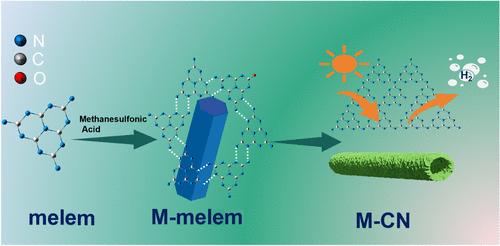
Graphitic carbon nitride (g-C3N4) is a photocatalyst that has been extensively investigated. Unfortunately, g-C3N4 suffers from the challenges of insufficient light absorption and rapid complexation of photogenerated charges. Modification methods such as defect engineering and nanostructure reconstruction can improve photocatalytic performance. This is because modification can improve carrier separation efficiency, increase active sites and increase light absorption, etc. Here, we demonstrate a simple approach to fabricate nanosheet-stacked g-C3N4 (M-CN600) tubes with carbon vacancies (VCs) and used for photocatalytic water splitting to hydrogen production. M-CN600 was prepared by the thermal polymerization of precursors. These precursors were obtained through the melem induced by methanesulfonic acid. Due to the nano effect, the obtained M-CN600 exhibits a significantly higher specific surface area (105.2 m2 g–1) and pore volume (0.391 cm3 g–1) compared to pristine g-C3N4 (B-CN). This creates more reaction sites, which improve the performance of photocatalytic H2 production. The nanosheet-stacked structure reduces the transport distance of photogenerated carriers to the material surface. In addition, M-CN600 possesses more negative conduction band positions with stronger photocatalytic reduction ability. Moreover, due to the presence of VCs in the catalyst, the separation of photogenerated electron and hole pairs is accelerated. Under visible light (λ > 420 nm), the obtained M-CN600 exhibits excellent photocatalytic H2 evolution performance, which is 21.5-fold higher than that of B-CN. This work provides a method for preparation of nanostructured g-C3N4 with efficient photocatalytic performance.
期刊介绍:
ACS Applied Nano Materials is an interdisciplinary journal publishing original research covering all aspects of engineering, chemistry, physics and biology relevant to applications of nanomaterials. The journal is devoted to reports of new and original experimental and theoretical research of an applied nature that integrate knowledge in the areas of materials, engineering, physics, bioscience, and chemistry into important applications of nanomaterials.




 京公网安备 11010802042870号
京ICP备2023020795号-1
京公网安备 11010802042870号
京ICP备2023020795号-1

 分享
分享
 求助内容:
求助内容: 应助结果提醒方式:
 扫码关注我们
