Yunseong Ji , Jeong Min Jang , Ju Yeon Kim , Eunji Choi , Hyeongwon Jeong , Choong Hoo Lee , Suhyeon Lee , Yeonji Kwak , Yonghwi Cho , Hwayong Lee , Jae-ha Myung , Byeonggwan Kim , Seon Joon Kim , Dae Woo Kim
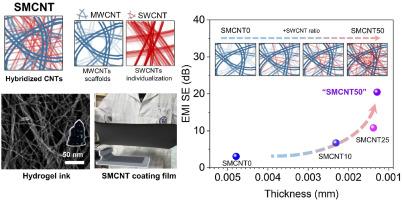
{"title":"SWCNT/MWCNT binderless hybrid hydrogel: Towards large-scale high-performance EMI shielding coating at commercial level","authors":"Yunseong Ji , Jeong Min Jang , Ju Yeon Kim , Eunji Choi , Hyeongwon Jeong , Choong Hoo Lee , Suhyeon Lee , Yeonji Kwak , Yonghwi Cho , Hwayong Lee , Jae-ha Myung , Byeonggwan Kim , Seon Joon Kim , Dae Woo Kim","doi":"10.1016/j.carbon.2025.120250","DOIUrl":null,"url":null,"abstract":"<div><div>Developing a multiscale hierarchical structure is advantageous for leveraging multiple EMI shielding mechanisms. Here, we present a seldom-reported method for synthesizing highly concentrated and well-dispersed carbon nanotube (CNT) composite materials that can be made into free-standing films without complex processing or binder materials. By combining multi-walled CNTs (MWCNTs) with single-walled CNTs (SWCNTs), we form a unique, highly entangled scaffold referred to as the single-walled nanotube and multi-walled nanotube complex (SMCNT). This self-assembles in the solvent after a proper functionalization process and mechanical mixing. Owing to its hybrid scaffold structure, the SMCNT dispersion can reach concentrations of up to 90 mg/mL, exhibiting viscoelastic rheological properties. This hybrid structure also enhances both the electrical conductivity and mechanical robustness in the resultant CNT films. Moreover, the SMCNT dispersion can be easily applied to large areas via the commercial shear coating method, making it suitable for various practical applications. The SMCNT composites exhibit outstanding EMI shielding effectiveness of up to 15,860 dB/mm and maintain stable shielding performance under 85/85 test conditions for approximately two weeks. This superior EMI shielding behavior is attributed to the dense, interwoven CNT network, which maximizes the air/material interface, as well as the intrinsic electrical conductivity and the chemical stability of CNTs.</div></div>","PeriodicalId":262,"journal":{"name":"Carbon","volume":"238 ","pages":"Article 120250"},"PeriodicalIF":11.6000,"publicationDate":"2025-05-05","publicationTypes":"Journal Article","fieldsOfStudy":null,"isOpenAccess":false,"openAccessPdf":"","citationCount":"0","resultStr":null,"platform":"Semanticscholar","paperid":null,"PeriodicalName":"Carbon","FirstCategoryId":"88","ListUrlMain":"https://www.sciencedirect.com/science/article/pii/S0008622325002660","RegionNum":2,"RegionCategory":"材料科学","ArticlePicture":[],"TitleCN":null,"AbstractTextCN":null,"PMCID":null,"EPubDate":"2025/3/20 0:00:00","PubModel":"Epub","JCR":"Q1","JCRName":"CHEMISTRY, PHYSICAL","Score":null,"Total":0}
引用次数: 0
Abstract
Developing a multiscale hierarchical structure is advantageous for leveraging multiple EMI shielding mechanisms. Here, we present a seldom-reported method for synthesizing highly concentrated and well-dispersed carbon nanotube (CNT) composite materials that can be made into free-standing films without complex processing or binder materials. By combining multi-walled CNTs (MWCNTs) with single-walled CNTs (SWCNTs), we form a unique, highly entangled scaffold referred to as the single-walled nanotube and multi-walled nanotube complex (SMCNT). This self-assembles in the solvent after a proper functionalization process and mechanical mixing. Owing to its hybrid scaffold structure, the SMCNT dispersion can reach concentrations of up to 90 mg/mL, exhibiting viscoelastic rheological properties. This hybrid structure also enhances both the electrical conductivity and mechanical robustness in the resultant CNT films. Moreover, the SMCNT dispersion can be easily applied to large areas via the commercial shear coating method, making it suitable for various practical applications. The SMCNT composites exhibit outstanding EMI shielding effectiveness of up to 15,860 dB/mm and maintain stable shielding performance under 85/85 test conditions for approximately two weeks. This superior EMI shielding behavior is attributed to the dense, interwoven CNT network, which maximizes the air/material interface, as well as the intrinsic electrical conductivity and the chemical stability of CNTs.
期刊介绍:
The journal Carbon is an international multidisciplinary forum for communicating scientific advances in the field of carbon materials. It reports new findings related to the formation, structure, properties, behaviors, and technological applications of carbons. Carbons are a broad class of ordered or disordered solid phases composed primarily of elemental carbon, including but not limited to carbon black, carbon fibers and filaments, carbon nanotubes, diamond and diamond-like carbon, fullerenes, glassy carbon, graphite, graphene, graphene-oxide, porous carbons, pyrolytic carbon, and other sp2 and non-sp2 hybridized carbon systems. Carbon is the companion title to the open access journal Carbon Trends. Relevant application areas for carbon materials include biology and medicine, catalysis, electronic, optoelectronic, spintronic, high-frequency, and photonic devices, energy storage and conversion systems, environmental applications and water treatment, smart materials and systems, and structural and thermal applications.




 京公网安备 11010802042870号
京ICP备2023020795号-1
京公网安备 11010802042870号
京ICP备2023020795号-1

 分享
分享
 求助内容:
求助内容: 应助结果提醒方式:
 扫码关注我们
