{"title":"Structural analysis and elucidation of the formation process of specific carbon lamellae formed during the carbonization and graphitization of pitch","authors":"Kyoichi Oshida , Kenji Takeuchi , Sylvie Bonnamy , Tatsuo Nakazawa , Morinobu Endo","doi":"10.1016/j.carbon.2025.120247","DOIUrl":null,"url":null,"abstract":"<div><div>A specific carbon lamella structure formed during the carbonization treatment of naphthalene-based anisotropic pitch and anisotropic coal tar pitch was investigated. Under transmission electron microscopy (TEM), the lamellae, despite being several tens of microns in size, were so thin that the TEM microgrid beneath the sample was visible through them, making them quite different from other common carbon particles. However, the detailed structure of the lamellae was not yet known.</div><div>The purpose of this study was to analyze the detailed structure, formation process, properties, and surface conditions of carbon lamellae exhibiting unusual shapes. By tracing the formation process of the carbon lamellae, using various microscopy techniques, it was found that the structure of the lamella consisted of thick stacks of extremely thin hexagonal carbon layers. The edges of these layers were oriented perpendicular to the lamellar surfaces (edge-on). The lamellae were created on the surface of the thinner pores during foaming of the sample. The specific carbon lamellae were found to be graphitized in the same way as other normal carbons. Atomic force microscopy confirmed that these edge-on carbon layers could be clearly imaged.</div><div>Until now, little attention has been paid to the existence of this specific carbon lamellae and their applications. However, since the edge sites of hexagonal carbon layers are much more reactive than those of basal planes, active utilization of hexagonal carbon layers is expected to lead to a variety of unprecedented applications. Further investigation of these edge sites is anticipated to open new scientific fields.</div></div>","PeriodicalId":262,"journal":{"name":"Carbon","volume":"238 ","pages":"Article 120247"},"PeriodicalIF":11.6000,"publicationDate":"2025-03-20","publicationTypes":"Journal Article","fieldsOfStudy":null,"isOpenAccess":false,"openAccessPdf":"","citationCount":"0","resultStr":null,"platform":"Semanticscholar","paperid":null,"PeriodicalName":"Carbon","FirstCategoryId":"88","ListUrlMain":"https://www.sciencedirect.com/science/article/pii/S0008622325002635","RegionNum":2,"RegionCategory":"材料科学","ArticlePicture":[],"TitleCN":null,"AbstractTextCN":null,"PMCID":null,"EPubDate":"","PubModel":"","JCR":"Q1","JCRName":"CHEMISTRY, PHYSICAL","Score":null,"Total":0}
引用次数: 0
Abstract
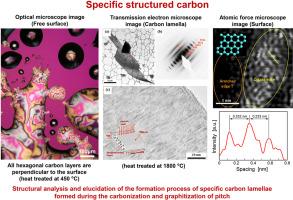
A specific carbon lamella structure formed during the carbonization treatment of naphthalene-based anisotropic pitch and anisotropic coal tar pitch was investigated. Under transmission electron microscopy (TEM), the lamellae, despite being several tens of microns in size, were so thin that the TEM microgrid beneath the sample was visible through them, making them quite different from other common carbon particles. However, the detailed structure of the lamellae was not yet known.
The purpose of this study was to analyze the detailed structure, formation process, properties, and surface conditions of carbon lamellae exhibiting unusual shapes. By tracing the formation process of the carbon lamellae, using various microscopy techniques, it was found that the structure of the lamella consisted of thick stacks of extremely thin hexagonal carbon layers. The edges of these layers were oriented perpendicular to the lamellar surfaces (edge-on). The lamellae were created on the surface of the thinner pores during foaming of the sample. The specific carbon lamellae were found to be graphitized in the same way as other normal carbons. Atomic force microscopy confirmed that these edge-on carbon layers could be clearly imaged.
Until now, little attention has been paid to the existence of this specific carbon lamellae and their applications. However, since the edge sites of hexagonal carbon layers are much more reactive than those of basal planes, active utilization of hexagonal carbon layers is expected to lead to a variety of unprecedented applications. Further investigation of these edge sites is anticipated to open new scientific fields.
期刊介绍:
The journal Carbon is an international multidisciplinary forum for communicating scientific advances in the field of carbon materials. It reports new findings related to the formation, structure, properties, behaviors, and technological applications of carbons. Carbons are a broad class of ordered or disordered solid phases composed primarily of elemental carbon, including but not limited to carbon black, carbon fibers and filaments, carbon nanotubes, diamond and diamond-like carbon, fullerenes, glassy carbon, graphite, graphene, graphene-oxide, porous carbons, pyrolytic carbon, and other sp2 and non-sp2 hybridized carbon systems. Carbon is the companion title to the open access journal Carbon Trends. Relevant application areas for carbon materials include biology and medicine, catalysis, electronic, optoelectronic, spintronic, high-frequency, and photonic devices, energy storage and conversion systems, environmental applications and water treatment, smart materials and systems, and structural and thermal applications.



 京公网安备 11010802042870号
京ICP备2023020795号-1
京公网安备 11010802042870号
京ICP备2023020795号-1

 分享
分享
 求助内容:
求助内容: 应助结果提醒方式:
 扫码关注我们
