Bin Yang , Yaguo Lei , Xiang Li , Naipeng Li , Xiaosheng Si , Chuanhai Chen
{"title":"A dynamic barycenter bridging network for federated transfer fault diagnosis in machine groups","authors":"Bin Yang , Yaguo Lei , Xiang Li , Naipeng Li , Xiaosheng Si , Chuanhai Chen","doi":"10.1016/j.ymssp.2025.112605","DOIUrl":null,"url":null,"abstract":"<div><div>Federated multi-source transfer fault diagnosis can address discrepancies between machine group nodes by utilizing an intermediate distribution in data decentralization scenarios. However, two key challenges remain: (1) most existing methods ignore the conditional distributions during multiple domain adaptation, and (2) the intermediate distribution used is often inadequate for bridging the domain gap effectively. To address these issues, we propose a dynamic barycenter bridging network (DBBN) for multi-source transfer diagnosis in the machine group. In DBBN, a server collects key distribution parameters (but not original data) from multiple source domains. The dynamic distribution barycenter is then solved by using the fixed-point iteration and subsequently broadcast to all machine nodes, where the adaptation trajectories of local data towards the common barycenter are scheduled according to the associated labels. The marginal and conditional distributions of multiple domain data are finally aligned along the designed trajectories through the collaborative training of the server and multiple domain sides. The proposed DBBN is evaluated through multi-source transfer diagnosis cases involving various machine-used bearings as well as different planetary gearboxes. The results demonstrate that DBBN can directionally align distributions across multiple domains in federated settings, ensuring high diagnosis accuracy when the intelligent model is transferred among machine group nodes. Moreover, even when faced with data imbalance among multiple source domains, the DBBN consistently retains the superior transfer diagnosis performance by directionally aligning distributions towards the common balanced barycenter.</div></div>","PeriodicalId":51124,"journal":{"name":"Mechanical Systems and Signal Processing","volume":"230 ","pages":"Article 112605"},"PeriodicalIF":8.9000,"publicationDate":"2025-03-28","publicationTypes":"Journal Article","fieldsOfStudy":null,"isOpenAccess":false,"openAccessPdf":"","citationCount":"0","resultStr":null,"platform":"Semanticscholar","paperid":null,"PeriodicalName":"Mechanical Systems and Signal Processing","FirstCategoryId":"5","ListUrlMain":"https://www.sciencedirect.com/science/article/pii/S0888327025003061","RegionNum":1,"RegionCategory":"工程技术","ArticlePicture":[],"TitleCN":null,"AbstractTextCN":null,"PMCID":null,"EPubDate":"","PubModel":"","JCR":"Q1","JCRName":"ENGINEERING, MECHANICAL","Score":null,"Total":0}
引用次数: 0
Abstract
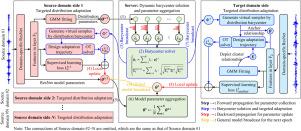
Federated multi-source transfer fault diagnosis can address discrepancies between machine group nodes by utilizing an intermediate distribution in data decentralization scenarios. However, two key challenges remain: (1) most existing methods ignore the conditional distributions during multiple domain adaptation, and (2) the intermediate distribution used is often inadequate for bridging the domain gap effectively. To address these issues, we propose a dynamic barycenter bridging network (DBBN) for multi-source transfer diagnosis in the machine group. In DBBN, a server collects key distribution parameters (but not original data) from multiple source domains. The dynamic distribution barycenter is then solved by using the fixed-point iteration and subsequently broadcast to all machine nodes, where the adaptation trajectories of local data towards the common barycenter are scheduled according to the associated labels. The marginal and conditional distributions of multiple domain data are finally aligned along the designed trajectories through the collaborative training of the server and multiple domain sides. The proposed DBBN is evaluated through multi-source transfer diagnosis cases involving various machine-used bearings as well as different planetary gearboxes. The results demonstrate that DBBN can directionally align distributions across multiple domains in federated settings, ensuring high diagnosis accuracy when the intelligent model is transferred among machine group nodes. Moreover, even when faced with data imbalance among multiple source domains, the DBBN consistently retains the superior transfer diagnosis performance by directionally aligning distributions towards the common balanced barycenter.
期刊介绍:
Journal Name: Mechanical Systems and Signal Processing (MSSP)
Interdisciplinary Focus:
Mechanical, Aerospace, and Civil Engineering
Purpose:Reporting scientific advancements of the highest quality
Arising from new techniques in sensing, instrumentation, signal processing, modelling, and control of dynamic systems




 京公网安备 11010802042870号
京ICP备2023020795号-1
京公网安备 11010802042870号
京ICP备2023020795号-1

 分享
分享
 求助内容:
求助内容: 应助结果提醒方式:
 扫码关注我们
