B.M. Mabakachaba , N. Numan , K. Shingange , I.G. Madiba , M.R. Letsoalo , Z.M. Khumalo , M. Nkosi , G.H. Mhlongo , S. Halindintwali , M. Maaza
{"title":"Synthesis and NO2 sensing characteristics of Mg-functionalized VO2(M) Nanorods","authors":"B.M. Mabakachaba , N. Numan , K. Shingange , I.G. Madiba , M.R. Letsoalo , Z.M. Khumalo , M. Nkosi , G.H. Mhlongo , S. Halindintwali , M. Maaza","doi":"10.1016/j.mseb.2025.118232","DOIUrl":null,"url":null,"abstract":"<div><div>Herein, we report the synthesis , characterization, and potential <span><math><msub><mrow><mi>NO</mi></mrow><mrow><mn>2</mn></mrow></msub></math></span> gas sensing application of pristine and Mg-doped <span><math><msub><mrow><mi>VO</mi></mrow><mrow><mn>2</mn></mrow></msub></math></span>(M) nanorods sensors. The gas sensing properties of both sensors were tested for various analytes, i.e., CO, <span><math><msub><mrow><mi>CH</mi></mrow><mrow><mn>4</mn></mrow></msub></math></span>, <span><math><msub><mrow><mi>H</mi></mrow><mrow><mn>2</mn></mrow></msub></math></span>S, <span><math><msub><mrow><mi>NO</mi></mrow><mrow><mn>2</mn></mrow></msub></math></span>, <span><math><msub><mrow><mi>SO</mi></mrow><mrow><mn>2</mn></mrow></msub></math></span> while varying operating temperatures. The sensors demonstrated substantial sensing performance at working temperature of about <span><math><mrow><mn>120</mn><mspace></mspace><mo>°</mo><mi>C</mi></mrow></math></span>, where <span><math><msub><mrow><mi>VO</mi></mrow><mrow><mn>2</mn></mrow></msub></math></span>-Mg outperformed the pristine sensor with a response value of about 59.3%. At ambient temperature (<span><math><mrow><mo>∼</mo><mn>25</mn><mspace></mspace><mo>°</mo><mi>C</mi></mrow></math></span>), the response values for pristine and <span><math><msub><mrow><mi>VO</mi></mrow><mrow><mn>2</mn></mrow></msub></math></span>-Mg were 3.29% and 6.35%, respectively. The Mg-dopant’s catalytic activity alters the electrical characteristics and adsorbed oxygen species on the sensor surface, leading to improved sensing performance. <span><math><msub><mrow><mi>VO</mi></mrow><mrow><mn>2</mn></mrow></msub></math></span>(M)-based sensor‘s sensing mechanism fits the Freundlich isotherm model, thus making the sensors suitable for detecting <span><math><msub><mrow><mi>NO</mi></mrow><mrow><mn>2</mn></mrow></msub></math></span> at high and ambient temperatures.</div></div>","PeriodicalId":18233,"journal":{"name":"Materials Science and Engineering: B","volume":"318 ","pages":"Article 118232"},"PeriodicalIF":4.6000,"publicationDate":"2025-03-28","publicationTypes":"Journal Article","fieldsOfStudy":null,"isOpenAccess":false,"openAccessPdf":"","citationCount":"0","resultStr":null,"platform":"Semanticscholar","paperid":null,"PeriodicalName":"Materials Science and Engineering: B","FirstCategoryId":"88","ListUrlMain":"https://www.sciencedirect.com/science/article/pii/S0921510725002557","RegionNum":3,"RegionCategory":"材料科学","ArticlePicture":[],"TitleCN":null,"AbstractTextCN":null,"PMCID":null,"EPubDate":"","PubModel":"","JCR":"Q2","JCRName":"MATERIALS SCIENCE, MULTIDISCIPLINARY","Score":null,"Total":0}
引用次数: 0
Abstract
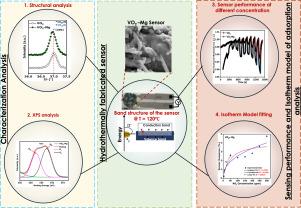
Herein, we report the synthesis , characterization, and potential gas sensing application of pristine and Mg-doped (M) nanorods sensors. The gas sensing properties of both sensors were tested for various analytes, i.e., CO, , S, , while varying operating temperatures. The sensors demonstrated substantial sensing performance at working temperature of about , where -Mg outperformed the pristine sensor with a response value of about 59.3%. At ambient temperature (), the response values for pristine and -Mg were 3.29% and 6.35%, respectively. The Mg-dopant’s catalytic activity alters the electrical characteristics and adsorbed oxygen species on the sensor surface, leading to improved sensing performance. (M)-based sensor‘s sensing mechanism fits the Freundlich isotherm model, thus making the sensors suitable for detecting at high and ambient temperatures.
期刊介绍:
The journal provides an international medium for the publication of theoretical and experimental studies and reviews related to the electronic, electrochemical, ionic, magnetic, optical, and biosensing properties of solid state materials in bulk, thin film and particulate forms. Papers dealing with synthesis, processing, characterization, structure, physical properties and computational aspects of nano-crystalline, crystalline, amorphous and glassy forms of ceramics, semiconductors, layered insertion compounds, low-dimensional compounds and systems, fast-ion conductors, polymers and dielectrics are viewed as suitable for publication. Articles focused on nano-structured aspects of these advanced solid-state materials will also be considered suitable.



 京公网安备 11010802042870号
京ICP备2023020795号-1
京公网安备 11010802042870号
京ICP备2023020795号-1

 分享
分享
 求助内容:
求助内容: 应助结果提醒方式:
 扫码关注我们
