Xiao-Wen Han, Guo-Ling Zhang, Pu Chen, Jing Zhang, Guogang Shan, Chunxuan Qi, Ben Zhong Tang, Hai-Tao Feng
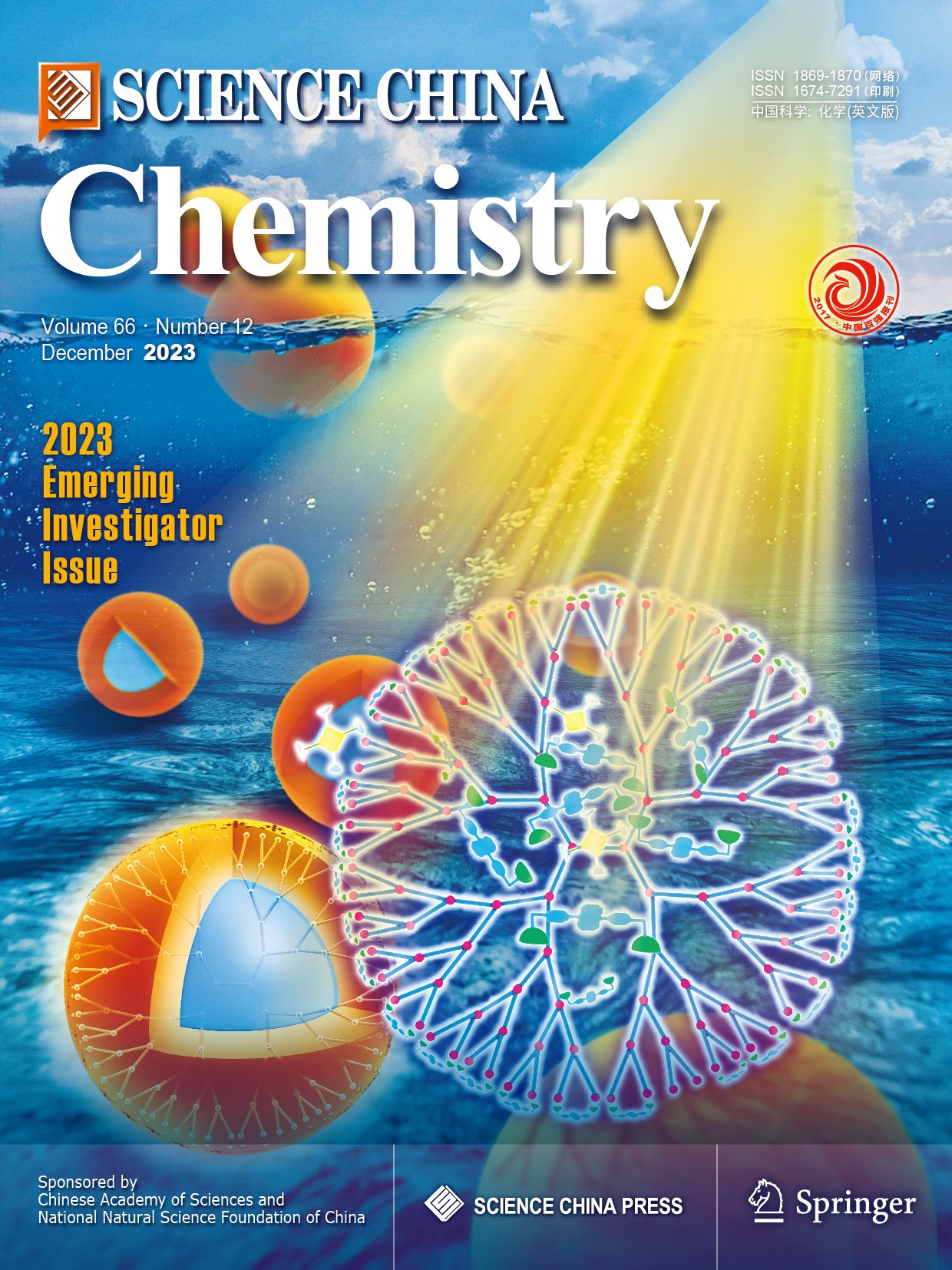
{"title":"Self-reporting hypoxia-responsive supramolecular phototheranostic nanomaterials based on AIEgen and azocalixarene","authors":"Xiao-Wen Han, Guo-Ling Zhang, Pu Chen, Jing Zhang, Guogang Shan, Chunxuan Qi, Ben Zhong Tang, Hai-Tao Feng","doi":"10.1007/s11426-024-2301-3","DOIUrl":null,"url":null,"abstract":"<div><p>Hypoxia is a significant feature in most of solid tumors. Hence, developing hypoxia-responsive phototheranostic system is still a challenge. In this contribution, a supramolecular assembly strategy based on sulfonate-functionalized azocalix[4]arene (SAC4A) and cationic aggregation-induced emission photosensitizer (namely TPA-H) was proposed for hypoxia-responsive bioimaging and photodynamic therapy (PDT). Upon supramolecular complexation of TPA-H and SAC4A through electrostatic interaction, the fluorescence and reactive oxygen species (ROS) generation of TPA-H were largely inhibited. In hypoxic tumors, the azo group of SAC4A can be reduced to aniline derivative and release the included TPA-H to recover its pristine fluorescence and ROS. Interestingly, the free TPA-H undergoes cell membrane-to-mitochondria translocation during cell imaging, achieving a real-time self-reporting PDT system. <i>In vivo</i> tumor imaging and therapy reveal that this as-prepared supramolecular complexes have good biosafety and efficient antitumor activity under hypoxia. Such hypoxia-responsive supramolecular photosensitizer system will enrich image-guided photodynamic therapy.</p><div><figure><div><div><picture><source><img></source></picture></div></div></figure></div></div>","PeriodicalId":772,"journal":{"name":"Science China Chemistry","volume":"68 4","pages":"1550 - 1562"},"PeriodicalIF":9.7000,"publicationDate":"2025-01-02","publicationTypes":"Journal Article","fieldsOfStudy":null,"isOpenAccess":false,"openAccessPdf":"","citationCount":"0","resultStr":null,"platform":"Semanticscholar","paperid":null,"PeriodicalName":"Science China Chemistry","FirstCategoryId":"1","ListUrlMain":"https://link.springer.com/article/10.1007/s11426-024-2301-3","RegionNum":1,"RegionCategory":"化学","ArticlePicture":[],"TitleCN":null,"AbstractTextCN":null,"PMCID":null,"EPubDate":"","PubModel":"","JCR":"Q1","JCRName":"CHEMISTRY, MULTIDISCIPLINARY","Score":null,"Total":0}
引用次数: 0
Abstract
Hypoxia is a significant feature in most of solid tumors. Hence, developing hypoxia-responsive phototheranostic system is still a challenge. In this contribution, a supramolecular assembly strategy based on sulfonate-functionalized azocalix[4]arene (SAC4A) and cationic aggregation-induced emission photosensitizer (namely TPA-H) was proposed for hypoxia-responsive bioimaging and photodynamic therapy (PDT). Upon supramolecular complexation of TPA-H and SAC4A through electrostatic interaction, the fluorescence and reactive oxygen species (ROS) generation of TPA-H were largely inhibited. In hypoxic tumors, the azo group of SAC4A can be reduced to aniline derivative and release the included TPA-H to recover its pristine fluorescence and ROS. Interestingly, the free TPA-H undergoes cell membrane-to-mitochondria translocation during cell imaging, achieving a real-time self-reporting PDT system. In vivo tumor imaging and therapy reveal that this as-prepared supramolecular complexes have good biosafety and efficient antitumor activity under hypoxia. Such hypoxia-responsive supramolecular photosensitizer system will enrich image-guided photodynamic therapy.
期刊介绍:
Science China Chemistry, co-sponsored by the Chinese Academy of Sciences and the National Natural Science Foundation of China and published by Science China Press, publishes high-quality original research in both basic and applied chemistry. Indexed by Science Citation Index, it is a premier academic journal in the field.
Categories of articles include:
Highlights. Brief summaries and scholarly comments on recent research achievements in any field of chemistry.
Perspectives. Concise reports on thelatest chemistry trends of interest to scientists worldwide, including discussions of research breakthroughs and interpretations of important science and funding policies.
Reviews. In-depth summaries of representative results and achievements of the past 5–10 years in selected topics based on or closely related to the research expertise of the authors, providing a thorough assessment of the significance, current status, and future research directions of the field.



 京公网安备 11010802042870号
京ICP备2023020795号-1
京公网安备 11010802042870号
京ICP备2023020795号-1

 分享
分享
 求助内容:
求助内容: 应助结果提醒方式:
 扫码关注我们
