Lingling Chen, Yuxin Liu, Yichun Su, Wenchen Zhu, Guangyu Du, Huan Pang
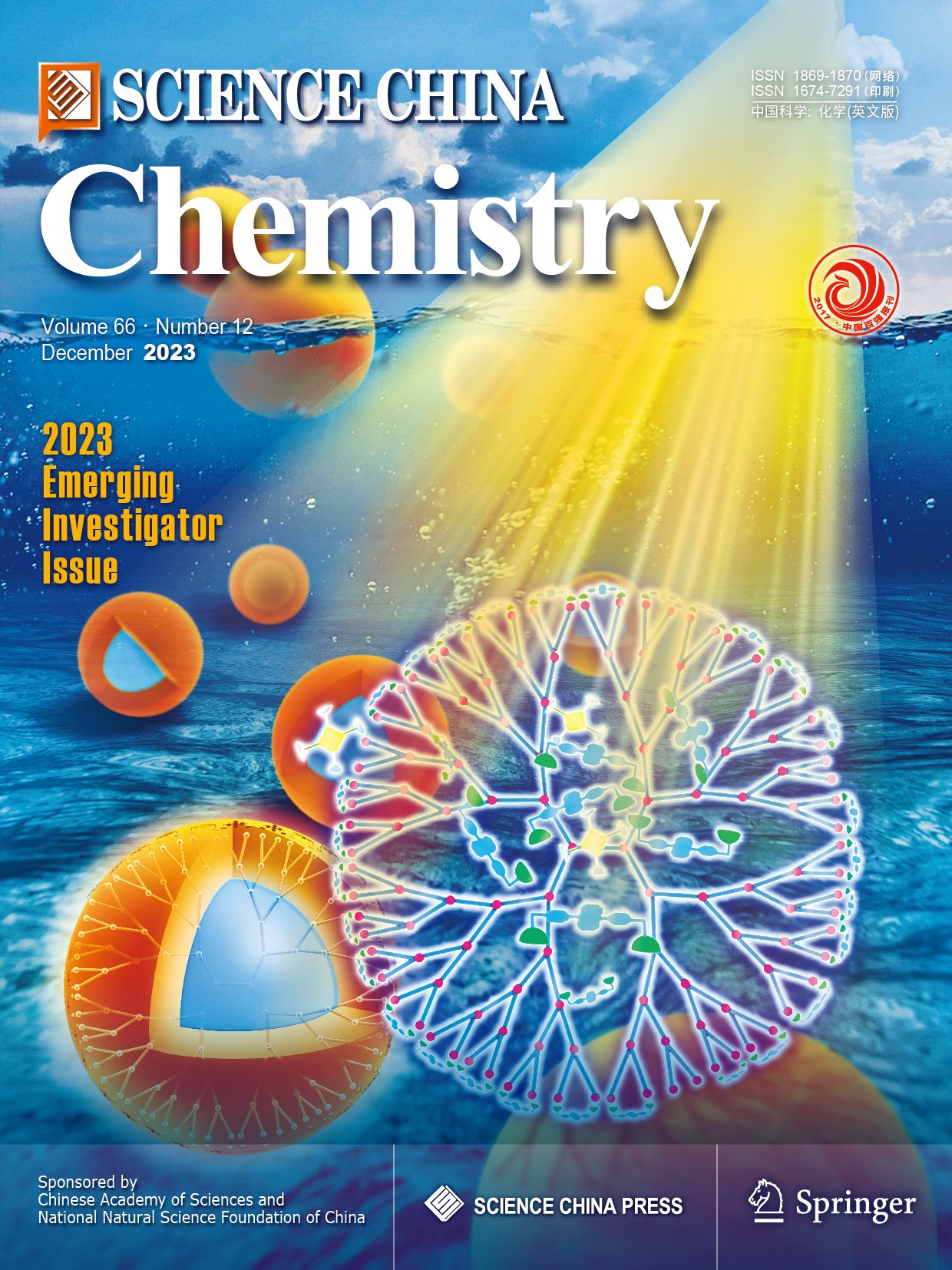
{"title":"Research progress in metal-organic frameworks and their derivatives in electrochemistry","authors":"Lingling Chen, Yuxin Liu, Yichun Su, Wenchen Zhu, Guangyu Du, Huan Pang","doi":"10.1007/s11426-024-2277-2","DOIUrl":null,"url":null,"abstract":"<div><p>Metal-organic frameworks (MOFs) are distinguished by their unique porosity and meticulously ordered framework structures, setting them apart from conventional complexes. These materials are defined by their highly organized crystalline and pore structures, extensive surface areas, robust porosity, and superior adsorption capabilities. Owing to their exceptional structural and functional attributes, MOFs and their derivatives are leveraged across a broad spectrum of applications, demonstrating significant potential across diverse sectors. In recent times, the scientific community has increasingly focused on MOFs, underscoring their growing importance in research. Despite the promising array of applications for MOFs and their derivatives, challenges persist in practical deployments, and the pathway to research advancement remains daunting. This document delves into the synthesis and various applications of MOFs and their derivatives, particularly in the domains of energy storage, catalysis, sensing, and water treatment. It also highlights the ongoing research progress in the field of electrochemistry, including developments in lithium ion batteries (LIBs), lithium-sulfur batteries (LSBs), zinc-ion batteries (ZIBs), aqueous nickel-zinc batteries (NZBs), and supercapacitors. Finally, it provides an outlook on the future prospects and potential hurdles facing the development of MOF materials.</p><div><figure><div><div><picture><source><img></source></picture></div></div></figure></div></div>","PeriodicalId":772,"journal":{"name":"Science China Chemistry","volume":"68 4","pages":"1287 - 1316"},"PeriodicalIF":9.7000,"publicationDate":"2025-01-02","publicationTypes":"Journal Article","fieldsOfStudy":null,"isOpenAccess":false,"openAccessPdf":"","citationCount":"0","resultStr":null,"platform":"Semanticscholar","paperid":null,"PeriodicalName":"Science China Chemistry","FirstCategoryId":"1","ListUrlMain":"https://link.springer.com/article/10.1007/s11426-024-2277-2","RegionNum":1,"RegionCategory":"化学","ArticlePicture":[],"TitleCN":null,"AbstractTextCN":null,"PMCID":null,"EPubDate":"","PubModel":"","JCR":"Q1","JCRName":"CHEMISTRY, MULTIDISCIPLINARY","Score":null,"Total":0}
引用次数: 0
Abstract
Metal-organic frameworks (MOFs) are distinguished by their unique porosity and meticulously ordered framework structures, setting them apart from conventional complexes. These materials are defined by their highly organized crystalline and pore structures, extensive surface areas, robust porosity, and superior adsorption capabilities. Owing to their exceptional structural and functional attributes, MOFs and their derivatives are leveraged across a broad spectrum of applications, demonstrating significant potential across diverse sectors. In recent times, the scientific community has increasingly focused on MOFs, underscoring their growing importance in research. Despite the promising array of applications for MOFs and their derivatives, challenges persist in practical deployments, and the pathway to research advancement remains daunting. This document delves into the synthesis and various applications of MOFs and their derivatives, particularly in the domains of energy storage, catalysis, sensing, and water treatment. It also highlights the ongoing research progress in the field of electrochemistry, including developments in lithium ion batteries (LIBs), lithium-sulfur batteries (LSBs), zinc-ion batteries (ZIBs), aqueous nickel-zinc batteries (NZBs), and supercapacitors. Finally, it provides an outlook on the future prospects and potential hurdles facing the development of MOF materials.
期刊介绍:
Science China Chemistry, co-sponsored by the Chinese Academy of Sciences and the National Natural Science Foundation of China and published by Science China Press, publishes high-quality original research in both basic and applied chemistry. Indexed by Science Citation Index, it is a premier academic journal in the field.
Categories of articles include:
Highlights. Brief summaries and scholarly comments on recent research achievements in any field of chemistry.
Perspectives. Concise reports on thelatest chemistry trends of interest to scientists worldwide, including discussions of research breakthroughs and interpretations of important science and funding policies.
Reviews. In-depth summaries of representative results and achievements of the past 5–10 years in selected topics based on or closely related to the research expertise of the authors, providing a thorough assessment of the significance, current status, and future research directions of the field.



 京公网安备 11010802042870号
京ICP备2023020795号-1
京公网安备 11010802042870号
京ICP备2023020795号-1

 分享
分享
 求助内容:
求助内容: 应助结果提醒方式:
 扫码关注我们
