{"title":"Effects of combination of influencing factors on earthquake-induced landslide susceptibility assessments","authors":"Yingbin Zhang, Ying Zeng, Peiyi Xu, Jing Liu, Zixin Li, Yu Sun, Zhenhai Feng","doi":"10.1007/s12665-025-12203-6","DOIUrl":null,"url":null,"abstract":"<div><p>This study aims to generate a multiple combination strategy and explore a combination of influencing factors on earthquake-induced landslides susceptibility assessments. Landslides caused by two earthquakes with similar magnitudes that both have surface rupture zones are taken as the study subjects. Data on twenty landslide influence factors including earthquakes, topography, geological structure, hydrology, stratum lithology, and human engineering activities were acquired. Based on frequency ratio analysis, normalization and correlation analysis, a multiple combination strategy is applied to develop different combinations of these factors. The logistic regression (LR) method is used to establish an evaluation model for all possible combinations. After constructing 2047 combinations of influence factors, the model with the greatest prediction accuracy was extracted. Results show that the combination of aspect, slope, distance from fault, elevation, lithology, plan curvature, profile curvature, NDVI, land cover type, PGA, and distance from river has better applicability in evaluation of earthquake-induced landslides susceptibility in the study area. The prediction accuracy of the model did not continue to improve as the number of influence factors increased, and varied depending on the type of influencing factors. We expect the multiple combination strategy to advance the prediction accuracy of modeling in the landslide susceptibility assessment process.</p></div>","PeriodicalId":542,"journal":{"name":"Environmental Earth Sciences","volume":"84 7","pages":""},"PeriodicalIF":2.8000,"publicationDate":"2025-03-28","publicationTypes":"Journal Article","fieldsOfStudy":null,"isOpenAccess":false,"openAccessPdf":"","citationCount":"0","resultStr":null,"platform":"Semanticscholar","paperid":null,"PeriodicalName":"Environmental Earth Sciences","FirstCategoryId":"93","ListUrlMain":"https://link.springer.com/article/10.1007/s12665-025-12203-6","RegionNum":4,"RegionCategory":"环境科学与生态学","ArticlePicture":[],"TitleCN":null,"AbstractTextCN":null,"PMCID":null,"EPubDate":"","PubModel":"","JCR":"Q3","JCRName":"ENVIRONMENTAL SCIENCES","Score":null,"Total":0}
引用次数: 0
Abstract
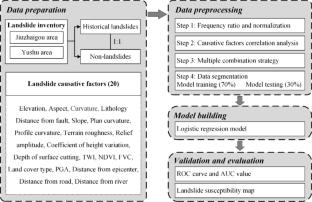
This study aims to generate a multiple combination strategy and explore a combination of influencing factors on earthquake-induced landslides susceptibility assessments. Landslides caused by two earthquakes with similar magnitudes that both have surface rupture zones are taken as the study subjects. Data on twenty landslide influence factors including earthquakes, topography, geological structure, hydrology, stratum lithology, and human engineering activities were acquired. Based on frequency ratio analysis, normalization and correlation analysis, a multiple combination strategy is applied to develop different combinations of these factors. The logistic regression (LR) method is used to establish an evaluation model for all possible combinations. After constructing 2047 combinations of influence factors, the model with the greatest prediction accuracy was extracted. Results show that the combination of aspect, slope, distance from fault, elevation, lithology, plan curvature, profile curvature, NDVI, land cover type, PGA, and distance from river has better applicability in evaluation of earthquake-induced landslides susceptibility in the study area. The prediction accuracy of the model did not continue to improve as the number of influence factors increased, and varied depending on the type of influencing factors. We expect the multiple combination strategy to advance the prediction accuracy of modeling in the landslide susceptibility assessment process.
期刊介绍:
Environmental Earth Sciences is an international multidisciplinary journal concerned with all aspects of interaction between humans, natural resources, ecosystems, special climates or unique geographic zones, and the earth:
Water and soil contamination caused by waste management and disposal practices
Environmental problems associated with transportation by land, air, or water
Geological processes that may impact biosystems or humans
Man-made or naturally occurring geological or hydrological hazards
Environmental problems associated with the recovery of materials from the earth
Environmental problems caused by extraction of minerals, coal, and ores, as well as oil and gas, water and alternative energy sources
Environmental impacts of exploration and recultivation – Environmental impacts of hazardous materials
Management of environmental data and information in data banks and information systems
Dissemination of knowledge on techniques, methods, approaches and experiences to improve and remediate the environment
In pursuit of these topics, the geoscientific disciplines are invited to contribute their knowledge and experience. Major disciplines include: hydrogeology, hydrochemistry, geochemistry, geophysics, engineering geology, remediation science, natural resources management, environmental climatology and biota, environmental geography, soil science and geomicrobiology.



 京公网安备 11010802042870号
京ICP备2023020795号-1
京公网安备 11010802042870号
京ICP备2023020795号-1

 分享
分享
 求助内容:
求助内容: 应助结果提醒方式:
 扫码关注我们
