{"title":"MuPETFlow: multiple ploidy estimation tool from flow cytometry data.","authors":"C Gómez-Muñoz, G Fischer","doi":"10.1186/s12864-025-11470-8","DOIUrl":null,"url":null,"abstract":"<p><strong>Background: </strong>Ploidy, representing the number of homologous chromosome sets, can be estimated from flow cytometry data acquired on cells stained with a fluorescent DNA dye. This estimation relies on a combination of tools that often require scripting, individual sample curation, and additional analyses.</p><p><strong>Results: </strong>To automate the ploidy estimation for multiple flow cytometry files, we developed MuPETFlow-a Shiny graphical user interface tool. MuPETFlow allows users to visualize cell fluorescence histograms, detect the peaks corresponding to the different cell cycle phases, perform a linear regression using standards, make ploidy or genome size predictions, and export results as figures and table files. The tool was benchmarked with known ploidy datasets from yeast and plant species, yielding consistent ploidy results. MuPETFlow's peaks detection and performance were also compared to those of other tools.</p><p><strong>Conclusions: </strong>MuPETFlow stands out as the only tool offering in-app ploidy detection, multiple peak detection, multi-sample visualization, and automation capabilities. These features significantly accelerate the analysis, making it especially valuable for projects involving large datasets.</p>","PeriodicalId":9030,"journal":{"name":"BMC Genomics","volume":"26 1","pages":"301"},"PeriodicalIF":3.7000,"publicationDate":"2025-03-26","publicationTypes":"Journal Article","fieldsOfStudy":null,"isOpenAccess":false,"openAccessPdf":"https://www.ncbi.nlm.nih.gov/pmc/articles/PMC11948760/pdf/","citationCount":"0","resultStr":null,"platform":"Semanticscholar","paperid":null,"PeriodicalName":"BMC Genomics","FirstCategoryId":"99","ListUrlMain":"https://doi.org/10.1186/s12864-025-11470-8","RegionNum":2,"RegionCategory":"生物学","ArticlePicture":[],"TitleCN":null,"AbstractTextCN":null,"PMCID":null,"EPubDate":"","PubModel":"","JCR":"Q2","JCRName":"BIOTECHNOLOGY & APPLIED MICROBIOLOGY","Score":null,"Total":0}
引用次数: 0
Abstract
Background: Ploidy, representing the number of homologous chromosome sets, can be estimated from flow cytometry data acquired on cells stained with a fluorescent DNA dye. This estimation relies on a combination of tools that often require scripting, individual sample curation, and additional analyses.
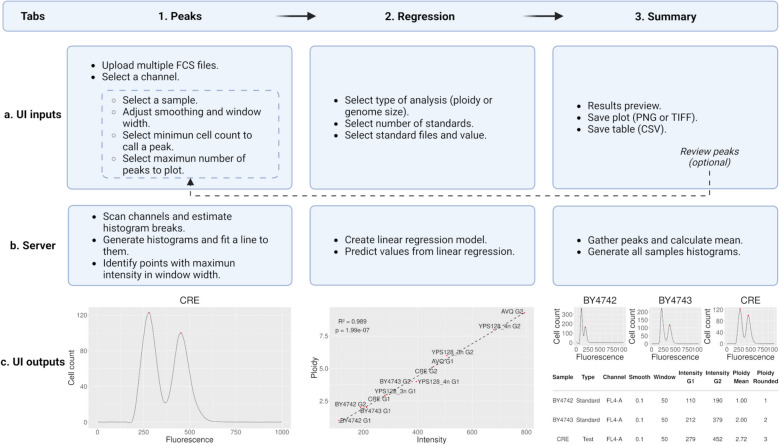
Results: To automate the ploidy estimation for multiple flow cytometry files, we developed MuPETFlow-a Shiny graphical user interface tool. MuPETFlow allows users to visualize cell fluorescence histograms, detect the peaks corresponding to the different cell cycle phases, perform a linear regression using standards, make ploidy or genome size predictions, and export results as figures and table files. The tool was benchmarked with known ploidy datasets from yeast and plant species, yielding consistent ploidy results. MuPETFlow's peaks detection and performance were also compared to those of other tools.
Conclusions: MuPETFlow stands out as the only tool offering in-app ploidy detection, multiple peak detection, multi-sample visualization, and automation capabilities. These features significantly accelerate the analysis, making it especially valuable for projects involving large datasets.
期刊介绍:
BMC Genomics is an open access, peer-reviewed journal that considers articles on all aspects of genome-scale analysis, functional genomics, and proteomics.
BMC Genomics is part of the BMC series which publishes subject-specific journals focused on the needs of individual research communities across all areas of biology and medicine. We offer an efficient, fair and friendly peer review service, and are committed to publishing all sound science, provided that there is some advance in knowledge presented by the work.




 京公网安备 11010802042870号
京ICP备2023020795号-1
京公网安备 11010802042870号
京ICP备2023020795号-1

 分享
分享
 求助内容:
求助内容: 应助结果提醒方式:
 扫码关注我们
