Xuen J. Ng, Tilman U. Esser, Vanessa T. Trossmann, Christoph Rudisch, Maren Fiedler, Kaveh Roshanbinfar, Zan Lamberger, Philipp Stahlhut, Gregor Lang, Thomas Scheibel, Felix B. Engel
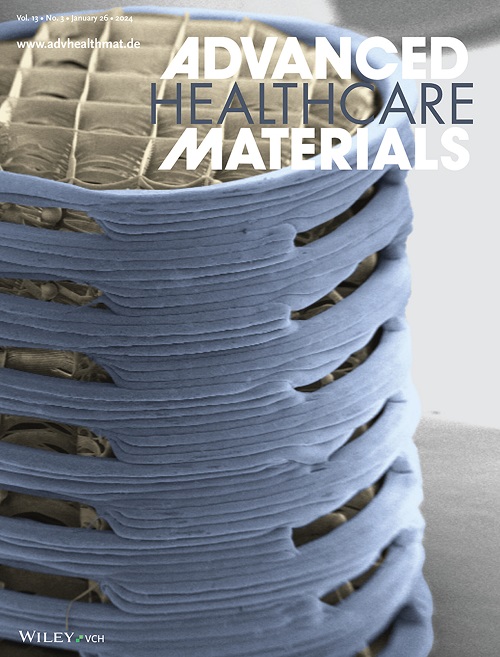
{"title":"Enhancing Form Stability: Shrink-Resistant Hydrogels Made of Interpenetrating Networks of Recombinant Spider Silk and Collagen-I","authors":"Xuen J. Ng, Tilman U. Esser, Vanessa T. Trossmann, Christoph Rudisch, Maren Fiedler, Kaveh Roshanbinfar, Zan Lamberger, Philipp Stahlhut, Gregor Lang, Thomas Scheibel, Felix B. Engel","doi":"10.1002/adhm.202500311","DOIUrl":null,"url":null,"abstract":"<p>Tissue engineering enables the production of tissues and organ-like structures as models for drug testing and mechanistical studies or functional replacements for injured tissues. Available cytocompatible materials are limited in number, suffer from insufficient mechanical properties, and cells interacting with them often cause construct shrinkage. As shape is important for function, identifying cytocompatible, shrink-resistant materials are a major aim. Here, it is shown that hydrogels made of interpenetrating networks of collagen-I and recombinant spider silk protein eADF4(C16)-RGD nanofibrils exhibit synergistic and tunable mechanical properties. Composite hydrogels allow cell adhesion and spreading and are resistant to shrinkage mediated by fibroblasts, C2C12 myoblasts, and human induced pluripotent stem cell (hiPSC)-derived cardiomyocytes. Myoblasts differentiate and fuse into myotubes, and hiPSC-cardiomyocytes can be cultured long-term, show spontaneous contractions, and remain drug responsive. Collectively, a novel composite material is developed to overcome the challenge of post-fabrication matrix shrinkage conferring high shape fidelity suitable for tissue engineering.</p>","PeriodicalId":113,"journal":{"name":"Advanced Healthcare Materials","volume":"14 12","pages":""},"PeriodicalIF":9.6000,"publicationDate":"2025-03-27","publicationTypes":"Journal Article","fieldsOfStudy":null,"isOpenAccess":false,"openAccessPdf":"https://onlinelibrary.wiley.com/doi/epdf/10.1002/adhm.202500311","citationCount":"0","resultStr":null,"platform":"Semanticscholar","paperid":null,"PeriodicalName":"Advanced Healthcare Materials","FirstCategoryId":"5","ListUrlMain":"https://advanced.onlinelibrary.wiley.com/doi/10.1002/adhm.202500311","RegionNum":2,"RegionCategory":"医学","ArticlePicture":[],"TitleCN":null,"AbstractTextCN":null,"PMCID":null,"EPubDate":"","PubModel":"","JCR":"Q1","JCRName":"ENGINEERING, BIOMEDICAL","Score":null,"Total":0}
引用次数: 0
Abstract
Tissue engineering enables the production of tissues and organ-like structures as models for drug testing and mechanistical studies or functional replacements for injured tissues. Available cytocompatible materials are limited in number, suffer from insufficient mechanical properties, and cells interacting with them often cause construct shrinkage. As shape is important for function, identifying cytocompatible, shrink-resistant materials are a major aim. Here, it is shown that hydrogels made of interpenetrating networks of collagen-I and recombinant spider silk protein eADF4(C16)-RGD nanofibrils exhibit synergistic and tunable mechanical properties. Composite hydrogels allow cell adhesion and spreading and are resistant to shrinkage mediated by fibroblasts, C2C12 myoblasts, and human induced pluripotent stem cell (hiPSC)-derived cardiomyocytes. Myoblasts differentiate and fuse into myotubes, and hiPSC-cardiomyocytes can be cultured long-term, show spontaneous contractions, and remain drug responsive. Collectively, a novel composite material is developed to overcome the challenge of post-fabrication matrix shrinkage conferring high shape fidelity suitable for tissue engineering.
期刊介绍:
Advanced Healthcare Materials, a distinguished member of the esteemed Advanced portfolio, has been dedicated to disseminating cutting-edge research on materials, devices, and technologies for enhancing human well-being for over ten years. As a comprehensive journal, it encompasses a wide range of disciplines such as biomaterials, biointerfaces, nanomedicine and nanotechnology, tissue engineering, and regenerative medicine.





 京公网安备 11010802042870号
京ICP备2023020795号-1
京公网安备 11010802042870号
京ICP备2023020795号-1

 分享
分享
 求助内容:
求助内容: 应助结果提醒方式:
 扫码关注我们
