Biomimetic organomineral layers with antibacterial properties based on di/tetrahydroquinolinediol and nanocrystalline hydroxyapatite deposited on enamel surface†
Pavel Seredin, Dmitry Goloshchapov, Yaroslav Peshkov, Andrey Potapov, Yana Gribanova, Khidmet Shikhaliev, Yury Ippolitov, Raul O. Freitas, Iman A. Mahdy, Manal A. Mahdy and Boknam Chae
{"title":"Biomimetic organomineral layers with antibacterial properties based on di/tetrahydroquinolinediol and nanocrystalline hydroxyapatite deposited on enamel surface†","authors":"Pavel Seredin, Dmitry Goloshchapov, Yaroslav Peshkov, Andrey Potapov, Yana Gribanova, Khidmet Shikhaliev, Yury Ippolitov, Raul O. Freitas, Iman A. Mahdy, Manal A. Mahdy and Boknam Chae","doi":"10.1039/D5BM00070J","DOIUrl":null,"url":null,"abstract":"<p >The paper proposes a strategy for the accelerated deposition of biomimetic organomineral layers on the surface of dental enamel, utilizing di/tetrahydroquinolinediol (hydroxyquinoline) polymerized in the presence of nanocrystalline hydroxyapatite (nano-cHAp). The mechanisms underlying the formation of dental coatings were elucidated through a combination of structural, microstructural, and spectroscopic analytical methods, including synchrotron infrared nanoimaging. Additionally, the antimicrobial effects of these coatings were investigated. It has been demonstrated that the deposition of an organomineral layer, based on polymerized dihydroxyquinoline, on the surface of natural enamel leads to the agglomeration and orientation of hydroxyapatite nanocrystals within the coating. This process enables the layer to replicate the mechanical properties of natural enamel, resulting in a microhardness value that closely resembles that of natural enamel. Using synchrotron s-SNOM, it has been established that the biomimetic organomineral layer possesses the morphological structure of a poly(2,2,4-trimethyl-1,2-dihydroquinoline-6,7-diol (TMDHQ))/nano-cHAp composite film, which is homogeneously distributed and tightly packed on the enamel surface. Furthermore, it has been demonstrated that the dental coating formed from polydihydroxyquinoline and nanocrystalline hydroxyapatite exhibits inhibitory activity against colonies of <em>Streptococcus</em> spp. The developed technology for the formation of dental biomimetic layers, which exhibit simultaneous antibacterial and mineralizing effects, holds significant potential for future clinical applications.</p>","PeriodicalId":65,"journal":{"name":"Biomaterials Science","volume":" 9","pages":" 2444-2461"},"PeriodicalIF":5.7000,"publicationDate":"2025-03-27","publicationTypes":"Journal Article","fieldsOfStudy":null,"isOpenAccess":false,"openAccessPdf":"","citationCount":"0","resultStr":null,"platform":"Semanticscholar","paperid":null,"PeriodicalName":"Biomaterials Science","FirstCategoryId":"5","ListUrlMain":"https://pubs.rsc.org/en/content/articlelanding/2025/bm/d5bm00070j","RegionNum":3,"RegionCategory":"医学","ArticlePicture":[],"TitleCN":null,"AbstractTextCN":null,"PMCID":null,"EPubDate":"","PubModel":"","JCR":"Q1","JCRName":"MATERIALS SCIENCE, BIOMATERIALS","Score":null,"Total":0}
引用次数: 0
Abstract
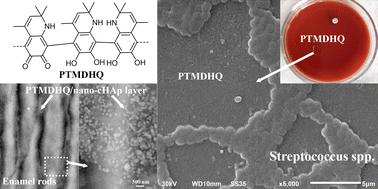
The paper proposes a strategy for the accelerated deposition of biomimetic organomineral layers on the surface of dental enamel, utilizing di/tetrahydroquinolinediol (hydroxyquinoline) polymerized in the presence of nanocrystalline hydroxyapatite (nano-cHAp). The mechanisms underlying the formation of dental coatings were elucidated through a combination of structural, microstructural, and spectroscopic analytical methods, including synchrotron infrared nanoimaging. Additionally, the antimicrobial effects of these coatings were investigated. It has been demonstrated that the deposition of an organomineral layer, based on polymerized dihydroxyquinoline, on the surface of natural enamel leads to the agglomeration and orientation of hydroxyapatite nanocrystals within the coating. This process enables the layer to replicate the mechanical properties of natural enamel, resulting in a microhardness value that closely resembles that of natural enamel. Using synchrotron s-SNOM, it has been established that the biomimetic organomineral layer possesses the morphological structure of a poly(2,2,4-trimethyl-1,2-dihydroquinoline-6,7-diol (TMDHQ))/nano-cHAp composite film, which is homogeneously distributed and tightly packed on the enamel surface. Furthermore, it has been demonstrated that the dental coating formed from polydihydroxyquinoline and nanocrystalline hydroxyapatite exhibits inhibitory activity against colonies of Streptococcus spp. The developed technology for the formation of dental biomimetic layers, which exhibit simultaneous antibacterial and mineralizing effects, holds significant potential for future clinical applications.
期刊介绍:
Biomaterials Science is an international high impact journal exploring the science of biomaterials and their translation towards clinical use. Its scope encompasses new concepts in biomaterials design, studies into the interaction of biomaterials with the body, and the use of materials to answer fundamental biological questions.



 京公网安备 11010802042870号
京ICP备2023020795号-1
京公网安备 11010802042870号
京ICP备2023020795号-1

 分享
分享
 求助内容:
求助内容: 应助结果提醒方式:
 扫码关注我们
