Céline Bastard, Jann Carl-Theodor Schulte, Md Asaduzzaman, Calvin Hohn, Yonca Kittel, Laura De Laporte and Ronald Gebhardt
{"title":"Casein microparticles filled with cellulase to enzymatically degrade nanocellulose for cell growth†","authors":"Céline Bastard, Jann Carl-Theodor Schulte, Md Asaduzzaman, Calvin Hohn, Yonca Kittel, Laura De Laporte and Ronald Gebhardt","doi":"10.1039/D4BM01508H","DOIUrl":null,"url":null,"abstract":"<p >For tissue engineering, nanocellulose-based three-dimensional hydrogel structures hold potential as biocompatible support materials for biomimetic scaffolds to regenerate damaged tissues. One challenge of this material is that nanocellulose does not degrade in the human body. Therefore, different carriers are needed to locally deliver cellulase in a controlled manner to degrade the scaffold at the same time the cells grow and proliferate. To achieve this, we developed casein microparticles (CMPs) as delivery vehicles as they are non-toxic and have high porosity with a stable structure at physiological pH values. The porosity of the CMPs was first tested by diffusion experiments with fluorescently labelled dextrans of different sizes as model molecules, demonstrating inward diffusion of dextrans up to 500 kDa. The CMPs continuously release active cellulase, resulting in the degradation of the nanocellulose hydrogel over a time of 21 days, supporting 3D cell growth.</p>","PeriodicalId":65,"journal":{"name":"Biomaterials Science","volume":" 9","pages":" 2435-2443"},"PeriodicalIF":5.7000,"publicationDate":"2025-03-13","publicationTypes":"Journal Article","fieldsOfStudy":null,"isOpenAccess":false,"openAccessPdf":"https://pubs.rsc.org/en/content/articlepdf/2025/bm/d4bm01508h?page=search","citationCount":"0","resultStr":null,"platform":"Semanticscholar","paperid":null,"PeriodicalName":"Biomaterials Science","FirstCategoryId":"5","ListUrlMain":"https://pubs.rsc.org/en/content/articlelanding/2025/bm/d4bm01508h","RegionNum":3,"RegionCategory":"医学","ArticlePicture":[],"TitleCN":null,"AbstractTextCN":null,"PMCID":null,"EPubDate":"","PubModel":"","JCR":"Q1","JCRName":"MATERIALS SCIENCE, BIOMATERIALS","Score":null,"Total":0}
引用次数: 0
Abstract
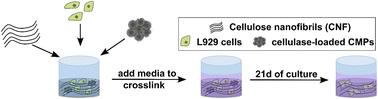
For tissue engineering, nanocellulose-based three-dimensional hydrogel structures hold potential as biocompatible support materials for biomimetic scaffolds to regenerate damaged tissues. One challenge of this material is that nanocellulose does not degrade in the human body. Therefore, different carriers are needed to locally deliver cellulase in a controlled manner to degrade the scaffold at the same time the cells grow and proliferate. To achieve this, we developed casein microparticles (CMPs) as delivery vehicles as they are non-toxic and have high porosity with a stable structure at physiological pH values. The porosity of the CMPs was first tested by diffusion experiments with fluorescently labelled dextrans of different sizes as model molecules, demonstrating inward diffusion of dextrans up to 500 kDa. The CMPs continuously release active cellulase, resulting in the degradation of the nanocellulose hydrogel over a time of 21 days, supporting 3D cell growth.
期刊介绍:
Biomaterials Science is an international high impact journal exploring the science of biomaterials and their translation towards clinical use. Its scope encompasses new concepts in biomaterials design, studies into the interaction of biomaterials with the body, and the use of materials to answer fundamental biological questions.



 京公网安备 11010802042870号
京ICP备2023020795号-1
京公网安备 11010802042870号
京ICP备2023020795号-1

 分享
分享
 求助内容:
求助内容: 应助结果提醒方式:
 扫码关注我们
