The IMDAV reaction between 3-(isoxazol-3-yl)allylamines and maleic anhydrides: an unusual approach to pyrrolo[3,4-c]pyridine derivatives, possessing anti-inflammatory activity†
Vladimir P. Zaytsev , Daria N. Simakova , Viktoria S. Maslova , Valentina V. Ilyushenkova , Roman A. Novikov , Mikhail S. Grigoriev , Roman D. Danilov , Roman Litvinov , Irina A. Kolesnik , Vladimir I. Potkin , Fedor I. Zubkov
{"title":"The IMDAV reaction between 3-(isoxazol-3-yl)allylamines and maleic anhydrides: an unusual approach to pyrrolo[3,4-c]pyridine derivatives, possessing anti-inflammatory activity†","authors":"Vladimir P. Zaytsev , Daria N. Simakova , Viktoria S. Maslova , Valentina V. Ilyushenkova , Roman A. Novikov , Mikhail S. Grigoriev , Roman D. Danilov , Roman Litvinov , Irina A. Kolesnik , Vladimir I. Potkin , Fedor I. Zubkov","doi":"10.1039/d5ob00040h","DOIUrl":null,"url":null,"abstract":"<div><div>An unexpected cascade of <em>N</em>-acylation/intramolecular [4 + 2] cycloaddition/decarboxylation/isoxazole ring-opening reactions is observed in the course of the interaction between 3-(isoxazol-3-yl)allylamines and maleic or trifluoromethylmaleic anhydrides. This four-step sequence begins with the initial <em>N</em>-acylation of allylamines by the anhydride, followed by an intramolecular Diels–Alder reaction, which is accompanied by spontaneous decarboxylation, and ends with the opening of the isoxazole ring. As a result, an original approach to a pyrrolo[3,4-<em>c</em>]pyridine core was discovered. A test series of pyrrolo[3,4-<em>c</em>]pyridin-3-ones was investigated for anti-inflammatory activity and cytotoxicity, including the ability to inhibit NLRP3 inflammasome activation.</div></div>","PeriodicalId":96,"journal":{"name":"Organic & Biomolecular Chemistry","volume":"23 16","pages":"Pages 3925-3936"},"PeriodicalIF":2.7000,"publicationDate":"2024-11-21","publicationTypes":"Journal Article","fieldsOfStudy":null,"isOpenAccess":false,"openAccessPdf":"","citationCount":"0","resultStr":null,"platform":"Semanticscholar","paperid":null,"PeriodicalName":"Organic & Biomolecular Chemistry","FirstCategoryId":"92","ListUrlMain":"https://www.sciencedirect.com/org/science/article/pii/S1477052025002265","RegionNum":3,"RegionCategory":"化学","ArticlePicture":[],"TitleCN":null,"AbstractTextCN":null,"PMCID":null,"EPubDate":"","PubModel":"","JCR":"Q1","JCRName":"CHEMISTRY, ORGANIC","Score":null,"Total":0}
引用次数: 0
Abstract
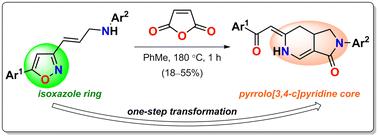
An unexpected cascade of N-acylation/intramolecular [4 + 2] cycloaddition/decarboxylation/isoxazole ring-opening reactions is observed in the course of the interaction between 3-(isoxazol-3-yl)allylamines and maleic or trifluoromethylmaleic anhydrides. This four-step sequence begins with the initial N-acylation of allylamines by the anhydride, followed by an intramolecular Diels–Alder reaction, which is accompanied by spontaneous decarboxylation, and ends with the opening of the isoxazole ring. As a result, an original approach to a pyrrolo[3,4-c]pyridine core was discovered. A test series of pyrrolo[3,4-c]pyridin-3-ones was investigated for anti-inflammatory activity and cytotoxicity, including the ability to inhibit NLRP3 inflammasome activation.
期刊介绍:
Organic & Biomolecular Chemistry is an international journal using integrated research in chemistry-organic chemistry. Founded in 2003 by the Royal Society of Chemistry, the journal is published in Semimonthly issues and has been indexed by SCIE, a leading international database. The journal focuses on the key research and cutting-edge progress in the field of chemistry-organic chemistry, publishes and reports the research results in this field in a timely manner, and is committed to becoming a window and platform for rapid academic exchanges among peers in this field. The journal's impact factor in 2023 is 2.9, and its CiteScore is 5.5.



 京公网安备 11010802042870号
京ICP备2023020795号-1
京公网安备 11010802042870号
京ICP备2023020795号-1

 分享
分享
 求助内容:
求助内容: 应助结果提醒方式:
 扫码关注我们
