{"title":"High-resolution 13C NMR indicates that changes in the dynamics of polyproline II conformations induce collagen I fibrillogenesis","authors":"Naomasa Kawashima and Paulo Peres De Sa Peixoto","doi":"10.1039/D4SM01003E","DOIUrl":null,"url":null,"abstract":"<p >Collagen I is a 300 nm long fibrous protein that plays an important role in maintaining the structure of several tissues, such as the dermis, bone, enamel and cornea. In these tissues, collagen is found in the form of fibrils, which can be several microns in length and have different diameters. Collagen–collagen interactions rely mainly on the hydrogen bond (H-bond) network and display a very strong sensitivity to temperature; at the physiological temperature, it forms micro to macro fibrils but tends to be dissolved into a triple helix at 5 °C. It has been argued that the temperature-dependent structural transformation of the more flexible regions of collagen is mainly responsible for this transition. In the present work, we used <small><sup>13</sup></small>C nuclear magnetic resonance (NMR) spectroscopy with magic angle spinning (MAS) technique to acquire local and unusual high-resolution information on the conformations and dynamics of collagen in the microfibril form (at the physiological temperature) and dissolved form (at 5 °C). The obtained data showed that at physiological temperatures, about 60% of the dihedral angles in the collagen are in the polyproline II (PII) conformation, which resulted in higher dynamics than the other residues. These residues displayed chemical shifts in previously assigned regions close to amino acids. Alternatively, the regions assigned to imino acid-rich regions displayed the strongest decrease in dynamics in contrast to the remaining conformations. Although the resolution remained relatively good at 5 °C, no strong shift was observed in the NMR spectrum for the other residues, indicating that the temperature affected mainly the PII residues. These results support the previous hypothesis that the PII regions are mainly responsible for the temperature-dependent tunability of collagen into fibrils. These data bring new insights into collagen mechanics and may help understand the impact of collagen defects in related diseases.</p>","PeriodicalId":103,"journal":{"name":"Soft Matter","volume":" 15","pages":" 2909-2914"},"PeriodicalIF":2.8000,"publicationDate":"2025-02-12","publicationTypes":"Journal Article","fieldsOfStudy":null,"isOpenAccess":false,"openAccessPdf":"","citationCount":"0","resultStr":null,"platform":"Semanticscholar","paperid":null,"PeriodicalName":"Soft Matter","FirstCategoryId":"92","ListUrlMain":"https://pubs.rsc.org/en/content/articlelanding/2025/sm/d4sm01003e","RegionNum":3,"RegionCategory":"化学","ArticlePicture":[],"TitleCN":null,"AbstractTextCN":null,"PMCID":null,"EPubDate":"","PubModel":"","JCR":"Q3","JCRName":"CHEMISTRY, PHYSICAL","Score":null,"Total":0}
引用次数: 0
Abstract
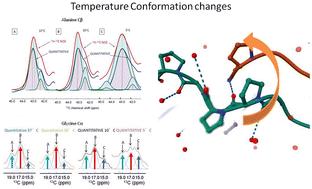
Collagen I is a 300 nm long fibrous protein that plays an important role in maintaining the structure of several tissues, such as the dermis, bone, enamel and cornea. In these tissues, collagen is found in the form of fibrils, which can be several microns in length and have different diameters. Collagen–collagen interactions rely mainly on the hydrogen bond (H-bond) network and display a very strong sensitivity to temperature; at the physiological temperature, it forms micro to macro fibrils but tends to be dissolved into a triple helix at 5 °C. It has been argued that the temperature-dependent structural transformation of the more flexible regions of collagen is mainly responsible for this transition. In the present work, we used 13C nuclear magnetic resonance (NMR) spectroscopy with magic angle spinning (MAS) technique to acquire local and unusual high-resolution information on the conformations and dynamics of collagen in the microfibril form (at the physiological temperature) and dissolved form (at 5 °C). The obtained data showed that at physiological temperatures, about 60% of the dihedral angles in the collagen are in the polyproline II (PII) conformation, which resulted in higher dynamics than the other residues. These residues displayed chemical shifts in previously assigned regions close to amino acids. Alternatively, the regions assigned to imino acid-rich regions displayed the strongest decrease in dynamics in contrast to the remaining conformations. Although the resolution remained relatively good at 5 °C, no strong shift was observed in the NMR spectrum for the other residues, indicating that the temperature affected mainly the PII residues. These results support the previous hypothesis that the PII regions are mainly responsible for the temperature-dependent tunability of collagen into fibrils. These data bring new insights into collagen mechanics and may help understand the impact of collagen defects in related diseases.
期刊介绍:
Soft Matter is an international journal published by the Royal Society of Chemistry using Engineering-Materials Science: A Synthesis as its research focus. It publishes original research articles, review articles, and synthesis articles related to this field, reporting the latest discoveries in the relevant theoretical, practical, and applied disciplines in a timely manner, and aims to promote the rapid exchange of scientific information in this subject area. The journal is an open access journal. The journal is an open access journal and has not been placed on the alert list in the last three years.



 京公网安备 11010802042870号
京ICP备2023020795号-1
京公网安备 11010802042870号
京ICP备2023020795号-1

 分享
分享
 求助内容:
求助内容: 应助结果提醒方式:
 扫码关注我们
