Shankar Ghosh, Anit Sane, Smita Gohil, Vedant Vashishtha, Sanat K. Kumar and Guruswamy Kumaraswamy
{"title":"Mechanism of microplastic and nanoplastic emission from tire wear†","authors":"Shankar Ghosh, Anit Sane, Smita Gohil, Vedant Vashishtha, Sanat K. Kumar and Guruswamy Kumaraswamy","doi":"10.1039/D5SM00074B","DOIUrl":null,"url":null,"abstract":"<p >Tire and brake-wear emissions, in particular nanoparticulate aerosols, can potentially impact human health and the environment adversely. While there is considerable phenomenological data on tire wear, the creation and environmental persistence of particulate pollutants is not well understood. Here, we unequivocally show that normal mechanical tire wear results in two distinct micro and nanoplastic (MNP) populations: a smaller, aerosolized fraction (<10 μm), and larger microplastics. Nanoplastic emissions follow a power law distribution that we show is consistent with the classical arguments of Archard, and Griffiths. Nanoplastic pollution increases dramatically with vehicle speed and weight, as the power law distribution characterizing these gets steeper. Charge stabilization of the tire wear nanoparticles keeps them suspended, while microplastics settle due to gravity. Larger microplastics are formed by sequential wear processes and show a log-normal distribution, as anticipated by Kolmogorov. Thus, the particle size distribution provides mechanistic insights to tire fragmentation: the aerosolized fraction is determined by power input to the tire while the larger microplastics are determined by sequential wear processes due to tire-road surface interactions, independent of vehicle weight and speed.</p>","PeriodicalId":103,"journal":{"name":"Soft Matter","volume":" 15","pages":" 2782-2786"},"PeriodicalIF":2.8000,"publicationDate":"2025-03-21","publicationTypes":"Journal Article","fieldsOfStudy":null,"isOpenAccess":false,"openAccessPdf":"","citationCount":"0","resultStr":null,"platform":"Semanticscholar","paperid":null,"PeriodicalName":"Soft Matter","FirstCategoryId":"92","ListUrlMain":"https://pubs.rsc.org/en/content/articlelanding/2025/sm/d5sm00074b","RegionNum":3,"RegionCategory":"化学","ArticlePicture":[],"TitleCN":null,"AbstractTextCN":null,"PMCID":null,"EPubDate":"","PubModel":"","JCR":"Q3","JCRName":"CHEMISTRY, PHYSICAL","Score":null,"Total":0}
引用次数: 0
Abstract
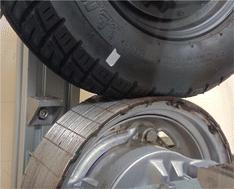
Tire and brake-wear emissions, in particular nanoparticulate aerosols, can potentially impact human health and the environment adversely. While there is considerable phenomenological data on tire wear, the creation and environmental persistence of particulate pollutants is not well understood. Here, we unequivocally show that normal mechanical tire wear results in two distinct micro and nanoplastic (MNP) populations: a smaller, aerosolized fraction (<10 μm), and larger microplastics. Nanoplastic emissions follow a power law distribution that we show is consistent with the classical arguments of Archard, and Griffiths. Nanoplastic pollution increases dramatically with vehicle speed and weight, as the power law distribution characterizing these gets steeper. Charge stabilization of the tire wear nanoparticles keeps them suspended, while microplastics settle due to gravity. Larger microplastics are formed by sequential wear processes and show a log-normal distribution, as anticipated by Kolmogorov. Thus, the particle size distribution provides mechanistic insights to tire fragmentation: the aerosolized fraction is determined by power input to the tire while the larger microplastics are determined by sequential wear processes due to tire-road surface interactions, independent of vehicle weight and speed.
期刊介绍:
Soft Matter is an international journal published by the Royal Society of Chemistry using Engineering-Materials Science: A Synthesis as its research focus. It publishes original research articles, review articles, and synthesis articles related to this field, reporting the latest discoveries in the relevant theoretical, practical, and applied disciplines in a timely manner, and aims to promote the rapid exchange of scientific information in this subject area. The journal is an open access journal. The journal is an open access journal and has not been placed on the alert list in the last three years.



 京公网安备 11010802042870号
京ICP备2023020795号-1
京公网安备 11010802042870号
京ICP备2023020795号-1

 分享
分享
 求助内容:
求助内容: 应助结果提醒方式:
 扫码关注我们
