Chaozheng Zhou, Haozhe Jia, Pengfei Yan, Chenglong Yang, Song Xu, Guangyu An, Baorui Song, Qun Xu
{"title":"Electrocatalytic Conversion of Glucose into Renewable Formic Acid Using “Electron-Withdrawing” MoO3 Support under Mild Conditions","authors":"Chaozheng Zhou, Haozhe Jia, Pengfei Yan, Chenglong Yang, Song Xu, Guangyu An, Baorui Song, Qun Xu","doi":"10.1002/cssc.202500297","DOIUrl":null,"url":null,"abstract":"<p>Electrocatalysis is a sustainable and effective approach to produce value-added chemical commodities from biomass, where highly effective catalyst is required. Since transition metal hydroxide is a feasible catalyst for electrochemical biomass conversion, rational optimization of its electrocatalytic activity is highly desired. Herein, electrocatalytic activity of glucose oxidation is significantly optimized by reducing the electron density at Ni active sites, which is achieved by depositing Ni(OH)<sub>2</sub> at “electron-withdrawing” MoO<sub>3</sub> support (Ni(OH)<sub>2</sub><span></span>MoO<sub>3−<i>x</i></sub>). As results, the formation of active sites (NiOOH) and the adsorption of glucose are simultaneously facilitated in Ni(OH)<sub>2</sub><span></span>MoO<sub>3−<i>x</i></sub>, which effectively converts glucose to formic acid (FA) with remarkable yield and Faraday efficiency (≈90.5 and 98%, respectively), far superior to conventional β-Ni(OH)<sub>2</sub> catalyst (≈22.5 and 58.9%, respectively). In addition to a novel strategy for efficient FA production from glucose, this work offers valuable insights into the rational optimization of electrocatalytic oxidation of biomass-based substrates.</p>","PeriodicalId":149,"journal":{"name":"ChemSusChem","volume":"18 12","pages":""},"PeriodicalIF":6.6000,"publicationDate":"2025-03-27","publicationTypes":"Journal Article","fieldsOfStudy":null,"isOpenAccess":false,"openAccessPdf":"","citationCount":"0","resultStr":null,"platform":"Semanticscholar","paperid":null,"PeriodicalName":"ChemSusChem","FirstCategoryId":"92","ListUrlMain":"https://chemistry-europe.onlinelibrary.wiley.com/doi/10.1002/cssc.202500297","RegionNum":2,"RegionCategory":"化学","ArticlePicture":[],"TitleCN":null,"AbstractTextCN":null,"PMCID":null,"EPubDate":"","PubModel":"","JCR":"Q1","JCRName":"CHEMISTRY, MULTIDISCIPLINARY","Score":null,"Total":0}
引用次数: 0
Abstract
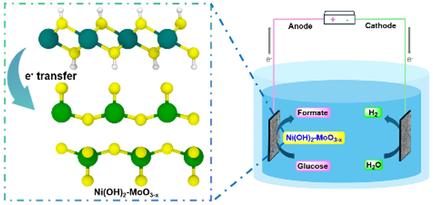
Electrocatalysis is a sustainable and effective approach to produce value-added chemical commodities from biomass, where highly effective catalyst is required. Since transition metal hydroxide is a feasible catalyst for electrochemical biomass conversion, rational optimization of its electrocatalytic activity is highly desired. Herein, electrocatalytic activity of glucose oxidation is significantly optimized by reducing the electron density at Ni active sites, which is achieved by depositing Ni(OH)2 at “electron-withdrawing” MoO3 support (Ni(OH)2MoO3−x). As results, the formation of active sites (NiOOH) and the adsorption of glucose are simultaneously facilitated in Ni(OH)2MoO3−x, which effectively converts glucose to formic acid (FA) with remarkable yield and Faraday efficiency (≈90.5 and 98%, respectively), far superior to conventional β-Ni(OH)2 catalyst (≈22.5 and 58.9%, respectively). In addition to a novel strategy for efficient FA production from glucose, this work offers valuable insights into the rational optimization of electrocatalytic oxidation of biomass-based substrates.
期刊介绍:
ChemSusChem
Impact Factor (2016): 7.226
Scope:
Interdisciplinary journal
Focuses on research at the interface of chemistry and sustainability
Features the best research on sustainability and energy
Areas Covered:
Chemistry
Materials Science
Chemical Engineering
Biotechnology





 京公网安备 11010802042870号
京ICP备2023020795号-1
京公网安备 11010802042870号
京ICP备2023020795号-1

 分享
分享
 求助内容:
求助内容: 应助结果提醒方式:
 扫码关注我们
