Treatment of an adult patient with severe dental crowding by applying asymmetric extraction, fixed appliance, and micro-implant anchorage: a case report.
Huixin Xue, Siyi Xu, Yezi Qi, Leilei Xue, Xinxin Ni, Liqi Xu, Qingshan Li, Jun Lin
{"title":"Treatment of an adult patient with severe dental crowding by applying asymmetric extraction, fixed appliance, and micro-implant anchorage: a case report.","authors":"Huixin Xue, Siyi Xu, Yezi Qi, Leilei Xue, Xinxin Ni, Liqi Xu, Qingshan Li, Jun Lin","doi":"10.1186/s12903-025-05808-7","DOIUrl":null,"url":null,"abstract":"<p><strong>Background: </strong>Severe dental crowding and protrusion often necessitate symmetric extraction for correction. However, asymmetric extraction may serve as a viable, albeit challenging, treatment option when the prognosis of individual tooth is poor. In this report, we present a case where asymmetric extraction was employed to address severe dental crowding and deviated midlines, resulting in satisfactory outcomes following retention.</p><p><strong>Case presentation: </strong>We report a case of a 31-year-old woman with severe dental crowding and deviated dental midlines. A fixed appliance, micro-implant anchorage, and asymmetric extraction, including a mandibular canine with severe buccal malposition, were applied to the patient. The treatment outcomes demonstrated successful achievement of the treatment objectives, with well-aligned teeth exhibiting solid interdigitation and the dental midlines aligned with the facial midline. At the 21-month follow-up, midline stability, favorable occlusal interdigitation, and improved smile line were observed.</p><p><strong>Conclusions: </strong>Asymmetric extraction may be considered a viable approach for patients with individual tooth of poor prognosis. Treatment stability can be achieved through well-interdigitated occlusion and the use of various retention methods.</p>","PeriodicalId":9072,"journal":{"name":"BMC Oral Health","volume":"25 1","pages":"436"},"PeriodicalIF":3.1000,"publicationDate":"2025-03-26","publicationTypes":"Journal Article","fieldsOfStudy":null,"isOpenAccess":false,"openAccessPdf":"https://www.ncbi.nlm.nih.gov/pmc/articles/PMC11938769/pdf/","citationCount":"0","resultStr":null,"platform":"Semanticscholar","paperid":null,"PeriodicalName":"BMC Oral Health","FirstCategoryId":"3","ListUrlMain":"https://doi.org/10.1186/s12903-025-05808-7","RegionNum":2,"RegionCategory":"医学","ArticlePicture":[],"TitleCN":null,"AbstractTextCN":null,"PMCID":null,"EPubDate":"","PubModel":"","JCR":"Q1","JCRName":"DENTISTRY, ORAL SURGERY & MEDICINE","Score":null,"Total":0}
引用次数: 0
Abstract
Background: Severe dental crowding and protrusion often necessitate symmetric extraction for correction. However, asymmetric extraction may serve as a viable, albeit challenging, treatment option when the prognosis of individual tooth is poor. In this report, we present a case where asymmetric extraction was employed to address severe dental crowding and deviated midlines, resulting in satisfactory outcomes following retention.
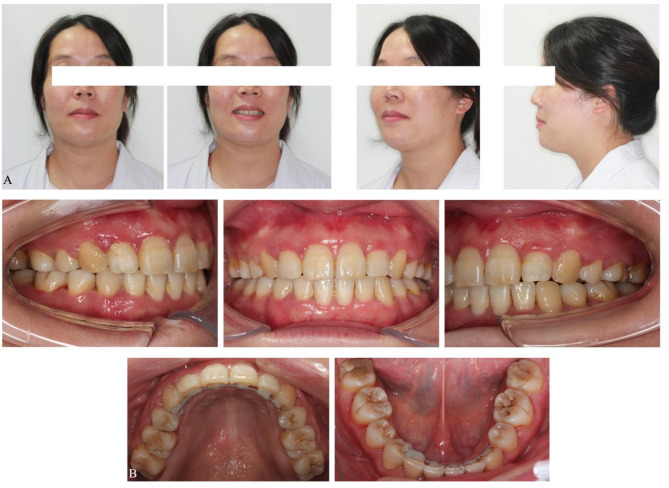
Case presentation: We report a case of a 31-year-old woman with severe dental crowding and deviated dental midlines. A fixed appliance, micro-implant anchorage, and asymmetric extraction, including a mandibular canine with severe buccal malposition, were applied to the patient. The treatment outcomes demonstrated successful achievement of the treatment objectives, with well-aligned teeth exhibiting solid interdigitation and the dental midlines aligned with the facial midline. At the 21-month follow-up, midline stability, favorable occlusal interdigitation, and improved smile line were observed.
Conclusions: Asymmetric extraction may be considered a viable approach for patients with individual tooth of poor prognosis. Treatment stability can be achieved through well-interdigitated occlusion and the use of various retention methods.
期刊介绍:
BMC Oral Health is an open access, peer-reviewed journal that considers articles on all aspects of the prevention, diagnosis and management of disorders of the mouth, teeth and gums, as well as related molecular genetics, pathophysiology, and epidemiology.





 京公网安备 11010802042870号
京ICP备2023020795号-1
京公网安备 11010802042870号
京ICP备2023020795号-1

 分享
分享
 求助内容:
求助内容: 应助结果提醒方式:
 扫码关注我们
