How do electronic personal health information technologies enhance obesity prevention behaviors? Examining the roles of obesity risk perception and body weight.
Jizhou Francis Ye, Yuxiang Sam Song, Yuyuan Lai, Song Harris Ao, Xinshu Zhao
{"title":"How do electronic personal health information technologies enhance obesity prevention behaviors? Examining the roles of obesity risk perception and body weight.","authors":"Jizhou Francis Ye, Yuxiang Sam Song, Yuyuan Lai, Song Harris Ao, Xinshu Zhao","doi":"10.1186/s12889-025-22225-1","DOIUrl":null,"url":null,"abstract":"<p><strong>Background: </strong>The global epidemic of overweight and obesity appears alongside numerous diseases. As electronic personal health information (ePHI) technology becomes more prevalent, understanding its relationship with health behaviors and how this relationship may differ across physical groups becomes increasingly relevant.</p><p><strong>Methods: </strong>Using secondary data from the National Cancer Institute's Health Information National Trends Survey (HINTS) 2020, this study examined the relationships between ePHI technology use, obesity preventive behaviors (e.g., physical activity, alcohol consumption, and diet control), and risk perception of obesity, considering body weight as a potential moderator.</p><p><strong>Results: </strong>The patterns between ePHI technology use and obesity preventive behaviors differed across behavior types and body weight groups. Higher ePHI technology use was associated with increased physical activity (b = 5.98, b<sub>p</sub> = 0.44, p < .01) and diet control (b = 0.03, b<sub>p</sub> = 0.28, OR = 1.11, p < .001), while no significant relationship was observed with alcohol consumption. The relationship between ePHI technology use and risk perception of obesity was weaker among the obese group (b = -0.03, b<sub>p</sub> = -0.11, p < .05). The indirect relationship between ePHI technology use and physical activity varied by body weight, showing stronger associations in the underweight group (95% CI [0.03, 2.77]) and weaker associations in the obese group (95% CI [-1.14, -0.04]).</p><p><strong>Conclusion: </strong>The findings suggest more limited relationships between ePHI technology and health behaviors than previously anticipated. Physical activity and dietary regulation showed modest associations with ePHI technology use, while alcohol consumption showed no significant relationship. Overweight and obese individuals did not show a higher risk perception of obesity or greater engagement in preventive behaviors compared to those of healthy weight. These findings highlight the importance of developing a more nuanced understanding of ePHI technology's role in health-related contexts.</p>","PeriodicalId":9039,"journal":{"name":"BMC Public Health","volume":"25 1","pages":"1155"},"PeriodicalIF":3.6000,"publicationDate":"2025-03-27","publicationTypes":"Journal Article","fieldsOfStudy":null,"isOpenAccess":false,"openAccessPdf":"https://www.ncbi.nlm.nih.gov/pmc/articles/PMC11948975/pdf/","citationCount":"0","resultStr":null,"platform":"Semanticscholar","paperid":null,"PeriodicalName":"BMC Public Health","FirstCategoryId":"3","ListUrlMain":"https://doi.org/10.1186/s12889-025-22225-1","RegionNum":2,"RegionCategory":"医学","ArticlePicture":[],"TitleCN":null,"AbstractTextCN":null,"PMCID":null,"EPubDate":"","PubModel":"","JCR":"Q1","JCRName":"PUBLIC, ENVIRONMENTAL & OCCUPATIONAL HEALTH","Score":null,"Total":0}
引用次数: 0
Abstract
Background: The global epidemic of overweight and obesity appears alongside numerous diseases. As electronic personal health information (ePHI) technology becomes more prevalent, understanding its relationship with health behaviors and how this relationship may differ across physical groups becomes increasingly relevant.
Methods: Using secondary data from the National Cancer Institute's Health Information National Trends Survey (HINTS) 2020, this study examined the relationships between ePHI technology use, obesity preventive behaviors (e.g., physical activity, alcohol consumption, and diet control), and risk perception of obesity, considering body weight as a potential moderator.
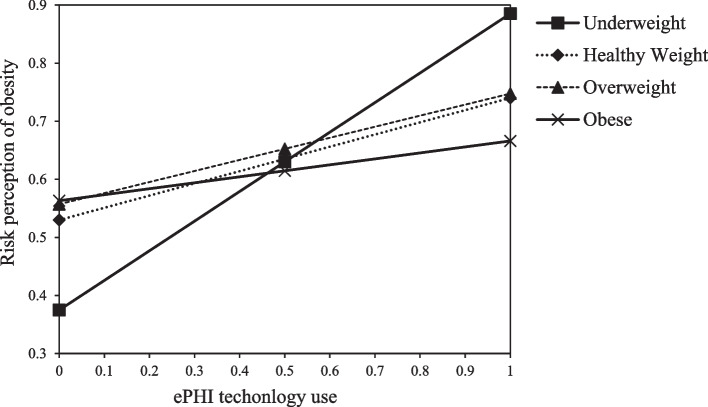
Results: The patterns between ePHI technology use and obesity preventive behaviors differed across behavior types and body weight groups. Higher ePHI technology use was associated with increased physical activity (b = 5.98, bp = 0.44, p < .01) and diet control (b = 0.03, bp = 0.28, OR = 1.11, p < .001), while no significant relationship was observed with alcohol consumption. The relationship between ePHI technology use and risk perception of obesity was weaker among the obese group (b = -0.03, bp = -0.11, p < .05). The indirect relationship between ePHI technology use and physical activity varied by body weight, showing stronger associations in the underweight group (95% CI [0.03, 2.77]) and weaker associations in the obese group (95% CI [-1.14, -0.04]).
Conclusion: The findings suggest more limited relationships between ePHI technology and health behaviors than previously anticipated. Physical activity and dietary regulation showed modest associations with ePHI technology use, while alcohol consumption showed no significant relationship. Overweight and obese individuals did not show a higher risk perception of obesity or greater engagement in preventive behaviors compared to those of healthy weight. These findings highlight the importance of developing a more nuanced understanding of ePHI technology's role in health-related contexts.
背景:超重和肥胖的全球流行与许多疾病一起出现。随着电子个人健康信息(ePHI)技术变得越来越普遍,了解其与健康行为的关系以及这种关系在不同身体群体之间的差异变得越来越重要。方法:本研究利用美国国家癌症研究所2020年健康信息国家趋势调查(HINTS)的二手数据,研究了ePHI技术使用、肥胖预防行为(如体育活动、饮酒和饮食控制)和肥胖风险认知之间的关系,并将体重视为潜在的调节因素。结果:ePHI技术使用与肥胖预防行为之间的模式在不同的行为类型和体重组中存在差异。较高的ePHI技术使用与增加的身体活动相关(b = 5.98, bp = 0.44, p p = 0.28, OR = 1.11, p p = -0.11, p)结论:研究结果表明,ePHI技术与健康行为之间的关系比先前预期的更为有限。体育活动和饮食调节与ePHI技术的使用有适度的关联,而饮酒没有显著的关系。与健康体重的人相比,超重和肥胖的人并没有表现出更高的肥胖风险认知或更多的预防行为。这些发现强调了对ePHI技术在健康相关环境中的作用进行更细致理解的重要性。
期刊介绍:
BMC Public Health is an open access, peer-reviewed journal that considers articles on the epidemiology of disease and the understanding of all aspects of public health. The journal has a special focus on the social determinants of health, the environmental, behavioral, and occupational correlates of health and disease, and the impact of health policies, practices and interventions on the community.





 京公网安备 11010802042870号
京ICP备2023020795号-1
京公网安备 11010802042870号
京ICP备2023020795号-1

 分享
分享
 求助内容:
求助内容: 应助结果提醒方式:
 扫码关注我们
