Yingfang She, Chunfei Wang, Le Fu, Liang Luo, Yide Li
{"title":"Glycemic Comparison Index (GCI): a retrospective analysis of its prognostic value in ICU patients with AMI and diabetes.","authors":"Yingfang She, Chunfei Wang, Le Fu, Liang Luo, Yide Li","doi":"10.1186/s12902-025-01907-2","DOIUrl":null,"url":null,"abstract":"<p><strong>Background: </strong>Acute myocardial infarction (AMI) has a significant impact on global health, especially among individuals with diabetes, emphasizing the need for specialized glycemic management. This study examines the glycemic comparison index (GCI), a novel prognostic tool designed for patients with AMI and diabetes, aiming to enhance glucose management in critical care settings.</p><p><strong>Methods: </strong>This retrospective cohort analysis used data from the Medical Information Mart for Intensive Care IV database (version 2.2). The GCI was calculated by comparing mean blood glucose levels in the intensive care unit (ICU) to baseline glucose levels. Patients were stratified into tertiles based on their GCI scores. The primary outcome measured was one-year all-cause mortality, while secondary outcomes included hospital mortality, ICU-free days, and hypoglycemic events. Statistical analyses included time-dependent receiver operating characteristic (ROC), cox proportional hazards models, generalized linear models (GLM), and restricted cubic spline analysis.</p><p><strong>Results: </strong>The patient population comprised 622 individuals, with a mean age of 69.9 years and 64.6% male representation. The high GCI group exhibited the highest one-year mortality rate and fewer ICU-free days, while the low GCI group exhibited a higher incidence of hypoglycemia. Statistical analyses revealed that GCI was a significant predictor of one-year all-cause mortality (hazard ratio: 2.21, 95% confidence interval: 1.51-3.24). Analysis using time-dependent ROC confirmed the consistent predictive accuracy of GCI for survival at 1, 6, and 12 months (area under the curve: 0.671, 0.670, and 0.634, respectively). Furthermore, GLM analysis indicated that a higher GCI was associated with fewer ICU-free days.</p><p><strong>Conclusions: </strong>Higher GCI values are associated with increased one-year mortality and fewer ICU-free days in patients with AMI and diabetes. In comparison, lower GCI values are correlated with a higher risk of hypoglycemia. The GCI demonstrates potential as a personalized prognostic tool, although further validation is needed.</p>","PeriodicalId":9152,"journal":{"name":"BMC Endocrine Disorders","volume":"25 1","pages":"85"},"PeriodicalIF":3.3000,"publicationDate":"2025-03-26","publicationTypes":"Journal Article","fieldsOfStudy":null,"isOpenAccess":false,"openAccessPdf":"https://www.ncbi.nlm.nih.gov/pmc/articles/PMC11938553/pdf/","citationCount":"0","resultStr":null,"platform":"Semanticscholar","paperid":null,"PeriodicalName":"BMC Endocrine Disorders","FirstCategoryId":"3","ListUrlMain":"https://doi.org/10.1186/s12902-025-01907-2","RegionNum":3,"RegionCategory":"医学","ArticlePicture":[],"TitleCN":null,"AbstractTextCN":null,"PMCID":null,"EPubDate":"","PubModel":"","JCR":"Q3","JCRName":"ENDOCRINOLOGY & METABOLISM","Score":null,"Total":0}
引用次数: 0
Abstract
Background: Acute myocardial infarction (AMI) has a significant impact on global health, especially among individuals with diabetes, emphasizing the need for specialized glycemic management. This study examines the glycemic comparison index (GCI), a novel prognostic tool designed for patients with AMI and diabetes, aiming to enhance glucose management in critical care settings.
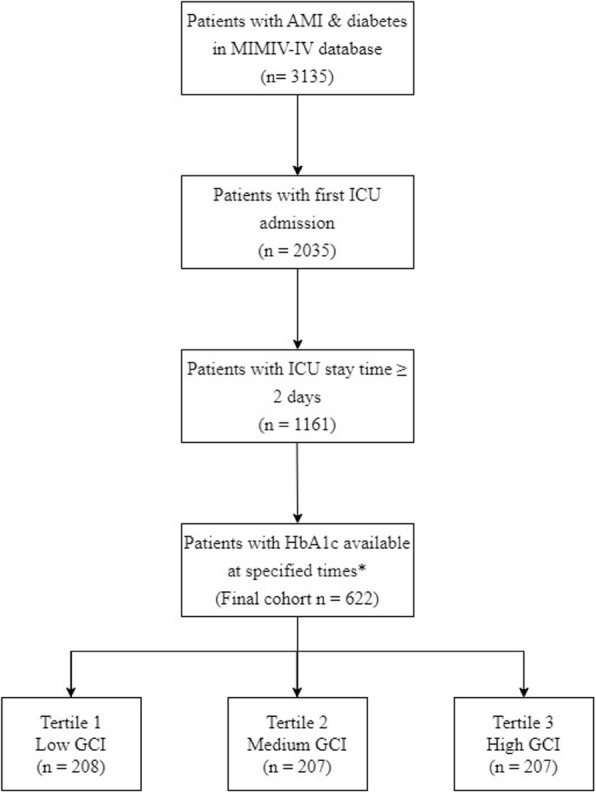
Methods: This retrospective cohort analysis used data from the Medical Information Mart for Intensive Care IV database (version 2.2). The GCI was calculated by comparing mean blood glucose levels in the intensive care unit (ICU) to baseline glucose levels. Patients were stratified into tertiles based on their GCI scores. The primary outcome measured was one-year all-cause mortality, while secondary outcomes included hospital mortality, ICU-free days, and hypoglycemic events. Statistical analyses included time-dependent receiver operating characteristic (ROC), cox proportional hazards models, generalized linear models (GLM), and restricted cubic spline analysis.
Results: The patient population comprised 622 individuals, with a mean age of 69.9 years and 64.6% male representation. The high GCI group exhibited the highest one-year mortality rate and fewer ICU-free days, while the low GCI group exhibited a higher incidence of hypoglycemia. Statistical analyses revealed that GCI was a significant predictor of one-year all-cause mortality (hazard ratio: 2.21, 95% confidence interval: 1.51-3.24). Analysis using time-dependent ROC confirmed the consistent predictive accuracy of GCI for survival at 1, 6, and 12 months (area under the curve: 0.671, 0.670, and 0.634, respectively). Furthermore, GLM analysis indicated that a higher GCI was associated with fewer ICU-free days.
Conclusions: Higher GCI values are associated with increased one-year mortality and fewer ICU-free days in patients with AMI and diabetes. In comparison, lower GCI values are correlated with a higher risk of hypoglycemia. The GCI demonstrates potential as a personalized prognostic tool, although further validation is needed.
期刊介绍:
BMC Endocrine Disorders is an open access, peer-reviewed journal that considers articles on all aspects of the prevention, diagnosis and management of endocrine disorders, as well as related molecular genetics, pathophysiology, and epidemiology.





 京公网安备 11010802042870号
京ICP备2023020795号-1
京公网安备 11010802042870号
京ICP备2023020795号-1

 分享
分享
 求助内容:
求助内容: 应助结果提醒方式:
 扫码关注我们
