Yijie Deng, Kai Etheridge, Xinping Ran, Hannah E Maurais, Rahul Sarpeshkar
{"title":"Growth-coupled continuous directed evolution by MutaT7 enables efficient and automated enzyme engineering.","authors":"Yijie Deng, Kai Etheridge, Xinping Ran, Hannah E Maurais, Rahul Sarpeshkar","doi":"10.1128/aem.02491-24","DOIUrl":null,"url":null,"abstract":"<p><p>Traditional directed evolution is limited by labor-intensive iterative steps and low-throughput selection and screening. To address these challenges, we developed a growth-coupled continuous directed evolution (GCCDE) approach, enabling automated and efficient enzyme engineering. By linking enzyme activity to bacterial growth and utilizing the MutaT7 system, GCCDE combines <i>in vivo</i> mutagenesis and high-throughput selection of superior enzyme variants in a single process. To validate this approach, we evolved the thermostable enzyme CelB from <i>Pyrococcus furiosus</i> to enhance its β-galactosidase activity at lower temperatures while maintaining thermal stability. CelB activity was coupled to the growth of <i>E. coli</i>, allowing variants with improved activity to utilize lactose more efficiently and promote faster growth in a minimal medium. Using a continuous culture system, we achieved automated high-throughput mutagenesis and simultaneous real-time selection of over 10⁹ variants per culture. Integrating <i>in vitro</i> and <i>in vivo</i> mutagenesis further increased genetic diversity, yielding CelB variants with significantly enhanced low-temperature activity compared to the wild type while preserving thermostability. DNA sequencing identified key mutations likely responsible for improved substrate binding and catalytic turnover. This GCCDE approach is broadly applicable for optimizing diverse enzymes, demonstrating the potential of automated continuous evolution for industrial and research applications.</p><p><strong>Importance: </strong>Enzyme engineering aims to develop enzymes with improved or novel traits, but traditional methods are slow and require repetitive manual steps. This study presents a faster, automated protein engineering approach. We utilized an <i>in vivo</i> mutagenesis technique, MutaT7 tools, to induce mutations in living bacteria and established a direct link between enzyme activity and bacterial growth. A continuous culture setup enables automated mutagenesis and growth-coupled selection of better-performing variants in real time. Bacteria with improved enzymes grew faster, selecting superior variants without manual intervention. Using this method, we engineered CelB with better performance at lower temperatures while maintaining thermal stability. By combining high-throughput mutagenesis and selection in a single process, this system bypasses iterative cycles of error-prone PCR, transformation, and screening. Our approach is adaptable to various enzymes, providing a faster and more efficient solution for enzyme engineering.</p>","PeriodicalId":8002,"journal":{"name":"Applied and Environmental Microbiology","volume":" ","pages":"e0249124"},"PeriodicalIF":3.7000,"publicationDate":"2025-04-23","publicationTypes":"Journal Article","fieldsOfStudy":null,"isOpenAccess":false,"openAccessPdf":"https://www.ncbi.nlm.nih.gov/pmc/articles/PMC12016552/pdf/","citationCount":"0","resultStr":null,"platform":"Semanticscholar","paperid":null,"PeriodicalName":"Applied and Environmental Microbiology","FirstCategoryId":"99","ListUrlMain":"https://doi.org/10.1128/aem.02491-24","RegionNum":2,"RegionCategory":"生物学","ArticlePicture":[],"TitleCN":null,"AbstractTextCN":null,"PMCID":null,"EPubDate":"2025/3/27 0:00:00","PubModel":"Epub","JCR":"Q2","JCRName":"BIOTECHNOLOGY & APPLIED MICROBIOLOGY","Score":null,"Total":0}
引用次数: 0
Abstract
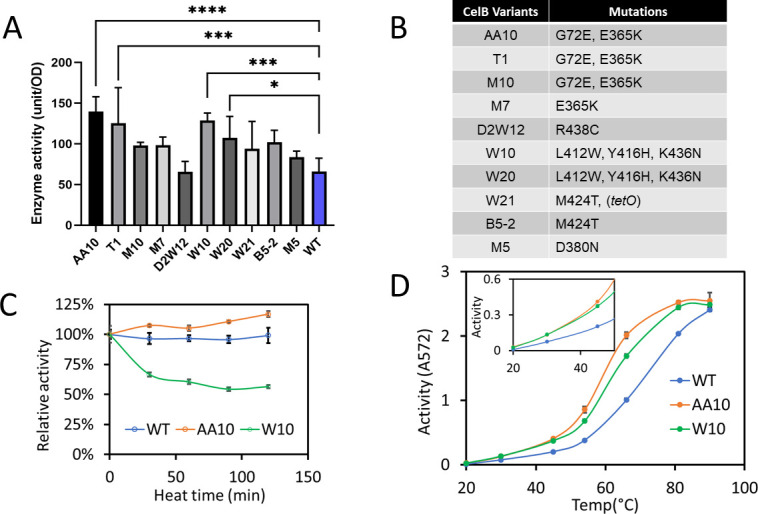
Traditional directed evolution is limited by labor-intensive iterative steps and low-throughput selection and screening. To address these challenges, we developed a growth-coupled continuous directed evolution (GCCDE) approach, enabling automated and efficient enzyme engineering. By linking enzyme activity to bacterial growth and utilizing the MutaT7 system, GCCDE combines in vivo mutagenesis and high-throughput selection of superior enzyme variants in a single process. To validate this approach, we evolved the thermostable enzyme CelB from Pyrococcus furiosus to enhance its β-galactosidase activity at lower temperatures while maintaining thermal stability. CelB activity was coupled to the growth of E. coli, allowing variants with improved activity to utilize lactose more efficiently and promote faster growth in a minimal medium. Using a continuous culture system, we achieved automated high-throughput mutagenesis and simultaneous real-time selection of over 10⁹ variants per culture. Integrating in vitro and in vivo mutagenesis further increased genetic diversity, yielding CelB variants with significantly enhanced low-temperature activity compared to the wild type while preserving thermostability. DNA sequencing identified key mutations likely responsible for improved substrate binding and catalytic turnover. This GCCDE approach is broadly applicable for optimizing diverse enzymes, demonstrating the potential of automated continuous evolution for industrial and research applications.
Importance: Enzyme engineering aims to develop enzymes with improved or novel traits, but traditional methods are slow and require repetitive manual steps. This study presents a faster, automated protein engineering approach. We utilized an in vivo mutagenesis technique, MutaT7 tools, to induce mutations in living bacteria and established a direct link between enzyme activity and bacterial growth. A continuous culture setup enables automated mutagenesis and growth-coupled selection of better-performing variants in real time. Bacteria with improved enzymes grew faster, selecting superior variants without manual intervention. Using this method, we engineered CelB with better performance at lower temperatures while maintaining thermal stability. By combining high-throughput mutagenesis and selection in a single process, this system bypasses iterative cycles of error-prone PCR, transformation, and screening. Our approach is adaptable to various enzymes, providing a faster and more efficient solution for enzyme engineering.
期刊介绍:
Applied and Environmental Microbiology (AEM) publishes papers that make significant contributions to (a) applied microbiology, including biotechnology, protein engineering, bioremediation, and food microbiology, (b) microbial ecology, including environmental, organismic, and genomic microbiology, and (c) interdisciplinary microbiology, including invertebrate microbiology, plant microbiology, aquatic microbiology, and geomicrobiology.





 京公网安备 11010802042870号
京ICP备2023020795号-1
京公网安备 11010802042870号
京ICP备2023020795号-1

 分享
分享
 求助内容:
求助内容: 应助结果提醒方式:
 扫码关注我们
