Jing Peng, Xiaoli Yao, Rong Luo, Xiuxia Wang, Liwen Wu, Jianmin Zhong, Ruifeng Jin, Xinguo Lu, Jianmin Liang, Siqi Hong, Lin Yang, Xiaoli Zhang, Shanshan Mao, Zhe Tao, Jun Hu, Dan Sun, Hua Wang, Li Zhang, Yanyan Xia, Ken Chen, Yi Wang
{"title":"Administration practices of and adherence to nusinersen in children with spinal muscular atrophy: a multicenter disease registry study in China.","authors":"Jing Peng, Xiaoli Yao, Rong Luo, Xiuxia Wang, Liwen Wu, Jianmin Zhong, Ruifeng Jin, Xinguo Lu, Jianmin Liang, Siqi Hong, Lin Yang, Xiaoli Zhang, Shanshan Mao, Zhe Tao, Jun Hu, Dan Sun, Hua Wang, Li Zhang, Yanyan Xia, Ken Chen, Yi Wang","doi":"10.1186/s12887-024-05290-0","DOIUrl":null,"url":null,"abstract":"<p><strong>Background: </strong>Nusinersen was the first approved disease modifying therapy (DMT) for spinal muscular atrophy (SMA). Intrathecal administration of nusinersen enables drug delivery directly to the central nervous system, where the motor neurons are located. Per the package insert, individuals with SMA receive 4 loading doses of nusinersen followed by maintenance doses every 4 months thereafter. The aim of this analysis was to investigate the administration practices of and adherence to nusinersen in Chinese children with SMA.</p><p><strong>Methods: </strong>Data were analyzed from a longitudinal, multicenter registry enrolling children with 5q-SMA in China. Information on nusinersen administration, including administration date, care setting, use of sedation and general anesthesia, method of administration, and use of imaging guidance before administration, was collected both retrospectively and prospectively. Adherence rate was calculated at dose and participant level. A dose was considered adherent if the inter-dose interval (for dose-level) and interval from the first dose (for participant-level) followed the standard dosing regimen, with a grace period of ± 7 days for Dose 2 to 4 and ± 28 days thereafter.</p><p><strong>Results: </strong>A total of 385 participants receiving nusinersen with a total of 2,415 doses were included in the study. The median (interquartile range) number of doses administered per participant was 6 (5-7). Over 99% of intrathecal injections were given in an inpatient setting. Only a few (n = 3, 0.1%) required general anesthesia, while 9% (n = 217) of doses were administered under the use of sedation. Interlaminar lumbar puncture (n = 2,407, 99.7%) was the most common method of administration, followed by cervical puncture (n = 5, 0.2%) and transforaminal lumbar puncture (n = 3, 0.1%). Over 90% of injections did not utilize any imaging guidance prior to administration, with ultrasound (n = 142, 5.9%) being the most commonly used imaging guidance. The adherence rate was 95.7% (1,943/2,030) at dose level and 81.0% (312/385) at participant level. The median inter-dose intervals aligned well with the dosing schedule, with 14 days for Doses 2 and 3, 35 days for Dose 4, and 114-124 days for maintenance doses thereafter.</p><p><strong>Conclusions: </strong>Findings from the analysis demonstrated high real-world adherence to nusinersen in Chinese children with SMA.</p>","PeriodicalId":9144,"journal":{"name":"BMC Pediatrics","volume":"25 1","pages":"239"},"PeriodicalIF":2.0000,"publicationDate":"2025-03-27","publicationTypes":"Journal Article","fieldsOfStudy":null,"isOpenAccess":false,"openAccessPdf":"https://www.ncbi.nlm.nih.gov/pmc/articles/PMC11948911/pdf/","citationCount":"0","resultStr":null,"platform":"Semanticscholar","paperid":null,"PeriodicalName":"BMC Pediatrics","FirstCategoryId":"3","ListUrlMain":"https://doi.org/10.1186/s12887-024-05290-0","RegionNum":3,"RegionCategory":"医学","ArticlePicture":[],"TitleCN":null,"AbstractTextCN":null,"PMCID":null,"EPubDate":"","PubModel":"","JCR":"Q2","JCRName":"PEDIATRICS","Score":null,"Total":0}
引用次数: 0
Abstract
Background: Nusinersen was the first approved disease modifying therapy (DMT) for spinal muscular atrophy (SMA). Intrathecal administration of nusinersen enables drug delivery directly to the central nervous system, where the motor neurons are located. Per the package insert, individuals with SMA receive 4 loading doses of nusinersen followed by maintenance doses every 4 months thereafter. The aim of this analysis was to investigate the administration practices of and adherence to nusinersen in Chinese children with SMA.
Methods: Data were analyzed from a longitudinal, multicenter registry enrolling children with 5q-SMA in China. Information on nusinersen administration, including administration date, care setting, use of sedation and general anesthesia, method of administration, and use of imaging guidance before administration, was collected both retrospectively and prospectively. Adherence rate was calculated at dose and participant level. A dose was considered adherent if the inter-dose interval (for dose-level) and interval from the first dose (for participant-level) followed the standard dosing regimen, with a grace period of ± 7 days for Dose 2 to 4 and ± 28 days thereafter.
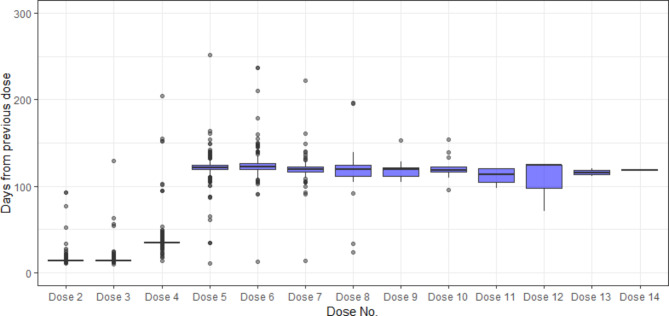
Results: A total of 385 participants receiving nusinersen with a total of 2,415 doses were included in the study. The median (interquartile range) number of doses administered per participant was 6 (5-7). Over 99% of intrathecal injections were given in an inpatient setting. Only a few (n = 3, 0.1%) required general anesthesia, while 9% (n = 217) of doses were administered under the use of sedation. Interlaminar lumbar puncture (n = 2,407, 99.7%) was the most common method of administration, followed by cervical puncture (n = 5, 0.2%) and transforaminal lumbar puncture (n = 3, 0.1%). Over 90% of injections did not utilize any imaging guidance prior to administration, with ultrasound (n = 142, 5.9%) being the most commonly used imaging guidance. The adherence rate was 95.7% (1,943/2,030) at dose level and 81.0% (312/385) at participant level. The median inter-dose intervals aligned well with the dosing schedule, with 14 days for Doses 2 and 3, 35 days for Dose 4, and 114-124 days for maintenance doses thereafter.
Conclusions: Findings from the analysis demonstrated high real-world adherence to nusinersen in Chinese children with SMA.
期刊介绍:
BMC Pediatrics is an open access journal publishing peer-reviewed research articles in all aspects of health care in neonates, children and adolescents, as well as related molecular genetics, pathophysiology, and epidemiology.



 京公网安备 11010802042870号
京ICP备2023020795号-1
京公网安备 11010802042870号
京ICP备2023020795号-1

 分享
分享
 求助内容:
求助内容: 应助结果提醒方式:
 扫码关注我们
