{"title":"Targeted immunotherapies for Graves' thyroidal & orbital diseases.","authors":"Alan Chun Hong Lee, George J Kahaly","doi":"10.3389/fimmu.2025.1571427","DOIUrl":null,"url":null,"abstract":"<p><strong>Background: </strong>Graves' hyperthyroidism and its associated Graves' orbitopathy are common autoimmune disorders associated with significant adverse health impact. Current standard treatments have limitations regarding efficacy and safety, and most do not specifically target the pathogenic mechanisms. We aim to review the latest development of targeted immunotherapies in these two closely related disorders.</p><p><strong>Summary: </strong>Targeted immunotherapies of Graves' hyperthyroidism have recently demonstrated clinical efficacy in early phase clinical studies. They include rituximab, an anti-CD20 monoclonal antibody which causes rapid B cell depletion; ATX-GD-59, an antigen specific immunotherapy which restores immune tolerance to thyrotropin receptor; iscalimab, an anti-CD40 monoclonal antibody which blocks the CD40-CD154 co-stimulatory pathway in B-T cell interaction; and K1-70, a thyrotropin receptor blocking monoclonal antibody. Furthermore, there have been major therapeutic advances in the management of Graves' orbitopathy. Mycophenolate has a dual mechanism of action both inhibiting the proliferation of activated B & T cells as well as the mammalian target of rapamycin growth intracellular pathway. Rituximab appears to be effective in active disease of recent onset without impending dysthyroid optic neuropathy. Both tocilizumab (anti-interleukin 6 receptor monoclonal antibody) and sirolimus (mammalian target of rapamycin inhibitor) showed promise in glucocorticoid resistant active disease. Teprotumumab, an anti-insulin-like growth factor-1 receptor monoclonal antibody, demonstrated remarkable all-round efficacy across a wide disease spectrum. Linsitinib, a dual small molecule inhibitor of insulin-like growth factor-1 receptor and insulin receptor, displayed significant proptosis reduction in its phase 2b/3 study. Finally, Batoclimab, an anti-neonatal fragment crystallizable receptor monoclonal antibody, which blocks recycling of pathogenic thyrotropin receptor antibody, showed promising signals for significant proptosis reduction, disease inactivation, overall response, and improvement of quality of life.</p><p><strong>Conclusion: </strong>Therapeutic advances will continue to optimize our management of Graves' hyperthyroidism and its associated orbitopathy in an effective and safe manner.</p>","PeriodicalId":12622,"journal":{"name":"Frontiers in Immunology","volume":"16 ","pages":"1571427"},"PeriodicalIF":5.9000,"publicationDate":"2025-03-12","publicationTypes":"Journal Article","fieldsOfStudy":null,"isOpenAccess":false,"openAccessPdf":"https://www.ncbi.nlm.nih.gov/pmc/articles/PMC11936961/pdf/","citationCount":"0","resultStr":null,"platform":"Semanticscholar","paperid":null,"PeriodicalName":"Frontiers in Immunology","FirstCategoryId":"3","ListUrlMain":"https://doi.org/10.3389/fimmu.2025.1571427","RegionNum":2,"RegionCategory":"医学","ArticlePicture":[],"TitleCN":null,"AbstractTextCN":null,"PMCID":null,"EPubDate":"2025/1/1 0:00:00","PubModel":"eCollection","JCR":"Q1","JCRName":"IMMUNOLOGY","Score":null,"Total":0}
引用次数: 0
Abstract
Background: Graves' hyperthyroidism and its associated Graves' orbitopathy are common autoimmune disorders associated with significant adverse health impact. Current standard treatments have limitations regarding efficacy and safety, and most do not specifically target the pathogenic mechanisms. We aim to review the latest development of targeted immunotherapies in these two closely related disorders.
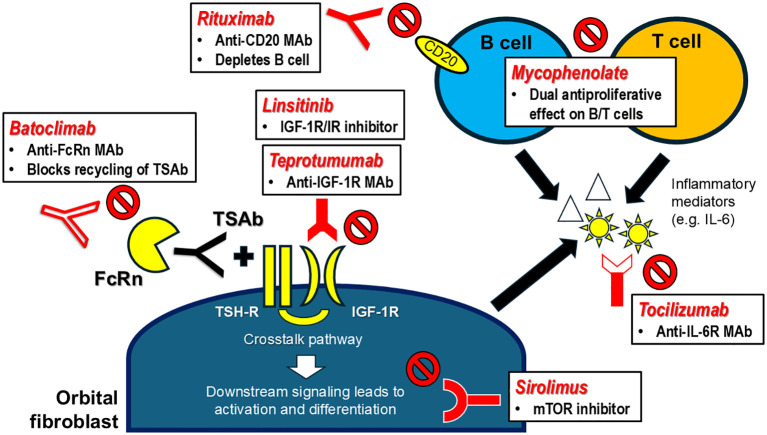
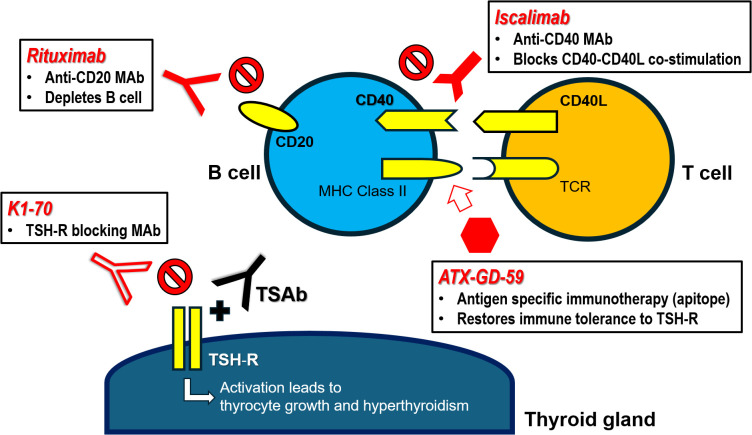
Summary: Targeted immunotherapies of Graves' hyperthyroidism have recently demonstrated clinical efficacy in early phase clinical studies. They include rituximab, an anti-CD20 monoclonal antibody which causes rapid B cell depletion; ATX-GD-59, an antigen specific immunotherapy which restores immune tolerance to thyrotropin receptor; iscalimab, an anti-CD40 monoclonal antibody which blocks the CD40-CD154 co-stimulatory pathway in B-T cell interaction; and K1-70, a thyrotropin receptor blocking monoclonal antibody. Furthermore, there have been major therapeutic advances in the management of Graves' orbitopathy. Mycophenolate has a dual mechanism of action both inhibiting the proliferation of activated B & T cells as well as the mammalian target of rapamycin growth intracellular pathway. Rituximab appears to be effective in active disease of recent onset without impending dysthyroid optic neuropathy. Both tocilizumab (anti-interleukin 6 receptor monoclonal antibody) and sirolimus (mammalian target of rapamycin inhibitor) showed promise in glucocorticoid resistant active disease. Teprotumumab, an anti-insulin-like growth factor-1 receptor monoclonal antibody, demonstrated remarkable all-round efficacy across a wide disease spectrum. Linsitinib, a dual small molecule inhibitor of insulin-like growth factor-1 receptor and insulin receptor, displayed significant proptosis reduction in its phase 2b/3 study. Finally, Batoclimab, an anti-neonatal fragment crystallizable receptor monoclonal antibody, which blocks recycling of pathogenic thyrotropin receptor antibody, showed promising signals for significant proptosis reduction, disease inactivation, overall response, and improvement of quality of life.
Conclusion: Therapeutic advances will continue to optimize our management of Graves' hyperthyroidism and its associated orbitopathy in an effective and safe manner.
期刊介绍:
Frontiers in Immunology is a leading journal in its field, publishing rigorously peer-reviewed research across basic, translational and clinical immunology. This multidisciplinary open-access journal is at the forefront of disseminating and communicating scientific knowledge and impactful discoveries to researchers, academics, clinicians and the public worldwide.
Frontiers in Immunology is the official Journal of the International Union of Immunological Societies (IUIS). Encompassing the entire field of Immunology, this journal welcomes papers that investigate basic mechanisms of immune system development and function, with a particular emphasis given to the description of the clinical and immunological phenotype of human immune disorders, and on the definition of their molecular basis.



 京公网安备 11010802042870号
京ICP备2023020795号-1
京公网安备 11010802042870号
京ICP备2023020795号-1

 分享
分享
 求助内容:
求助内容: 应助结果提醒方式:
 扫码关注我们
