{"title":"Tick HRF-dependent ferroptosis pathway to promote tick acquisition of <i>Babesia microti</i>.","authors":"Songqin Chen, Shanming Hu, Yongzhi Zhou, Jie Cao, Houshuang Zhang, Yanan Wang, Jinlin Zhou","doi":"10.3389/fcimb.2025.1560152","DOIUrl":null,"url":null,"abstract":"<p><p><i>B. microti</i> is a tick-transmitted zoonotic erythrocytic intracellular parasite. Ferroptosis is an iron-dependent form of programmed cell death that affects pathogen replication in the host. Currently, there is limited research concerning the effect of tick ferroptosis on <i>Babesia</i> infection and the underlying mechanism of action. The present study used a <i>B. microti</i> -mouse- <i>Haemaphysalis longicornis</i> infection model in which nymphs fed on the blood of <i>B. microti</i>-infected mice. The midgut divalent iron (<i>p<0.01</i>) and reactive oxygen species (ROS) (<i>p<0.05</i>) levels were significantly elevated in infected ticks, and transmission electron microscopy (TEM) showed that mitochondrial ridges were absent or decreased in size. Downregulation of ferritin 1 and glutathione peroxidase 4 (GPX4) in ticks infected with <i>B. microti</i> suggests that these changes promote ferroptosis. <i>In vivo</i> studies demonstrated that the ferroptosis promoter Erastin increased <i>B. microti</i> load (<i>p<0.05</i>), while the inhibitor Ferrostatin-1 effectively decreased load (<i>p<0.01</i>). Tick histamine-releasing factor (HRF), a protein related to the antioxidant system, was downregulated in infected nymphs compared with uninfected nymphs (<i>p<0.05</i>), and interference with HRF promoted tick acquisition of <i>B. microti</i> (<i>p<0.001</i>). Transcriptomic analyses showed that HRF interference promotes tick ferroptosis by downregulating ferritin 1 and GPX4. Meanwhile, interference with tick HRF molecules showed increased divalent iron and ROS and decreased mitochondrial ridges compared with controls. These findings highlight the critical role of tick HRF molecules in regulating ferroptosis and acquisition of <i>B. microti</i>, thereby providing important insights for a deeper understanding of the tick-<i>Babesia</i> interaction.</p>","PeriodicalId":12458,"journal":{"name":"Frontiers in Cellular and Infection Microbiology","volume":"15 ","pages":"1560152"},"PeriodicalIF":4.8000,"publicationDate":"2025-03-12","publicationTypes":"Journal Article","fieldsOfStudy":null,"isOpenAccess":false,"openAccessPdf":"https://www.ncbi.nlm.nih.gov/pmc/articles/PMC11936993/pdf/","citationCount":"0","resultStr":null,"platform":"Semanticscholar","paperid":null,"PeriodicalName":"Frontiers in Cellular and Infection Microbiology","FirstCategoryId":"3","ListUrlMain":"https://doi.org/10.3389/fcimb.2025.1560152","RegionNum":2,"RegionCategory":"医学","ArticlePicture":[],"TitleCN":null,"AbstractTextCN":null,"PMCID":null,"EPubDate":"2025/1/1 0:00:00","PubModel":"eCollection","JCR":"Q2","JCRName":"IMMUNOLOGY","Score":null,"Total":0}
引用次数: 0
Abstract
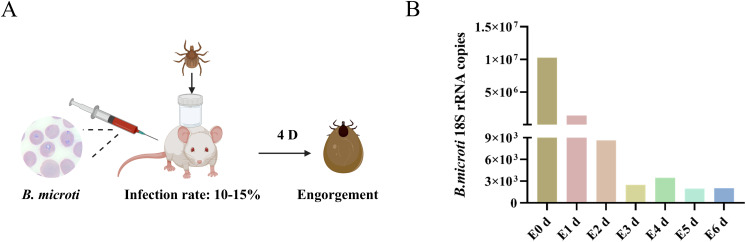
B. microti is a tick-transmitted zoonotic erythrocytic intracellular parasite. Ferroptosis is an iron-dependent form of programmed cell death that affects pathogen replication in the host. Currently, there is limited research concerning the effect of tick ferroptosis on Babesia infection and the underlying mechanism of action. The present study used a B. microti -mouse- Haemaphysalis longicornis infection model in which nymphs fed on the blood of B. microti-infected mice. The midgut divalent iron (p<0.01) and reactive oxygen species (ROS) (p<0.05) levels were significantly elevated in infected ticks, and transmission electron microscopy (TEM) showed that mitochondrial ridges were absent or decreased in size. Downregulation of ferritin 1 and glutathione peroxidase 4 (GPX4) in ticks infected with B. microti suggests that these changes promote ferroptosis. In vivo studies demonstrated that the ferroptosis promoter Erastin increased B. microti load (p<0.05), while the inhibitor Ferrostatin-1 effectively decreased load (p<0.01). Tick histamine-releasing factor (HRF), a protein related to the antioxidant system, was downregulated in infected nymphs compared with uninfected nymphs (p<0.05), and interference with HRF promoted tick acquisition of B. microti (p<0.001). Transcriptomic analyses showed that HRF interference promotes tick ferroptosis by downregulating ferritin 1 and GPX4. Meanwhile, interference with tick HRF molecules showed increased divalent iron and ROS and decreased mitochondrial ridges compared with controls. These findings highlight the critical role of tick HRF molecules in regulating ferroptosis and acquisition of B. microti, thereby providing important insights for a deeper understanding of the tick-Babesia interaction.
期刊介绍:
Frontiers in Cellular and Infection Microbiology is a leading specialty journal, publishing rigorously peer-reviewed research across all pathogenic microorganisms and their interaction with their hosts. Chief Editor Yousef Abu Kwaik, University of Louisville is supported by an outstanding Editorial Board of international experts. This multidisciplinary open-access journal is at the forefront of disseminating and communicating scientific knowledge and impactful discoveries to researchers, academics, clinicians and the public worldwide.
Frontiers in Cellular and Infection Microbiology includes research on bacteria, fungi, parasites, viruses, endosymbionts, prions and all microbial pathogens as well as the microbiota and its effect on health and disease in various hosts. The research approaches include molecular microbiology, cellular microbiology, gene regulation, proteomics, signal transduction, pathogenic evolution, genomics, structural biology, and virulence factors as well as model hosts. Areas of research to counteract infectious agents by the host include the host innate and adaptive immune responses as well as metabolic restrictions to various pathogenic microorganisms, vaccine design and development against various pathogenic microorganisms, and the mechanisms of antibiotic resistance and its countermeasures.






 京公网安备 11010802042870号
京ICP备2023020795号-1
京公网安备 11010802042870号
京ICP备2023020795号-1

 分享
分享
 求助内容:
求助内容: 应助结果提醒方式:
 扫码关注我们
