Associations of serum sLOX-1 levels with disease severity and 3-month function prognosis after spontaneous intracerebral hemorrhage: a prospective cohort study.
Xiufeng Ye, Heng He, Huan Song, Jing Huang, Zhixing Zhang, Yan Zhou
{"title":"Associations of serum sLOX-1 levels with disease severity and 3-month function prognosis after spontaneous intracerebral hemorrhage: a prospective cohort study.","authors":"Xiufeng Ye, Heng He, Huan Song, Jing Huang, Zhixing Zhang, Yan Zhou","doi":"10.3389/fneur.2025.1521774","DOIUrl":null,"url":null,"abstract":"<p><strong>Background: </strong>Soluble lectin-like oxidized low-density lipoprotein receptor-1 (sLOX-1) may be involved in the inflammatory response and aggravate secondary brain injury after spontaneous intracerebral hemorrhage (sICH). The aim of this study was to reveal the association of serum sLOX-1 levels with disease severity and the predictive power of 90-day neurological outcomes after sICH.</p><p><strong>Method: </strong>This prospective cohort study included 118 sICH patients and 118 healthy controls, whose serum sLOX-1 levels were quantified. Glasgow Coma Scale (GCS) scores and hematoma volumes were used to assess disease severity. Glasgow Outcome Scale (GOS) scores were used to assess 3-month function prognosis after stroke. The relation of serum sLOX-1 levels to disease severity and prognosis (GOS scores 1-3) was discerned Receiver operating characteristic curve was built to evaluate the prognostic predictive capability.</p><p><strong>Result: </strong>Serum sLOX-1 levels were significantly increased in patients compared to healthy controls, and were independently correlated with GCS scores (<i>ρ</i> = -0.577, <i>p</i> < 0.001; <i>t</i> = -6.732, <i>p</i> < 0.001) and hematoma volumes (<i>ρ</i> = 0.540, <i>p</i> < 0.001; <i>t</i> = 7.136, <i>p</i> < 0.001). Patients with poor prognosis have higher serum sLOX-1 levels than in those with good prognosis (<i>p</i> < 0.001). Serum sLOX-1 levels >1539.75 pg/mL distinguished the risk of poor prognosis at 3 months after stroke, with a sensitivity of 83.72% and a specificity of 72.00% (area under curve, 0.813; 95% confidence interval (CI), 0.731-0.879, <i>p</i> < 0.001). Serum sLOX-1 levels were independently associated with poor 3-month prognosis with odds ratio of 1.002 (95% CI, 1.000-1.004).</p><p><strong>Conclusion: </strong>Serum sLOX-1 levels are obviously increased after stroke and are significantly associated with disease severity and poor prognosis. Hence, sLOX-1 may serve as a useful potential prognostic biomarker for sICH.</p>","PeriodicalId":12575,"journal":{"name":"Frontiers in Neurology","volume":"16 ","pages":"1521774"},"PeriodicalIF":2.8000,"publicationDate":"2025-03-12","publicationTypes":"Journal Article","fieldsOfStudy":null,"isOpenAccess":false,"openAccessPdf":"https://www.ncbi.nlm.nih.gov/pmc/articles/PMC11936780/pdf/","citationCount":"0","resultStr":null,"platform":"Semanticscholar","paperid":null,"PeriodicalName":"Frontiers in Neurology","FirstCategoryId":"3","ListUrlMain":"https://doi.org/10.3389/fneur.2025.1521774","RegionNum":3,"RegionCategory":"医学","ArticlePicture":[],"TitleCN":null,"AbstractTextCN":null,"PMCID":null,"EPubDate":"2025/1/1 0:00:00","PubModel":"eCollection","JCR":"Q2","JCRName":"CLINICAL NEUROLOGY","Score":null,"Total":0}
引用次数: 0
Abstract
Background: Soluble lectin-like oxidized low-density lipoprotein receptor-1 (sLOX-1) may be involved in the inflammatory response and aggravate secondary brain injury after spontaneous intracerebral hemorrhage (sICH). The aim of this study was to reveal the association of serum sLOX-1 levels with disease severity and the predictive power of 90-day neurological outcomes after sICH.
Method: This prospective cohort study included 118 sICH patients and 118 healthy controls, whose serum sLOX-1 levels were quantified. Glasgow Coma Scale (GCS) scores and hematoma volumes were used to assess disease severity. Glasgow Outcome Scale (GOS) scores were used to assess 3-month function prognosis after stroke. The relation of serum sLOX-1 levels to disease severity and prognosis (GOS scores 1-3) was discerned Receiver operating characteristic curve was built to evaluate the prognostic predictive capability.
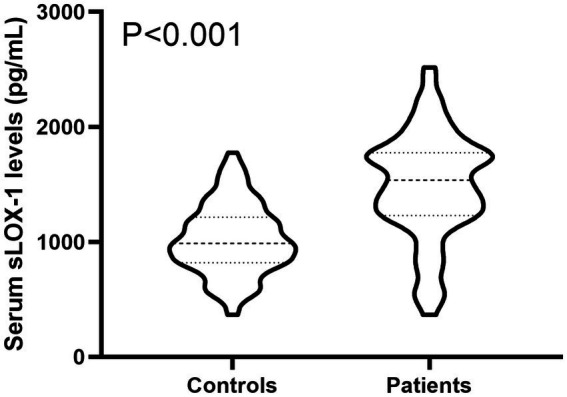
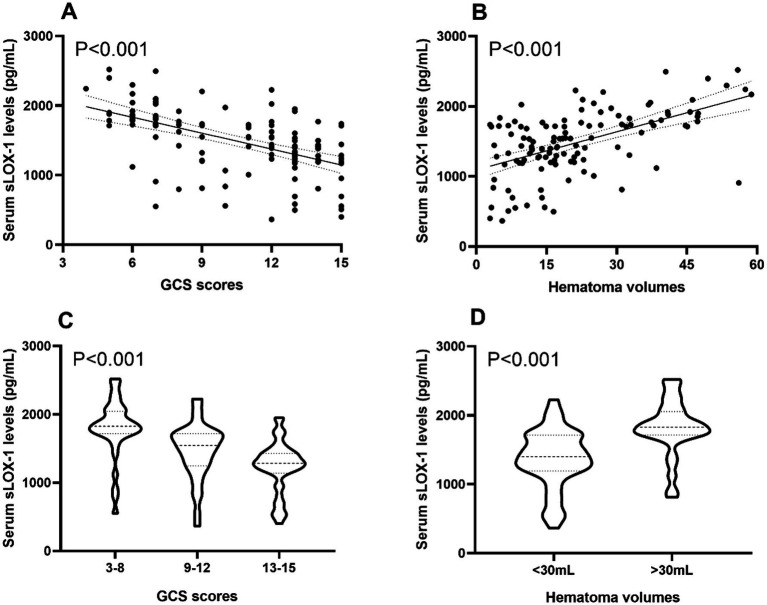
Result: Serum sLOX-1 levels were significantly increased in patients compared to healthy controls, and were independently correlated with GCS scores (ρ = -0.577, p < 0.001; t = -6.732, p < 0.001) and hematoma volumes (ρ = 0.540, p < 0.001; t = 7.136, p < 0.001). Patients with poor prognosis have higher serum sLOX-1 levels than in those with good prognosis (p < 0.001). Serum sLOX-1 levels >1539.75 pg/mL distinguished the risk of poor prognosis at 3 months after stroke, with a sensitivity of 83.72% and a specificity of 72.00% (area under curve, 0.813; 95% confidence interval (CI), 0.731-0.879, p < 0.001). Serum sLOX-1 levels were independently associated with poor 3-month prognosis with odds ratio of 1.002 (95% CI, 1.000-1.004).
Conclusion: Serum sLOX-1 levels are obviously increased after stroke and are significantly associated with disease severity and poor prognosis. Hence, sLOX-1 may serve as a useful potential prognostic biomarker for sICH.
期刊介绍:
The section Stroke aims to quickly and accurately publish important experimental, translational and clinical studies, and reviews that contribute to the knowledge of stroke, its causes, manifestations, diagnosis, and management.




 京公网安备 11010802042870号
京ICP备2023020795号-1
京公网安备 11010802042870号
京ICP备2023020795号-1

 分享
分享
 求助内容:
求助内容: 应助结果提醒方式:
 扫码关注我们
