{"title":"Timing of hydrocortisone therapy in neonates with shock: a systematic review, meta-analysis, and clinical practice guideline.","authors":"Viraraghavan Vadakkencherry Ramaswamy, Gunjana Kumar, Abdul Kareem Pullattayil S, Abhishek S Aradhya, Pradeep Suryawanshi, Mohit Sahni, Supreet Khurana, Shiv Sajan Saini, Ravishankar K, Shashi Kant Dhir, Deepak Chawla, Praveen Kumar, Kiran More","doi":"10.3389/fped.2025.1491976","DOIUrl":null,"url":null,"abstract":"<p><strong>Background: </strong>The effect of the timing of initiation of hydrocortisone in neonatal shock has not been evaluated. The objective of this systematic review was to compare the effect of earlier vs. later initiation of hydrocortisone in neonatal shock.</p><p><strong>Methods: </strong>Medline, Embase, and CENTRAL were searched from inception until 15 May 2024. Randomized controlled trials (RCTs) and non-RCTs were eligible for inclusion. A random effects meta-analysis was used to synthesize the data. The evidence certainty was evaluated according to Grading of Recommendations Assessment, Development, and Evaluation (GRADE). A clinical practice guideline was formulated as recommended by the GRADE group.</p><p><strong>Results: </strong>Of the 3,757 titles and abstracts screened, 20 studies were included: 7 RCTs and 13 non-RCTs. While clinical benefit or harm could not be ruled out for the outcome of mortality from the meta-analysis of the RCTs [early initiation risk ratio (RR): 0.46, 95% confidence interval (CI): 0.03-7.92; late initiation RR: 0.43, 95% CI: 0.12-1.47], the non-RCTs included in the narrative review suggested that late hydrocortisone initiation might be associated with increased risk of mortality. The meta-analysis indicated that early and late hydrocortisone administration may be associated with an increased response to treatment therapy (early initiation RR: 1.85, 95% CI: 1.26-2.71; late initiation RR: 2.50, 95% CI: 1.16-5.39). Late hydrocortisone initiation may increase the risk of necrotizing enterocolitis (NEC) ≥ stage 2 (RR: 2.46, 95% CI: 1.19-5.08). The evidence certainty was very low for most of the outcomes evaluated.</p><p><strong>Conclusion: </strong>The early use of hydrocortisone in neonates with shock requiring vasopressors is associated with better outcomes and no major adverse effects. Later institution of hydrocortisone therapy in neonatal shock may improve the response to therapy but may be associated with adverse outcomes including mortality and NEC. The results are to be interpreted with caution as the evidence certainty was predominantly very low.</p><p><strong>Systematic review registration: </strong>https://www.crd.york.ac.uk/PROSPERO/view/CRD42023432169, identifier: CRD42023432169.</p>","PeriodicalId":12637,"journal":{"name":"Frontiers in Pediatrics","volume":"13 ","pages":"1491976"},"PeriodicalIF":2.0000,"publicationDate":"2025-03-12","publicationTypes":"Journal Article","fieldsOfStudy":null,"isOpenAccess":false,"openAccessPdf":"https://www.ncbi.nlm.nih.gov/pmc/articles/PMC11937126/pdf/","citationCount":"0","resultStr":null,"platform":"Semanticscholar","paperid":null,"PeriodicalName":"Frontiers in Pediatrics","FirstCategoryId":"3","ListUrlMain":"https://doi.org/10.3389/fped.2025.1491976","RegionNum":3,"RegionCategory":"医学","ArticlePicture":[],"TitleCN":null,"AbstractTextCN":null,"PMCID":null,"EPubDate":"2025/1/1 0:00:00","PubModel":"eCollection","JCR":"Q2","JCRName":"PEDIATRICS","Score":null,"Total":0}
引用次数: 0
Abstract
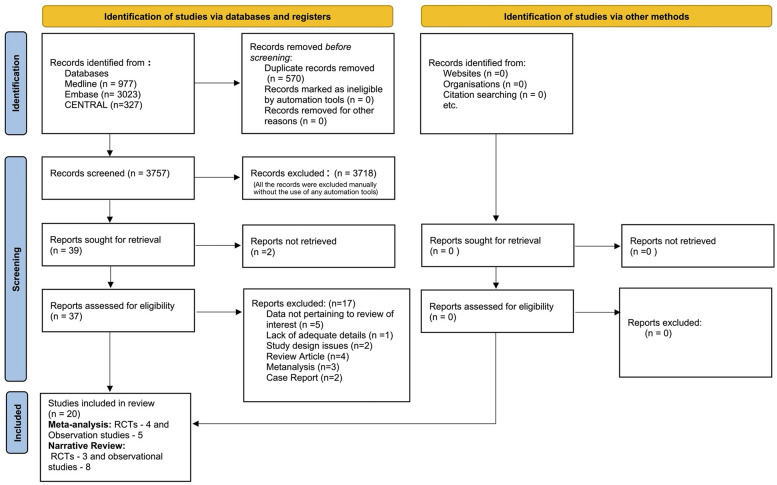
Background: The effect of the timing of initiation of hydrocortisone in neonatal shock has not been evaluated. The objective of this systematic review was to compare the effect of earlier vs. later initiation of hydrocortisone in neonatal shock.
Methods: Medline, Embase, and CENTRAL were searched from inception until 15 May 2024. Randomized controlled trials (RCTs) and non-RCTs were eligible for inclusion. A random effects meta-analysis was used to synthesize the data. The evidence certainty was evaluated according to Grading of Recommendations Assessment, Development, and Evaluation (GRADE). A clinical practice guideline was formulated as recommended by the GRADE group.
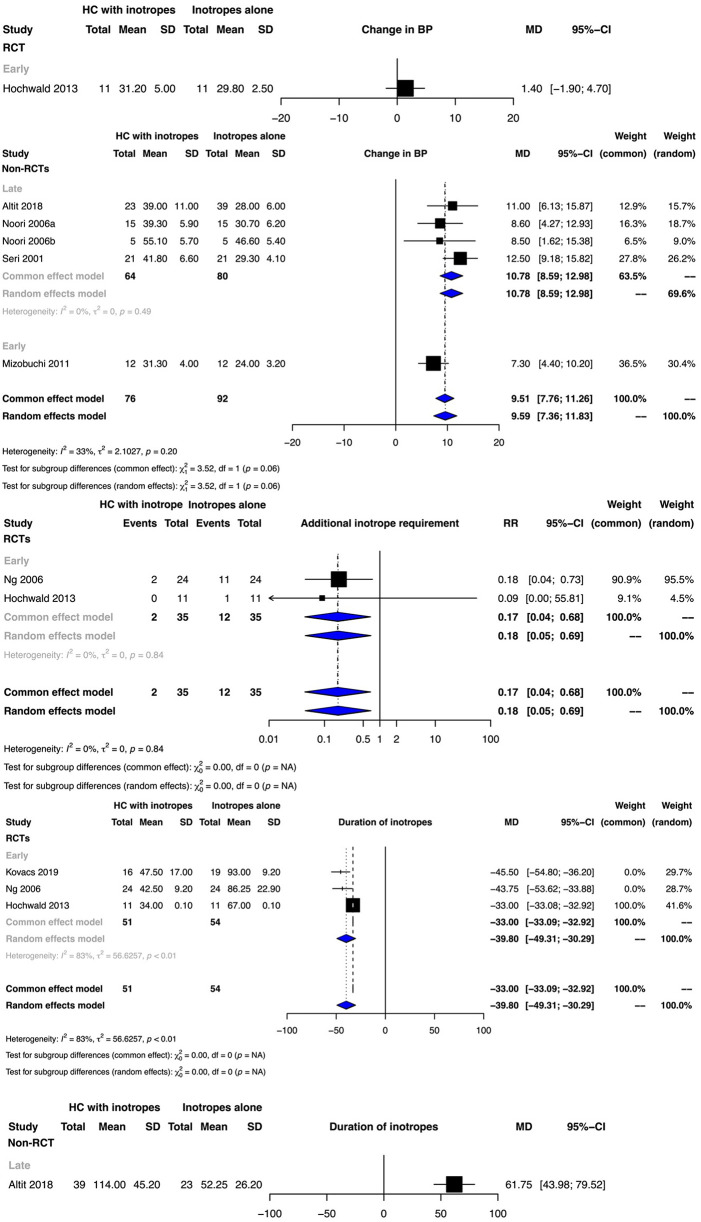
Results: Of the 3,757 titles and abstracts screened, 20 studies were included: 7 RCTs and 13 non-RCTs. While clinical benefit or harm could not be ruled out for the outcome of mortality from the meta-analysis of the RCTs [early initiation risk ratio (RR): 0.46, 95% confidence interval (CI): 0.03-7.92; late initiation RR: 0.43, 95% CI: 0.12-1.47], the non-RCTs included in the narrative review suggested that late hydrocortisone initiation might be associated with increased risk of mortality. The meta-analysis indicated that early and late hydrocortisone administration may be associated with an increased response to treatment therapy (early initiation RR: 1.85, 95% CI: 1.26-2.71; late initiation RR: 2.50, 95% CI: 1.16-5.39). Late hydrocortisone initiation may increase the risk of necrotizing enterocolitis (NEC) ≥ stage 2 (RR: 2.46, 95% CI: 1.19-5.08). The evidence certainty was very low for most of the outcomes evaluated.
Conclusion: The early use of hydrocortisone in neonates with shock requiring vasopressors is associated with better outcomes and no major adverse effects. Later institution of hydrocortisone therapy in neonatal shock may improve the response to therapy but may be associated with adverse outcomes including mortality and NEC. The results are to be interpreted with caution as the evidence certainty was predominantly very low.
期刊介绍:
Frontiers in Pediatrics (Impact Factor 2.33) publishes rigorously peer-reviewed research broadly across the field, from basic to clinical research that meets ongoing challenges in pediatric patient care and child health. Field Chief Editors Arjan Te Pas at Leiden University and Michael L. Moritz at the Children''s Hospital of Pittsburgh are supported by an outstanding Editorial Board of international experts. This multidisciplinary open-access journal is at the forefront of disseminating and communicating scientific knowledge and impactful discoveries to researchers, academics, clinicians and the public worldwide.
Frontiers in Pediatrics also features Research Topics, Frontiers special theme-focused issues managed by Guest Associate Editors, addressing important areas in pediatrics. In this fashion, Frontiers serves as an outlet to publish the broadest aspects of pediatrics in both basic and clinical research, including high-quality reviews, case reports, editorials and commentaries related to all aspects of pediatrics.




 京公网安备 11010802042870号
京ICP备2023020795号-1
京公网安备 11010802042870号
京ICP备2023020795号-1

 分享
分享
 求助内容:
求助内容: 应助结果提醒方式:
 扫码关注我们
