Iris E Cuperus, Parinaz Rostamzad, Simone E Bernard, Sarah L Versnel, Laura L Veder, Irene M J Mathijssen
{"title":"Clinical Nasal Deviation Following Midface Advancement in Patients With Syndromic Craniosynostosis.","authors":"Iris E Cuperus, Parinaz Rostamzad, Simone E Bernard, Sarah L Versnel, Laura L Veder, Irene M J Mathijssen","doi":"10.1097/SCS.0000000000011186","DOIUrl":null,"url":null,"abstract":"<p><strong>Introduction: </strong>Nasal deviations have been observed in patients following midface surgery. Therefore, the purpose of this study was to evaluate the development of clinically visible nasal deviations following midface surgery and to assess the natural course of the nose over time.</p><p><strong>Methods: </strong>This retrospective study included all Apert and Crouzon patients who underwent midface surgery (Le Fort III (LF3), monobloc (MB), or facial bipartition (FB)). Clinical nasal deviation was assessed on preoperative, short-term postoperative (≤ 1 year), and long-term postoperative (> 1 year) 2D facial photographs by consensus of pediatric ENT surgeons and one craniofacial surgeon. Additionally, pre- and postoperative CT scans were reviewed when available.</p><p><strong>Results: </strong>Sixty-eight procedures were included (27 Apert, 41 Crouzon); 34 LF3, 31 MB, and 3 FB. The median age at surgery was 10.2 years. Twenty-five (37%) patients were found to have clinically worsening nasal asymmetry, of whom 4 (16%) had pre-existing deviation preoperatively. Seventeen patients with worsening deviation had long-term postoperative facial photographs available (median time 5.8 years), and in 9 (53%), the postoperative clinical nasal deviation appeared to improve spontaneously. We were unable to identify predictive factors for postoperative nasal deviation.</p><p><strong>Conclusion: </strong>In 16% of the patients, a clinically deviated nose was observed preoperatively. Nasal deviation worsened in 37% of the patients after midface surgery, but also spontaneously improved in 53% of these patients over the long-term. Since predicting the occurrence of nasal deviation and self-correction is difficult, the possibility of developing nasal deviation should be discussed with the patient and their parents.</p>","PeriodicalId":15462,"journal":{"name":"Journal of Craniofacial Surgery","volume":" ","pages":"1552-1555"},"PeriodicalIF":1.0000,"publicationDate":"2025-07-01","publicationTypes":"Journal Article","fieldsOfStudy":null,"isOpenAccess":false,"openAccessPdf":"https://www.ncbi.nlm.nih.gov/pmc/articles/PMC12187153/pdf/","citationCount":"0","resultStr":null,"platform":"Semanticscholar","paperid":null,"PeriodicalName":"Journal of Craniofacial Surgery","FirstCategoryId":"3","ListUrlMain":"https://doi.org/10.1097/SCS.0000000000011186","RegionNum":4,"RegionCategory":"医学","ArticlePicture":[],"TitleCN":null,"AbstractTextCN":null,"PMCID":null,"EPubDate":"2025/3/27 0:00:00","PubModel":"Epub","JCR":"Q3","JCRName":"SURGERY","Score":null,"Total":0}
引用次数: 0
Abstract
Introduction: Nasal deviations have been observed in patients following midface surgery. Therefore, the purpose of this study was to evaluate the development of clinically visible nasal deviations following midface surgery and to assess the natural course of the nose over time.
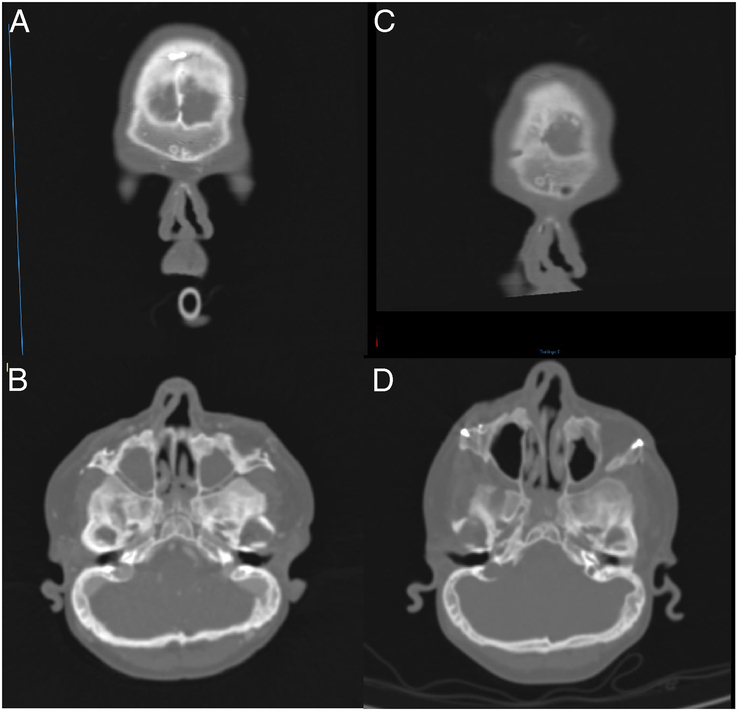
Methods: This retrospective study included all Apert and Crouzon patients who underwent midface surgery (Le Fort III (LF3), monobloc (MB), or facial bipartition (FB)). Clinical nasal deviation was assessed on preoperative, short-term postoperative (≤ 1 year), and long-term postoperative (> 1 year) 2D facial photographs by consensus of pediatric ENT surgeons and one craniofacial surgeon. Additionally, pre- and postoperative CT scans were reviewed when available.
Results: Sixty-eight procedures were included (27 Apert, 41 Crouzon); 34 LF3, 31 MB, and 3 FB. The median age at surgery was 10.2 years. Twenty-five (37%) patients were found to have clinically worsening nasal asymmetry, of whom 4 (16%) had pre-existing deviation preoperatively. Seventeen patients with worsening deviation had long-term postoperative facial photographs available (median time 5.8 years), and in 9 (53%), the postoperative clinical nasal deviation appeared to improve spontaneously. We were unable to identify predictive factors for postoperative nasal deviation.
Conclusion: In 16% of the patients, a clinically deviated nose was observed preoperatively. Nasal deviation worsened in 37% of the patients after midface surgery, but also spontaneously improved in 53% of these patients over the long-term. Since predicting the occurrence of nasal deviation and self-correction is difficult, the possibility of developing nasal deviation should be discussed with the patient and their parents.
导读:在中脸手术患者中观察到鼻偏曲。因此,本研究的目的是评估中脸手术后临床上可见的鼻偏曲的发展,并评估鼻子随时间的自然过程。方法:本回顾性研究纳入了所有接受中脸手术(Le Fort III (LF3),单块(MB)或面部双分割(FB))的Apert和Crouzon患者。通过儿科耳鼻喉外科医生和一名颅面外科医生的共识,对术前、术后短期(≤1年)和术后长期(> 1年)2D面部照片进行临床鼻偏度评估。此外,术前和术后的CT扫描也进行了回顾。结果:共纳入68例手术(Apert 27例,Crouzon 41例);34lf3, 31mb, 3fb。手术的中位年龄为10.2岁。25例(37%)患者发现临床上鼻不对称加重,其中4例(16%)患者术前已有偏曲。17例鼻偏加重患者术后有长期面部照片(中位时间为5.8年),其中9例(53%)术后临床鼻偏出现自发改善。我们无法确定术后鼻偏曲的预测因素。结论:术前16%的患者出现临床鼻偏。37%的患者在中脸手术后鼻偏曲恶化,但53%的患者在长期内也自发改善。由于预测鼻部偏曲的发生和自我矫正是困难的,因此发生鼻部偏曲的可能性应与患者及其父母讨论。
期刊介绍:
The Journal of Craniofacial Surgery serves as a forum of communication for all those involved in craniofacial surgery, maxillofacial surgery and pediatric plastic surgery. Coverage ranges from practical aspects of craniofacial surgery to the basic science that underlies surgical practice. The journal publishes original articles, scientific reviews, editorials and invited commentary, abstracts and selected articles from international journals, and occasional international bibliographies in craniofacial surgery.





 京公网安备 11010802042870号
京ICP备2023020795号-1
京公网安备 11010802042870号
京ICP备2023020795号-1

 分享
分享
 求助内容:
求助内容: 应助结果提醒方式:
 扫码关注我们
