Cup positioning relative to the acetabular rim planned with three-dimensional computed tomography improves precision in total hip arthroplasty: a randomized controlled trial.
Anuwat Pongkunakorn, Napon Wongkamthong, Rukthanin Ruktrakul
{"title":"Cup positioning relative to the acetabular rim planned with three-dimensional computed tomography improves precision in total hip arthroplasty: a randomized controlled trial.","authors":"Anuwat Pongkunakorn, Napon Wongkamthong, Rukthanin Ruktrakul","doi":"10.1186/s13018-025-05704-4","DOIUrl":null,"url":null,"abstract":"<p><strong>Background: </strong>Accurate acetabular cup positioning is essential for successful total hip arthroplasty (THA) outcomes. The conventional mechanical alignment guide (MAG) method provides moderate accuracy. We developed a novel technique for cup positioning that utilizes preoperative three-dimensional computed tomography (3D-CT) planning based on the native acetabular rim's relative position and compared cup orientation between this method and the MAG technique.</p><p><strong>Methods: </strong>A randomized controlled trial with 120 patients undergoing primary THA via the posterolateral approach targeted cup positions of 40° radiographic inclination (RI) and 20° radiographic anteversion (RA). The control group (n = 40) used a MAG for cup placement, while the study group (n = 80) utilized preoperative 3D-CT to measure native RI, calculate RA, and determine the cup overhang distance (COD). The cup inclination was positioned relative to the superior rim point and the transverse acetabular notch. The cup anteversion was adjusted to achieve overhang at the posterior or anterior rim point according to the planned COD. Postoperative RI and RA were assessed using tilt-adjusted plain radiographs and CT scans. The percentages of cups positioned within 5° of the target position (RI/RA of 40°/20° ± 5°), and within the Grammatopoulos aiming zone (RI/RA of 40°/20° ± 10°) were compared between the two groups.</p><p><strong>Results: </strong>The mean RI was 41.7° ± 5.4° (range, 33°-59°) in the control group and 39.9° ± 3.2° (range, 33.8°-45.5°) in the study group (p = 0.019). The mean RA was 19.5° ± 7.6° (range, 3°-33°) in the control group and 20.2° ± 3.3° (range, 12.9°-28.3°) in the study group (p = 0.356). Cup alignment within 5° of the target was achieved in 86.2% (69 hips) of the study group and 32.5% (13 hips) of the control group (p < 0.001). The study group had a significantly higher percentage of cups within Grammatopoulos aiming zone (100% vs. 77.5%, p < 0.001).</p><p><strong>Conclusions: </strong>3D-CT-guided cup positioning relative to the acetabular rim can enhance the precision of cup placement in THA to achieve alignment within 5° of the target position.</p><p><strong>Trial registration: </strong>Thai Clinical Trials Registry (TCTR 20201220001). Registered on 20 December 2020. Prospectively registered.</p>","PeriodicalId":16629,"journal":{"name":"Journal of Orthopaedic Surgery and Research","volume":"20 1","pages":"318"},"PeriodicalIF":2.8000,"publicationDate":"2025-03-27","publicationTypes":"Journal Article","fieldsOfStudy":null,"isOpenAccess":false,"openAccessPdf":"https://www.ncbi.nlm.nih.gov/pmc/articles/PMC11948801/pdf/","citationCount":"0","resultStr":null,"platform":"Semanticscholar","paperid":null,"PeriodicalName":"Journal of Orthopaedic Surgery and Research","FirstCategoryId":"3","ListUrlMain":"https://doi.org/10.1186/s13018-025-05704-4","RegionNum":3,"RegionCategory":"医学","ArticlePicture":[],"TitleCN":null,"AbstractTextCN":null,"PMCID":null,"EPubDate":"","PubModel":"","JCR":"Q1","JCRName":"ORTHOPEDICS","Score":null,"Total":0}
引用次数: 0
Abstract
Background: Accurate acetabular cup positioning is essential for successful total hip arthroplasty (THA) outcomes. The conventional mechanical alignment guide (MAG) method provides moderate accuracy. We developed a novel technique for cup positioning that utilizes preoperative three-dimensional computed tomography (3D-CT) planning based on the native acetabular rim's relative position and compared cup orientation between this method and the MAG technique.
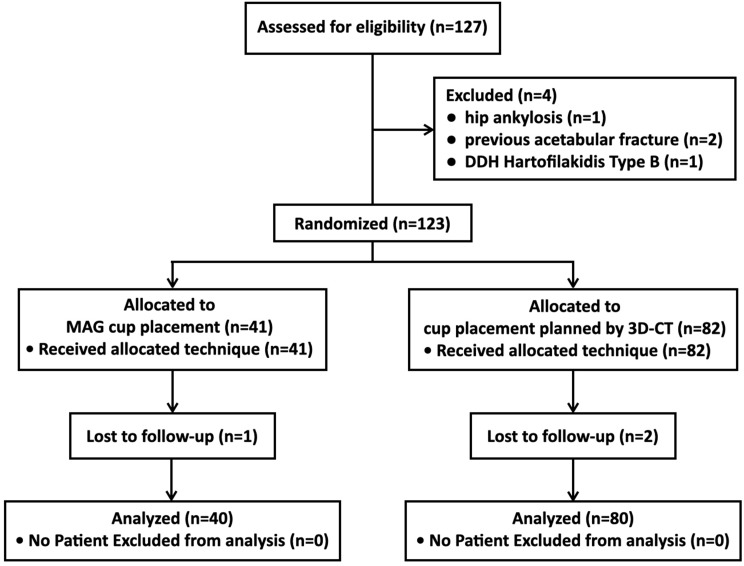
Methods: A randomized controlled trial with 120 patients undergoing primary THA via the posterolateral approach targeted cup positions of 40° radiographic inclination (RI) and 20° radiographic anteversion (RA). The control group (n = 40) used a MAG for cup placement, while the study group (n = 80) utilized preoperative 3D-CT to measure native RI, calculate RA, and determine the cup overhang distance (COD). The cup inclination was positioned relative to the superior rim point and the transverse acetabular notch. The cup anteversion was adjusted to achieve overhang at the posterior or anterior rim point according to the planned COD. Postoperative RI and RA were assessed using tilt-adjusted plain radiographs and CT scans. The percentages of cups positioned within 5° of the target position (RI/RA of 40°/20° ± 5°), and within the Grammatopoulos aiming zone (RI/RA of 40°/20° ± 10°) were compared between the two groups.
Results: The mean RI was 41.7° ± 5.4° (range, 33°-59°) in the control group and 39.9° ± 3.2° (range, 33.8°-45.5°) in the study group (p = 0.019). The mean RA was 19.5° ± 7.6° (range, 3°-33°) in the control group and 20.2° ± 3.3° (range, 12.9°-28.3°) in the study group (p = 0.356). Cup alignment within 5° of the target was achieved in 86.2% (69 hips) of the study group and 32.5% (13 hips) of the control group (p < 0.001). The study group had a significantly higher percentage of cups within Grammatopoulos aiming zone (100% vs. 77.5%, p < 0.001).
Conclusions: 3D-CT-guided cup positioning relative to the acetabular rim can enhance the precision of cup placement in THA to achieve alignment within 5° of the target position.
Trial registration: Thai Clinical Trials Registry (TCTR 20201220001). Registered on 20 December 2020. Prospectively registered.
期刊介绍:
Journal of Orthopaedic Surgery and Research is an open access journal that encompasses all aspects of clinical and basic research studies related to musculoskeletal issues.
Orthopaedic research is conducted at clinical and basic science levels. With the advancement of new technologies and the increasing expectation and demand from doctors and patients, we are witnessing an enormous growth in clinical orthopaedic research, particularly in the fields of traumatology, spinal surgery, joint replacement, sports medicine, musculoskeletal tumour management, hand microsurgery, foot and ankle surgery, paediatric orthopaedic, and orthopaedic rehabilitation. The involvement of basic science ranges from molecular, cellular, structural and functional perspectives to tissue engineering, gait analysis, automation and robotic surgery. Implant and biomaterial designs are new disciplines that complement clinical applications.
JOSR encourages the publication of multidisciplinary research with collaboration amongst clinicians and scientists from different disciplines, which will be the trend in the coming decades.





 京公网安备 11010802042870号
京ICP备2023020795号-1
京公网安备 11010802042870号
京ICP备2023020795号-1

 分享
分享
 求助内容:
求助内容: 应助结果提醒方式:
 扫码关注我们
