{"title":"Integrating Cover Crops and Manure to Boost Goji Berry Yield: Responses of Soil Physicochemical Properties and Microbial Communities.","authors":"Haonan Chen, Fang Wang, Yamiao Gao, Yaran Ma, Lizhen Zhu, Xiongxiong Nan","doi":"10.3390/microorganisms13030696","DOIUrl":null,"url":null,"abstract":"<p><p>A sustainable Goji berry (<i>Lycium barbarum</i> L.) planting system that integrates forage radish cover crops (<i>Raphanus sativus</i> L.) and animal manure has been established in northwestern China. This study investigated the effects of different cropping systems and manure application levels on soil physicochemical properties, microbial community structure, and <i>L. barbarum</i> yield under field conditions. A split-plot design was used, with the main-plot treatments consisting of two cropping systems and the sub-plot treatments involving three manure application levels. The results showed that compared to <i>L. barbarum</i> monocropping, cover cropping with <i>R. sativus</i> led to a decrease in soil bulk density (1.90%) and increase in soil electrical conductivity (11.5%), nutrient contents (total N and available N, P, and K: 30.3-138%), and microbial biomass (C: 79.0%; N: 184%). Cover cropping additionally enhanced the community diversity and richness of soil bacteria. Beta-diversity analysis revealed significant differences in bacterial rather than fungal community composition among various treatments. The bacterial network showed a lower ratio of positive to negative correlations and reduced complexity in response to cover cropping, which contrasted with fungal network patterns. Integration of cover cropping and medium manure application increased fruit yield by 8.71%. Cover crops and manure influenced soil microbial diversity mainly through their positive effects on soil total and available N contents.</p>","PeriodicalId":18667,"journal":{"name":"Microorganisms","volume":"13 3","pages":""},"PeriodicalIF":4.2000,"publicationDate":"2025-03-20","publicationTypes":"Journal Article","fieldsOfStudy":null,"isOpenAccess":false,"openAccessPdf":"https://www.ncbi.nlm.nih.gov/pmc/articles/PMC11944604/pdf/","citationCount":"0","resultStr":null,"platform":"Semanticscholar","paperid":null,"PeriodicalName":"Microorganisms","FirstCategoryId":"99","ListUrlMain":"https://doi.org/10.3390/microorganisms13030696","RegionNum":2,"RegionCategory":"生物学","ArticlePicture":[],"TitleCN":null,"AbstractTextCN":null,"PMCID":null,"EPubDate":"","PubModel":"","JCR":"Q2","JCRName":"MICROBIOLOGY","Score":null,"Total":0}
引用次数: 0
Abstract
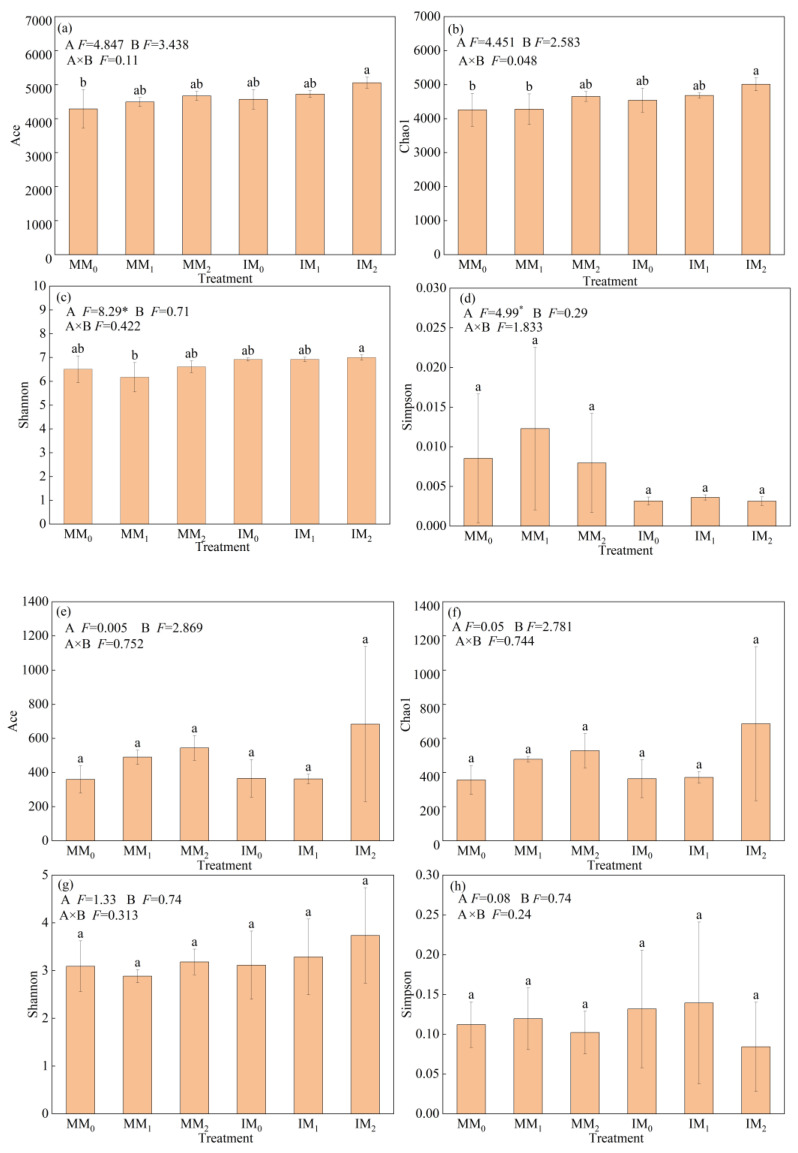
A sustainable Goji berry (Lycium barbarum L.) planting system that integrates forage radish cover crops (Raphanus sativus L.) and animal manure has been established in northwestern China. This study investigated the effects of different cropping systems and manure application levels on soil physicochemical properties, microbial community structure, and L. barbarum yield under field conditions. A split-plot design was used, with the main-plot treatments consisting of two cropping systems and the sub-plot treatments involving three manure application levels. The results showed that compared to L. barbarum monocropping, cover cropping with R. sativus led to a decrease in soil bulk density (1.90%) and increase in soil electrical conductivity (11.5%), nutrient contents (total N and available N, P, and K: 30.3-138%), and microbial biomass (C: 79.0%; N: 184%). Cover cropping additionally enhanced the community diversity and richness of soil bacteria. Beta-diversity analysis revealed significant differences in bacterial rather than fungal community composition among various treatments. The bacterial network showed a lower ratio of positive to negative correlations and reduced complexity in response to cover cropping, which contrasted with fungal network patterns. Integration of cover cropping and medium manure application increased fruit yield by 8.71%. Cover crops and manure influenced soil microbial diversity mainly through their positive effects on soil total and available N contents.
期刊介绍:
Microorganisms (ISSN 2076-2607) is an international, peer-reviewed open access journal which provides an advanced forum for studies related to prokaryotic and eukaryotic microorganisms, viruses and prions. It publishes reviews, research papers and communications. Our aim is to encourage scientists to publish their experimental and theoretical results in as much detail as possible. There is no restriction on the length of the papers. The full experimental details must be provided so that the results can be reproduced. Electronic files and software regarding the full details of the calculation or experimental procedure, if unable to be published in a normal way, can be deposited as supplementary electronic material.





 京公网安备 11010802042870号
京ICP备2023020795号-1
京公网安备 11010802042870号
京ICP备2023020795号-1

 分享
分享
 求助内容:
求助内容: 应助结果提醒方式:
 扫码关注我们
