Wenwen Zhu, Ailin Gong, Bin Zhang, Hanxing Cheng, Lishan Huang, Xiao Wu, Dechou Zhang, Wenbin Dai, Sen Li, Houping Xu
{"title":"The Chronobiological and Neuroprotective Mechanisms of Resveratrol in Improving Sleep.","authors":"Wenwen Zhu, Ailin Gong, Bin Zhang, Hanxing Cheng, Lishan Huang, Xiao Wu, Dechou Zhang, Wenbin Dai, Sen Li, Houping Xu","doi":"10.1155/mi/4954030","DOIUrl":null,"url":null,"abstract":"<p><p>According to statistics, more than one-third of the global population currently experiences sleep problems, and about 10% of adults have been diagnosed with insomnia, a proportion that is increasing annually. Most currently used insomnia medications are not specifically developed but are discovered by chance, often resulting in unavoidable side effects like addiction. Thus, there is an urgent need to find safer and more effective therapeutic options. Resveratrol, a natural polyphenolic compound, shows significant potential in improving insomnia. Research shows that its effects may be achieved through multiple biological processes, including antiapoptosis, antioxidant activity, anti-inflammation, circadian rhythm regulation, modulation of neurotransmitters (gamma-aminobutyric acid (GABA), DA, 5-HT, cortisol), and increased levels of neurotrophic factor BDNF. Additionally, resveratrol's treatment of insomnia is closely linked to the SIRT1, AMPK, NF-<i>κ</i>B, mTOR, PI3K/Akt, and MAPK pathways. This review summarizes the mechanisms of resveratrol in treating insomnia to provide researchers with a deeper understanding of its action, which can aid in the development of novel targeted drugs and offer innovative ideas and methods for clinical insomnia treatment.</p>","PeriodicalId":18371,"journal":{"name":"Mediators of Inflammation","volume":"2025 ","pages":"4954030"},"PeriodicalIF":4.2000,"publicationDate":"2025-03-19","publicationTypes":"Journal Article","fieldsOfStudy":null,"isOpenAccess":false,"openAccessPdf":"https://www.ncbi.nlm.nih.gov/pmc/articles/PMC11944795/pdf/","citationCount":"0","resultStr":null,"platform":"Semanticscholar","paperid":null,"PeriodicalName":"Mediators of Inflammation","FirstCategoryId":"3","ListUrlMain":"https://doi.org/10.1155/mi/4954030","RegionNum":3,"RegionCategory":"医学","ArticlePicture":[],"TitleCN":null,"AbstractTextCN":null,"PMCID":null,"EPubDate":"2025/1/1 0:00:00","PubModel":"eCollection","JCR":"Q2","JCRName":"CELL BIOLOGY","Score":null,"Total":0}
引用次数: 0
Abstract
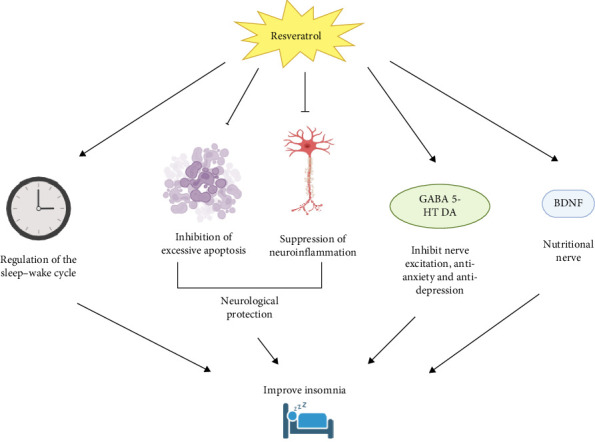
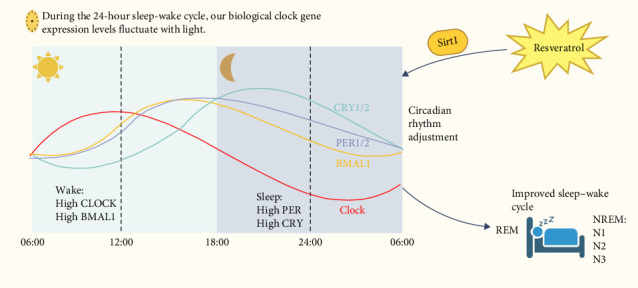
According to statistics, more than one-third of the global population currently experiences sleep problems, and about 10% of adults have been diagnosed with insomnia, a proportion that is increasing annually. Most currently used insomnia medications are not specifically developed but are discovered by chance, often resulting in unavoidable side effects like addiction. Thus, there is an urgent need to find safer and more effective therapeutic options. Resveratrol, a natural polyphenolic compound, shows significant potential in improving insomnia. Research shows that its effects may be achieved through multiple biological processes, including antiapoptosis, antioxidant activity, anti-inflammation, circadian rhythm regulation, modulation of neurotransmitters (gamma-aminobutyric acid (GABA), DA, 5-HT, cortisol), and increased levels of neurotrophic factor BDNF. Additionally, resveratrol's treatment of insomnia is closely linked to the SIRT1, AMPK, NF-κB, mTOR, PI3K/Akt, and MAPK pathways. This review summarizes the mechanisms of resveratrol in treating insomnia to provide researchers with a deeper understanding of its action, which can aid in the development of novel targeted drugs and offer innovative ideas and methods for clinical insomnia treatment.
期刊介绍:
Mediators of Inflammation is a peer-reviewed, Open Access journal that publishes original research and review articles on all types of inflammatory mediators, including cytokines, histamine, bradykinin, prostaglandins, leukotrienes, PAF, biological response modifiers and the family of cell adhesion-promoting molecules.




 京公网安备 11010802042870号
京ICP备2023020795号-1
京公网安备 11010802042870号
京ICP备2023020795号-1

 分享
分享
 求助内容:
求助内容: 应助结果提醒方式:
 扫码关注我们
