Optimizing brain tumor detection in MRI scans through InceptionResNetV2 and deep stacked Autoencoders with SwiGLU activation and sparsity regularization.
{"title":"Optimizing brain tumor detection in MRI scans through InceptionResNetV2 and deep stacked Autoencoders with SwiGLU activation and sparsity regularization.","authors":"Vishal Awasthi, Mamta Tiwari, Amit Yadav, Gesu Thakur, Mamata Mayee Panda, Hemant Kumar, Shivneet Tripathi","doi":"10.1016/j.mex.2025.103255","DOIUrl":null,"url":null,"abstract":"<p><p>This study presents an automated framework for brain tumor classification aimed at accurately distinguishing tumor types in MRI images. The proposed model integrates InceptionResNetV2 for feature extraction with Deep Stacked Autoencoders (DSAEs) for classification, enhanced by sparsity regularization and the SwiGLU activation function. InceptionResNetV2, pre-trained on ImageNet, was fine-tuned to extract multi-scale features, while the DSAE structure compressed these features to highlight critical attributes essential for classification. The approach achieved high performance, reaching an overall accuracy of 99.53 %, precision of 98.27 %, recall of 99.21 %, specificity of 98.73 %, and an F1-score of 98.74 %. These results demonstrate the model's efficacy in accurately categorizing glioma, meningioma, pituitary tumors, and non-tumor cases, with minimal misclassifications. Despite its success, limitations include the model's dependency on pre-trained weights and significant computational resources. Future studies should address these limitations by enhancing interpretability, exploring domain-specific transfer learning, and validating on diverse datasets to strengthen the model's utility in real-world settings. Overall, the InceptionResNetV2 integrated with DSAEs, sparsity regularization, and SwiGLU offers a promising solution for reliable and efficient brain tumor diagnosis in clinical environments.•Leveraging a pre-trained InceptionResNetV2 model to capture multi-scale features from MRI data.•Utilizing Deep Stacked Autoencoders with sparsity regularization to emphasize critical attributes for precise classification.•Incorporating the SwiGLU activation function to capture complex, non-linear patterns within the data.</p>","PeriodicalId":18446,"journal":{"name":"MethodsX","volume":"14 ","pages":"103255"},"PeriodicalIF":1.9000,"publicationDate":"2025-03-07","publicationTypes":"Journal Article","fieldsOfStudy":null,"isOpenAccess":false,"openAccessPdf":"https://www.ncbi.nlm.nih.gov/pmc/articles/PMC11938147/pdf/","citationCount":"0","resultStr":null,"platform":"Semanticscholar","paperid":null,"PeriodicalName":"MethodsX","FirstCategoryId":"1085","ListUrlMain":"https://doi.org/10.1016/j.mex.2025.103255","RegionNum":0,"RegionCategory":null,"ArticlePicture":[],"TitleCN":null,"AbstractTextCN":null,"PMCID":null,"EPubDate":"2025/6/1 0:00:00","PubModel":"eCollection","JCR":"Q2","JCRName":"MULTIDISCIPLINARY SCIENCES","Score":null,"Total":0}
引用次数: 0
Abstract
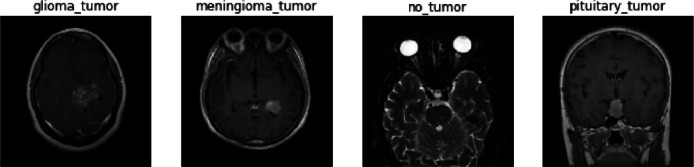
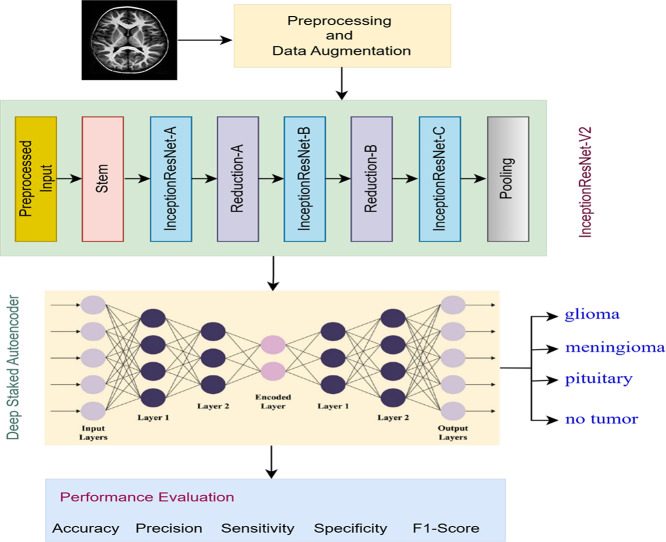
This study presents an automated framework for brain tumor classification aimed at accurately distinguishing tumor types in MRI images. The proposed model integrates InceptionResNetV2 for feature extraction with Deep Stacked Autoencoders (DSAEs) for classification, enhanced by sparsity regularization and the SwiGLU activation function. InceptionResNetV2, pre-trained on ImageNet, was fine-tuned to extract multi-scale features, while the DSAE structure compressed these features to highlight critical attributes essential for classification. The approach achieved high performance, reaching an overall accuracy of 99.53 %, precision of 98.27 %, recall of 99.21 %, specificity of 98.73 %, and an F1-score of 98.74 %. These results demonstrate the model's efficacy in accurately categorizing glioma, meningioma, pituitary tumors, and non-tumor cases, with minimal misclassifications. Despite its success, limitations include the model's dependency on pre-trained weights and significant computational resources. Future studies should address these limitations by enhancing interpretability, exploring domain-specific transfer learning, and validating on diverse datasets to strengthen the model's utility in real-world settings. Overall, the InceptionResNetV2 integrated with DSAEs, sparsity regularization, and SwiGLU offers a promising solution for reliable and efficient brain tumor diagnosis in clinical environments.•Leveraging a pre-trained InceptionResNetV2 model to capture multi-scale features from MRI data.•Utilizing Deep Stacked Autoencoders with sparsity regularization to emphasize critical attributes for precise classification.•Incorporating the SwiGLU activation function to capture complex, non-linear patterns within the data.





 京公网安备 11010802042870号
京ICP备2023020795号-1
京公网安备 11010802042870号
京ICP备2023020795号-1

 分享
分享
 求助内容:
求助内容: 应助结果提醒方式:
 扫码关注我们
