Valerie J Block, Kyra Henderson, Shane Poole, Gabby B Joseph, Jeffrey M Gelfand, Bruce Ac Cree, Riley Bove
{"title":"No evidence of fluctuations in daily step count between infusions in people with multiple sclerosis treated with anti-CD20 monoclonal antibodies.","authors":"Valerie J Block, Kyra Henderson, Shane Poole, Gabby B Joseph, Jeffrey M Gelfand, Bruce Ac Cree, Riley Bove","doi":"10.1177/20552173251329817","DOIUrl":null,"url":null,"abstract":"<p><strong>Background: </strong>Patients with multiple sclerosis (MS) on some disease-modifying therapies (i.e., natalizumab), report a \"wearing-off\" effect characterized by increased symptoms directly before infusions. Prior research suggests this may reflect natural MS fluctuations rather than true treatment waning; however, this has not been confirmed for anti-CD20 agents (e.g., ocrelizumab). Daily step count (STEPS) can reflect overall function. This study examined temporal associations between anti-CD20 therapy infusions and STEPS.</p><p><strong>Methods: </strong>Retrospective analysis evaluated data from two Fitbit-monitored cohorts (<i>N</i> = 145 total, 32 anti-CD20-treated participants) across 60 treatment cycles. Monthly STEPS were recorded directly pre- and three-month post-infusion over the six-month treatment intervals. Mixed-effects models evaluated the relationship between infusion timing, STEPS, and participant demographics, controlling for confounding variables.</p><p><strong>Results: </strong>No significant difference in STEPS was observed pre- versus post-infusion (<i>p</i> = 0.32). An average decrease of 3.3% was noted post-infusion but was not statistically significant. No associations between STEPS and participant characteristics (e.g., age, disability level) were identified. Individual variability existed, but no clear group-level trends emerged.</p><p><strong>Conclusions: </strong>This study found no evidence of an association between timing of anti-CD20 infusion and changes in STEPS. Findings highlight the need for integrating objective measures with patient-reported outcomes and biomarkers in future research to better understand potential treatment fluctuations.</p>","PeriodicalId":18961,"journal":{"name":"Multiple Sclerosis Journal - Experimental, Translational and Clinical","volume":"11 1","pages":"20552173251329817"},"PeriodicalIF":2.3000,"publicationDate":"2025-03-25","publicationTypes":"Journal Article","fieldsOfStudy":null,"isOpenAccess":false,"openAccessPdf":"https://www.ncbi.nlm.nih.gov/pmc/articles/PMC11938510/pdf/","citationCount":"0","resultStr":null,"platform":"Semanticscholar","paperid":null,"PeriodicalName":"Multiple Sclerosis Journal - Experimental, Translational and Clinical","FirstCategoryId":"1085","ListUrlMain":"https://doi.org/10.1177/20552173251329817","RegionNum":0,"RegionCategory":null,"ArticlePicture":[],"TitleCN":null,"AbstractTextCN":null,"PMCID":null,"EPubDate":"2025/1/1 0:00:00","PubModel":"eCollection","JCR":"Q2","JCRName":"CLINICAL NEUROLOGY","Score":null,"Total":0}
引用次数: 0
Abstract
Background: Patients with multiple sclerosis (MS) on some disease-modifying therapies (i.e., natalizumab), report a "wearing-off" effect characterized by increased symptoms directly before infusions. Prior research suggests this may reflect natural MS fluctuations rather than true treatment waning; however, this has not been confirmed for anti-CD20 agents (e.g., ocrelizumab). Daily step count (STEPS) can reflect overall function. This study examined temporal associations between anti-CD20 therapy infusions and STEPS.
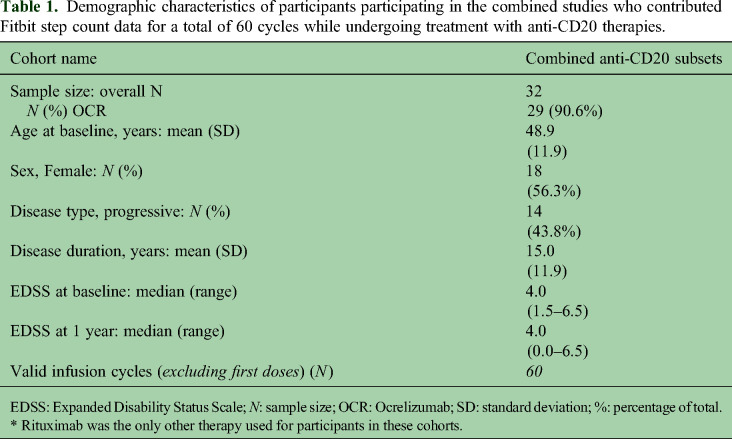
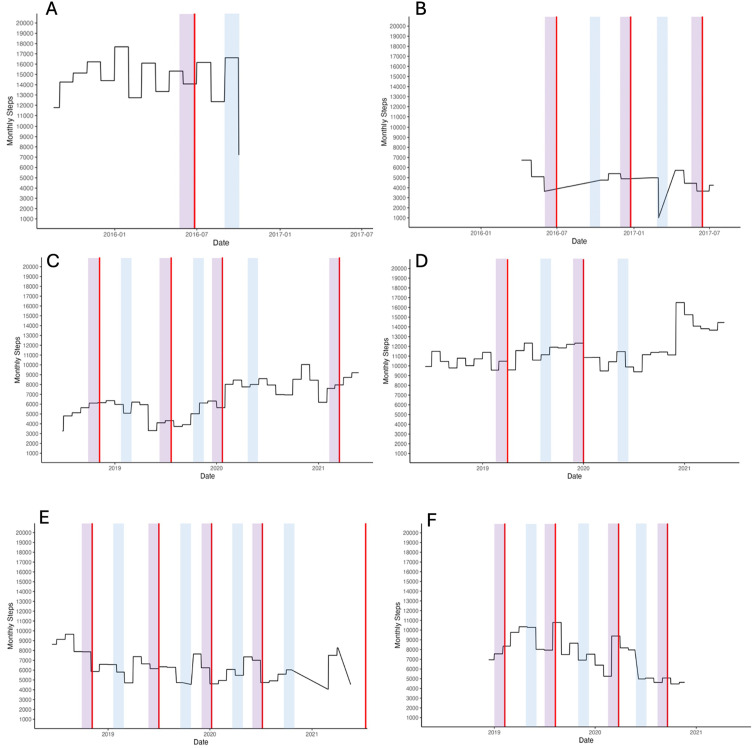
Methods: Retrospective analysis evaluated data from two Fitbit-monitored cohorts (N = 145 total, 32 anti-CD20-treated participants) across 60 treatment cycles. Monthly STEPS were recorded directly pre- and three-month post-infusion over the six-month treatment intervals. Mixed-effects models evaluated the relationship between infusion timing, STEPS, and participant demographics, controlling for confounding variables.
Results: No significant difference in STEPS was observed pre- versus post-infusion (p = 0.32). An average decrease of 3.3% was noted post-infusion but was not statistically significant. No associations between STEPS and participant characteristics (e.g., age, disability level) were identified. Individual variability existed, but no clear group-level trends emerged.
Conclusions: This study found no evidence of an association between timing of anti-CD20 infusion and changes in STEPS. Findings highlight the need for integrating objective measures with patient-reported outcomes and biomarkers in future research to better understand potential treatment fluctuations.




 京公网安备 11010802042870号
京ICP备2023020795号-1
京公网安备 11010802042870号
京ICP备2023020795号-1

 分享
分享
 求助内容:
求助内容: 应助结果提醒方式:
 扫码关注我们
