Deepak Nain, Anjali Rana, Rhitoban Raychoudhury, Ruchira Sen
{"title":"Parasite-Induced Replacement of Host Microbiota: Impact of Xenos gadagkari Parasitization on the Microbiota of Polistes wattii.","authors":"Deepak Nain, Anjali Rana, Rhitoban Raychoudhury, Ruchira Sen","doi":"10.1007/s00248-025-02517-0","DOIUrl":null,"url":null,"abstract":"<p><p>The study of microbiota of social insects under different ecological conditions can provide important insights into the role of microbes in their biology and behavior. Polistes is one of the most widely distributed and extensively studied genera of social wasps, yet a comprehensive study on the microbiota of any species of Polistes or any primitively eusocial wasp is missing. Polistes wattii is an Asian wasp, which hibernates in winter and exhibits a biannual nest founding strategy. It is often parasitized by the strepsipteran endoparasite/parasitoid Xenos gadagkari, which changes the morpho-physiology and behavior of their hosts. In this study, we employ 16S rRNA amplicon sequencing, using the Oxford Nanopore platform, to study the microbial community of P. wattii and investigate the effects of seasonality, sex, and Xenos parasitism. We show that the microbiota differs in females from solitary foundress spring nests and multiple foundress summer nests. The microbiota also differs in males and females. Finally, we show that X. gadagkari parasitism replaces and homogenizes the microbiota of P. wattii. Unlike the unparasitized wasps, the microbiota of X. gadagkari parasitoids and parasitized wasps are dominated by Wolbachia and Providencia. Although the normal microbiota of P. wattii resembles that of highly eusocial vespid wasps, we show that the microbiota of parasitized P. wattii becomes more like the microbiota of strepsipterans. Therefore, it appears that X. gadagkari and other such strepsipteran parasitoids may have a bigger impact on the biology of their hosts than previously thought.</p>","PeriodicalId":18708,"journal":{"name":"Microbial Ecology","volume":"88 1","pages":"20"},"PeriodicalIF":4.0000,"publicationDate":"2025-03-27","publicationTypes":"Journal Article","fieldsOfStudy":null,"isOpenAccess":false,"openAccessPdf":"https://www.ncbi.nlm.nih.gov/pmc/articles/PMC11950098/pdf/","citationCount":"0","resultStr":null,"platform":"Semanticscholar","paperid":null,"PeriodicalName":"Microbial Ecology","FirstCategoryId":"99","ListUrlMain":"https://doi.org/10.1007/s00248-025-02517-0","RegionNum":3,"RegionCategory":"生物学","ArticlePicture":[],"TitleCN":null,"AbstractTextCN":null,"PMCID":null,"EPubDate":"","PubModel":"","JCR":"Q2","JCRName":"ECOLOGY","Score":null,"Total":0}
引用次数: 0
Abstract
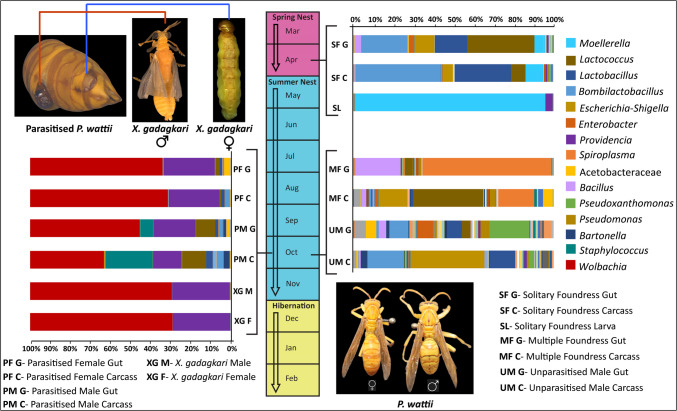
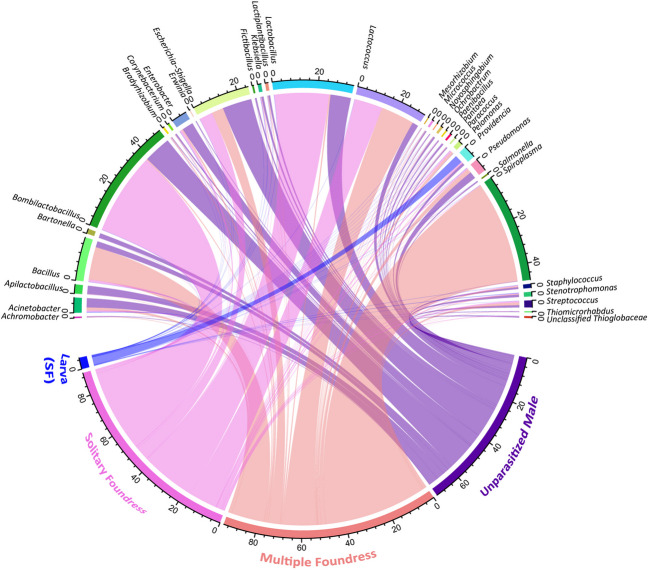
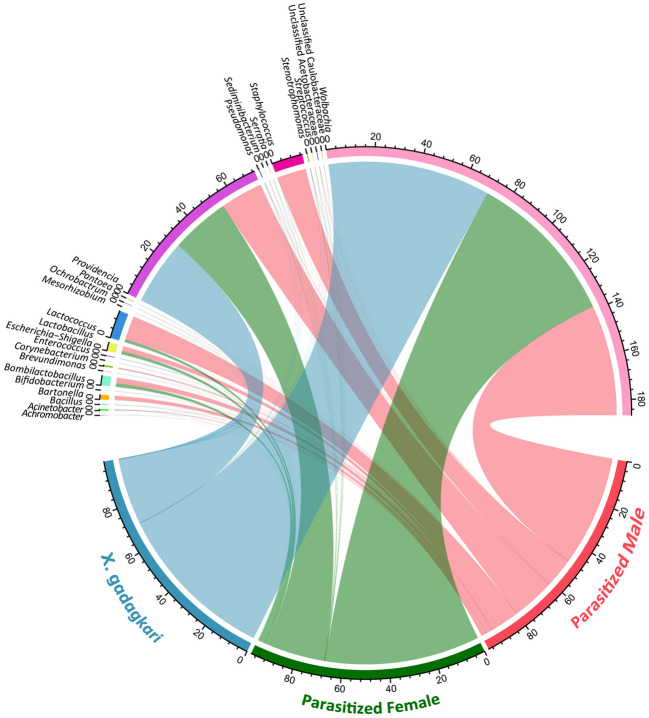
The study of microbiota of social insects under different ecological conditions can provide important insights into the role of microbes in their biology and behavior. Polistes is one of the most widely distributed and extensively studied genera of social wasps, yet a comprehensive study on the microbiota of any species of Polistes or any primitively eusocial wasp is missing. Polistes wattii is an Asian wasp, which hibernates in winter and exhibits a biannual nest founding strategy. It is often parasitized by the strepsipteran endoparasite/parasitoid Xenos gadagkari, which changes the morpho-physiology and behavior of their hosts. In this study, we employ 16S rRNA amplicon sequencing, using the Oxford Nanopore platform, to study the microbial community of P. wattii and investigate the effects of seasonality, sex, and Xenos parasitism. We show that the microbiota differs in females from solitary foundress spring nests and multiple foundress summer nests. The microbiota also differs in males and females. Finally, we show that X. gadagkari parasitism replaces and homogenizes the microbiota of P. wattii. Unlike the unparasitized wasps, the microbiota of X. gadagkari parasitoids and parasitized wasps are dominated by Wolbachia and Providencia. Although the normal microbiota of P. wattii resembles that of highly eusocial vespid wasps, we show that the microbiota of parasitized P. wattii becomes more like the microbiota of strepsipterans. Therefore, it appears that X. gadagkari and other such strepsipteran parasitoids may have a bigger impact on the biology of their hosts than previously thought.
期刊介绍:
The journal Microbial Ecology was founded more than 50 years ago by Dr. Ralph Mitchell, Gordon McKay Professor of Applied Biology at Harvard University in Cambridge, MA. The journal has evolved to become a premier location for the presentation of manuscripts that represent advances in the field of microbial ecology. The journal has become a dedicated international forum for the presentation of high-quality scientific investigations of how microorganisms interact with their environment, with each other and with their hosts. Microbial Ecology offers articles of original research in full paper and note formats, as well as brief reviews and topical position papers.



 京公网安备 11010802042870号
京ICP备2023020795号-1
京公网安备 11010802042870号
京ICP备2023020795号-1

 分享
分享
 求助内容:
求助内容: 应助结果提醒方式:
 扫码关注我们
