Omkar N Athavale, Recep Avci, Alys R Clark, Leo K Cheng, Peng Du
{"title":"Acute Cervical Vagus Nerve Stimulation Modulates Gastric Slow Waves in the Distal Rat Stomach.","authors":"Omkar N Athavale, Recep Avci, Alys R Clark, Leo K Cheng, Peng Du","doi":"10.1111/nmo.70030","DOIUrl":null,"url":null,"abstract":"<p><strong>Background: </strong>Gastric motility is coordinated by bioelectrical events, named slow waves, which propagate across the stomach. Gastric dysrhythmias are associated with disorders of gut-brain interaction. Electrical cervical vagus nerve stimulation (cVNS) affects gastric contractions, but associated changes in gastric slow waves have not been quantified.</p><p><strong>Methods: </strong>Three cVNS protocols (low: 0.30 ms, 0.25 mA, 1 Hz; medium: 0.50 ms, 0.50 mA, 5 Hz; high: 1.00 ms, 1.00 mA, 10 Hz) were administered to six rats. Gastric slow waves were concurrently recorded from the serosa of the antrum and distal corpus using flexible electrode arrays. Slow wave amplitude and frequency (mean ± standard deviation) were analyzed with a mixed linear effects model.</p><p><strong>Key results: </strong>cVNS had no effect on mean slow wave amplitude (p ≥ 0.2208). Slow wave frequency decreased during the high stimulation protocol compared to sham (3.93 ± 0.90 cpm to 3.49 ± 0.54 cpm, p = 0.0374, antrum; 3.94 ± 1.04 cpm to 3.15 ± 0.53 cpm, p < 0.0001, distal corpus) but returned to sham levels after a recovery period (p = 0.9190, antrum; p = 0.9995, distal corpus). Ectopic activation of gastric slow waves occurred during cVNS, resulting in a transient effect on gastric slow wave frequency and propagation but not amplitude.</p><p><strong>Conclusions & inferences: </strong>Slow wave activity was modified by acute medium and high cVNS stimulation protocols with changes in propagation patterns and mean frequency. Therefore, modified slow wave activity could affect gastric motility function during acute cVNS.</p>","PeriodicalId":19123,"journal":{"name":"Neurogastroenterology and Motility","volume":" ","pages":"e70030"},"PeriodicalIF":2.9000,"publicationDate":"2025-07-01","publicationTypes":"Journal Article","fieldsOfStudy":null,"isOpenAccess":false,"openAccessPdf":"https://www.ncbi.nlm.nih.gov/pmc/articles/PMC12163215/pdf/","citationCount":"0","resultStr":null,"platform":"Semanticscholar","paperid":null,"PeriodicalName":"Neurogastroenterology and Motility","FirstCategoryId":"3","ListUrlMain":"https://doi.org/10.1111/nmo.70030","RegionNum":3,"RegionCategory":"医学","ArticlePicture":[],"TitleCN":null,"AbstractTextCN":null,"PMCID":null,"EPubDate":"2025/3/27 0:00:00","PubModel":"Epub","JCR":"Q1","JCRName":"CLINICAL NEUROLOGY","Score":null,"Total":0}
引用次数: 0
Abstract
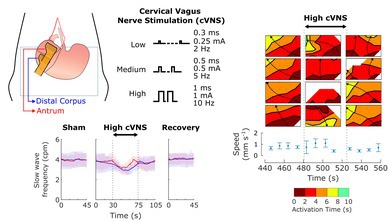
Background: Gastric motility is coordinated by bioelectrical events, named slow waves, which propagate across the stomach. Gastric dysrhythmias are associated with disorders of gut-brain interaction. Electrical cervical vagus nerve stimulation (cVNS) affects gastric contractions, but associated changes in gastric slow waves have not been quantified.
Methods: Three cVNS protocols (low: 0.30 ms, 0.25 mA, 1 Hz; medium: 0.50 ms, 0.50 mA, 5 Hz; high: 1.00 ms, 1.00 mA, 10 Hz) were administered to six rats. Gastric slow waves were concurrently recorded from the serosa of the antrum and distal corpus using flexible electrode arrays. Slow wave amplitude and frequency (mean ± standard deviation) were analyzed with a mixed linear effects model.
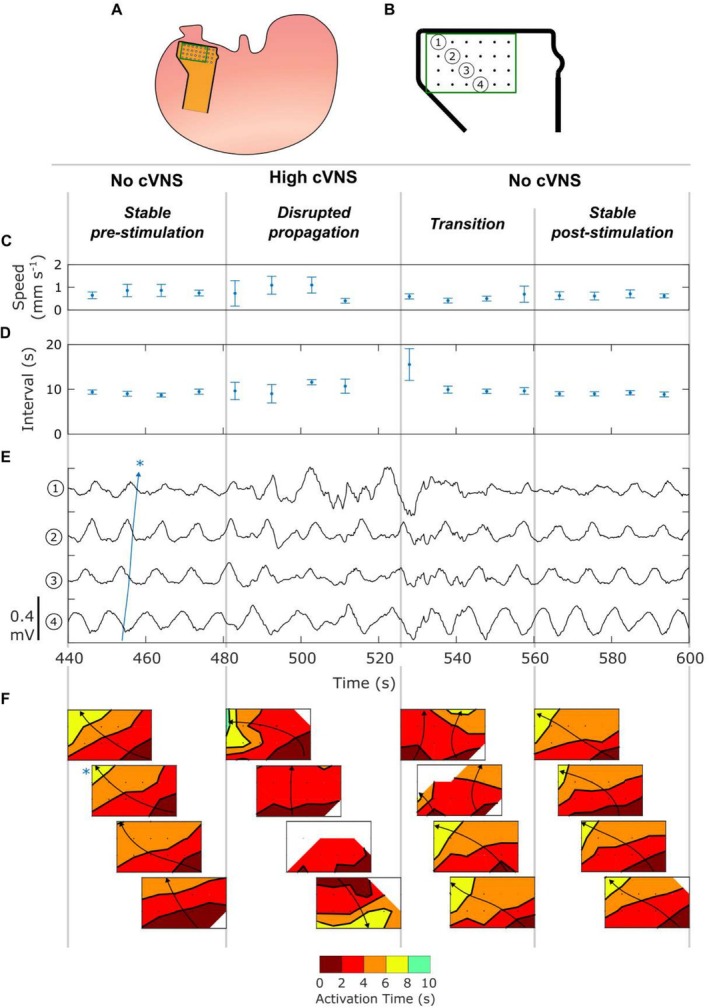
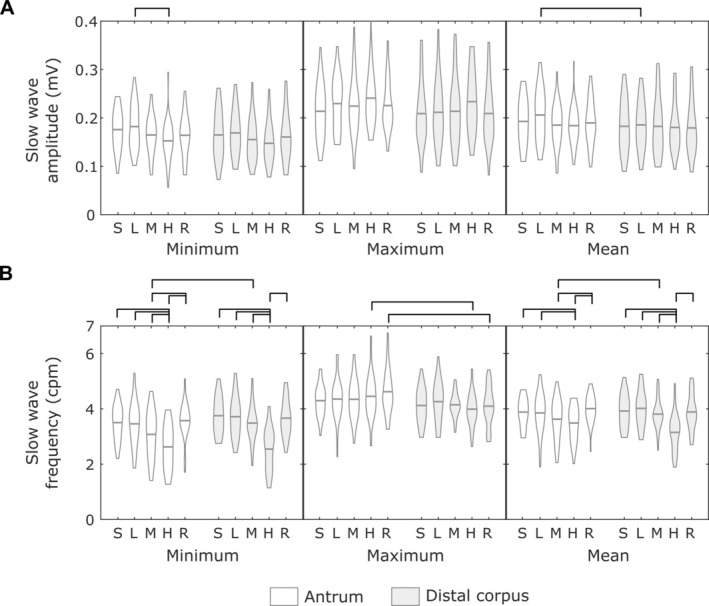
Key results: cVNS had no effect on mean slow wave amplitude (p ≥ 0.2208). Slow wave frequency decreased during the high stimulation protocol compared to sham (3.93 ± 0.90 cpm to 3.49 ± 0.54 cpm, p = 0.0374, antrum; 3.94 ± 1.04 cpm to 3.15 ± 0.53 cpm, p < 0.0001, distal corpus) but returned to sham levels after a recovery period (p = 0.9190, antrum; p = 0.9995, distal corpus). Ectopic activation of gastric slow waves occurred during cVNS, resulting in a transient effect on gastric slow wave frequency and propagation but not amplitude.
Conclusions & inferences: Slow wave activity was modified by acute medium and high cVNS stimulation protocols with changes in propagation patterns and mean frequency. Therefore, modified slow wave activity could affect gastric motility function during acute cVNS.
期刊介绍:
Neurogastroenterology & Motility (NMO) is the official Journal of the European Society of Neurogastroenterology & Motility (ESNM) and the American Neurogastroenterology and Motility Society (ANMS). It is edited by James Galligan, Albert Bredenoord, and Stephen Vanner. The editorial and peer review process is independent of the societies affiliated to the journal and publisher: Neither the ANMS, the ESNM or the Publisher have editorial decision-making power. Whenever these are relevant to the content being considered or published, the editors, journal management committee and editorial board declare their interests and affiliations.




 京公网安备 11010802042870号
京ICP备2023020795号-1
京公网安备 11010802042870号
京ICP备2023020795号-1

 分享
分享
 求助内容:
求助内容: 应助结果提醒方式:
 扫码关注我们
