Beatriz Noriega-Fernandes, Mariam Ibrahim, Rui Cruz, Philip J Kuehl, Kimberly B Shepard
{"title":"Navigating the Development of Dry Powder for Inhalation: A CDMO Perspective.","authors":"Beatriz Noriega-Fernandes, Mariam Ibrahim, Rui Cruz, Philip J Kuehl, Kimberly B Shepard","doi":"10.3390/ph18030434","DOIUrl":null,"url":null,"abstract":"<p><p>Interest in pulmonary/nasal routes for local delivery has significantly increased over the last decade owing to challenges faced in the delivery of molecules with poor solubility, systemic side effects, or new modalities such as biologics. This increasing interest has attracted new stakeholders to the field who have yet to explore inhaled drug product development. Contract development and manufacturing organizations (CDMOs) play a key role in supporting the development of drug products for inhalation, from early feasibility to post marketing. However, a critical gap exists for these newcomers: a clear, integrated, and a CDMO-centric roadmap for navigating the complexities of pulmonary/nasal drug product development. The purpose of this publication is to highlight the key aspects considered in the product development of inhaled dry powder products from a CDMO perspective, providing a novel and stepwise development strategy. A roadmap for the development of inhalable drug products is proposed with authors' recommendations to facilitate the decision-making process, starting from the definition of the desired target product profile followed by dose selection in preclinical studies. The importance of understanding the nature of the API, whether a small molecule or a biologic, will be highlighted. Additionally, technical guidance on the choice of formulation (dry powder/liquid) will be provided with special focus on dry powders. Selection criteria for the particle engineering technology, mainly jet milling and spray drying, will also be discussed, including the advantages and limitations of such technologies, based on the authors' industry expertise. Lastly, the paper will highlight the challenges and considerations for encapsulating both spray dried and jet milled powders. Unlike existing literature, this paper offers a unified framework that bridges preclinical, formulation, manufacturing, and encapsulation considerations, providing a practical tool for newcomers.</p>","PeriodicalId":20198,"journal":{"name":"Pharmaceuticals","volume":"18 3","pages":""},"PeriodicalIF":4.8000,"publicationDate":"2025-03-19","publicationTypes":"Journal Article","fieldsOfStudy":null,"isOpenAccess":false,"openAccessPdf":"https://www.ncbi.nlm.nih.gov/pmc/articles/PMC11944951/pdf/","citationCount":"0","resultStr":null,"platform":"Semanticscholar","paperid":null,"PeriodicalName":"Pharmaceuticals","FirstCategoryId":"3","ListUrlMain":"https://doi.org/10.3390/ph18030434","RegionNum":3,"RegionCategory":"医学","ArticlePicture":[],"TitleCN":null,"AbstractTextCN":null,"PMCID":null,"EPubDate":"","PubModel":"","JCR":"Q2","JCRName":"CHEMISTRY, MEDICINAL","Score":null,"Total":0}
引用次数: 0
Abstract
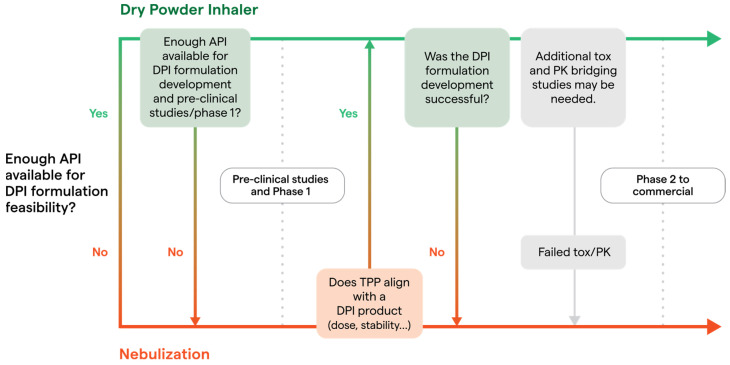
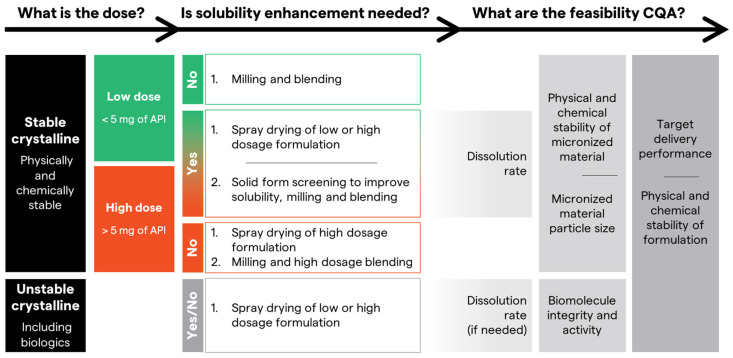
Interest in pulmonary/nasal routes for local delivery has significantly increased over the last decade owing to challenges faced in the delivery of molecules with poor solubility, systemic side effects, or new modalities such as biologics. This increasing interest has attracted new stakeholders to the field who have yet to explore inhaled drug product development. Contract development and manufacturing organizations (CDMOs) play a key role in supporting the development of drug products for inhalation, from early feasibility to post marketing. However, a critical gap exists for these newcomers: a clear, integrated, and a CDMO-centric roadmap for navigating the complexities of pulmonary/nasal drug product development. The purpose of this publication is to highlight the key aspects considered in the product development of inhaled dry powder products from a CDMO perspective, providing a novel and stepwise development strategy. A roadmap for the development of inhalable drug products is proposed with authors' recommendations to facilitate the decision-making process, starting from the definition of the desired target product profile followed by dose selection in preclinical studies. The importance of understanding the nature of the API, whether a small molecule or a biologic, will be highlighted. Additionally, technical guidance on the choice of formulation (dry powder/liquid) will be provided with special focus on dry powders. Selection criteria for the particle engineering technology, mainly jet milling and spray drying, will also be discussed, including the advantages and limitations of such technologies, based on the authors' industry expertise. Lastly, the paper will highlight the challenges and considerations for encapsulating both spray dried and jet milled powders. Unlike existing literature, this paper offers a unified framework that bridges preclinical, formulation, manufacturing, and encapsulation considerations, providing a practical tool for newcomers.
PharmaceuticalsPharmacology, Toxicology and Pharmaceutics-Pharmaceutical Science
CiteScore
6.10
自引率
4.30%
发文量
1332
审稿时长
6 weeks
期刊介绍:
Pharmaceuticals (ISSN 1424-8247) is an international scientific journal of medicinal chemistry and related drug sciences.Our aim is to publish updated reviews as well as research articles with comprehensive theoretical and experimental details. Short communications are also accepted; therefore, there is no restriction on the maximum length of the papers.




 京公网安备 11010802042870号
京ICP备2023020795号-1
京公网安备 11010802042870号
京ICP备2023020795号-1

 分享
分享
 求助内容:
求助内容: 应助结果提醒方式:
 扫码关注我们
