{"title":"A Cross-over Pilot Study on the Effects of Classical Guitar Instruction on Motor and Non-Motor Symptoms in People with Parkinson's Disease.","authors":"Christopher Adams, Greg Fulton","doi":"10.1177/26331055251329878","DOIUrl":null,"url":null,"abstract":"<p><strong>Background: </strong>A previous randomized pre-post cross-over study with 26 participants found positive changes in motor and non-motor symptoms in people with Parkinson's disease (PwPD) after six weeks of group classical guitar sessions but not customary and usual treatment.</p><p><strong>Objective: </strong>To determine if a six-week group classical guitar instruction program improved motor function, mood, and quality of life for PwPD in comparison to a six-week group exercise program in a non-randomized cross-over pilot study.</p><p><strong>Methods: </strong>Eighteen PwPD were enrolled and 15 completed the study. Group 1 (N = 10) received a six-week group guitar instruction program, and then a six-week group exercise program. Group 2 (N = 8) received a six-week group exercise program, and then a six-week guitar instruction program. Assessments were at baseline, six weeks, and 12 weeks. The groups were combined for analysis by two-tailed paired <i>t</i>-tests due to the low sample size. Assessments included the Movement Disorder Society-Unified Parkinson's Disease Rating Scale (MDS-UPDRS) motor sub-section, Hoehn and Yahr scale, Parkinson's Disease Questionnaire-39 (PDQ-39), Apathy Evaluation Scale-Self (AES-S), and Beck Depression Inventory II (BDI-II).</p><p><strong>Results: </strong>MDS-UPDRS mean motor scores decreased compared to pre-test scores with group guitar instruction (-5.3 points, <i>P</i> < .001), but not group exercise (-0.47 points, <i>P</i> = .85). BDI-II mean scores decreased by 2.13 (<i>P</i> = .08) and 1.87 points (<i>P</i> = .02) with group guitar instruction and group exercise, respectively. PDQ-39 mean scores decreased by 1.93 (<i>P</i> = .02) and 2.52 (<i>P</i> = .02) points with group guitar instruction and group exercise, respectively. AES-S mean scores decreased with group exercise (-2.40 points, <i>P</i> = .03) but not group guitar instruction (-2.4 points, <i>P</i> = .26).</p><p><strong>Conclusions: </strong>Group guitar instruction could potentially help with both motor and non-motor symptoms in PwPD. There appears to be a specific effect of group guitar instruction on MDS-UPDRS motor scores that is not due to regular meetings and general exercises. This unfunded study was registered at ClinicalTrials.gov (NCT05917704).</p>","PeriodicalId":36527,"journal":{"name":"Neuroscience Insights","volume":"20 ","pages":"26331055251329878"},"PeriodicalIF":2.6000,"publicationDate":"2025-03-24","publicationTypes":"Journal Article","fieldsOfStudy":null,"isOpenAccess":false,"openAccessPdf":"https://www.ncbi.nlm.nih.gov/pmc/articles/PMC11938490/pdf/","citationCount":"0","resultStr":null,"platform":"Semanticscholar","paperid":null,"PeriodicalName":"Neuroscience Insights","FirstCategoryId":"1085","ListUrlMain":"https://doi.org/10.1177/26331055251329878","RegionNum":0,"RegionCategory":null,"ArticlePicture":[],"TitleCN":null,"AbstractTextCN":null,"PMCID":null,"EPubDate":"2025/1/1 0:00:00","PubModel":"eCollection","JCR":"Q2","JCRName":"NEUROSCIENCES","Score":null,"Total":0}
引用次数: 0
Abstract
Background: A previous randomized pre-post cross-over study with 26 participants found positive changes in motor and non-motor symptoms in people with Parkinson's disease (PwPD) after six weeks of group classical guitar sessions but not customary and usual treatment.
Objective: To determine if a six-week group classical guitar instruction program improved motor function, mood, and quality of life for PwPD in comparison to a six-week group exercise program in a non-randomized cross-over pilot study.
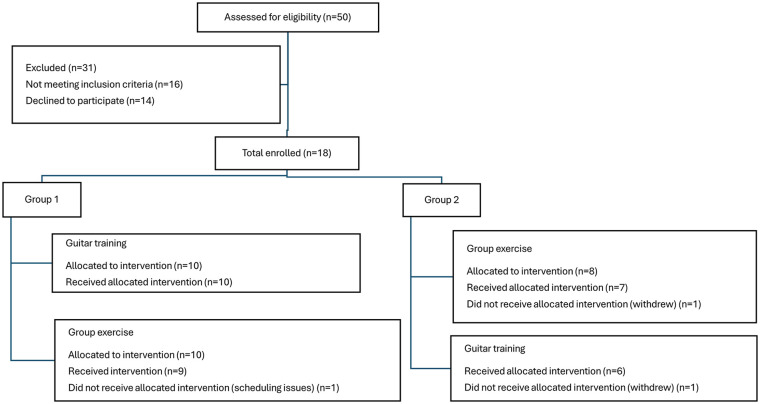
Methods: Eighteen PwPD were enrolled and 15 completed the study. Group 1 (N = 10) received a six-week group guitar instruction program, and then a six-week group exercise program. Group 2 (N = 8) received a six-week group exercise program, and then a six-week guitar instruction program. Assessments were at baseline, six weeks, and 12 weeks. The groups were combined for analysis by two-tailed paired t-tests due to the low sample size. Assessments included the Movement Disorder Society-Unified Parkinson's Disease Rating Scale (MDS-UPDRS) motor sub-section, Hoehn and Yahr scale, Parkinson's Disease Questionnaire-39 (PDQ-39), Apathy Evaluation Scale-Self (AES-S), and Beck Depression Inventory II (BDI-II).
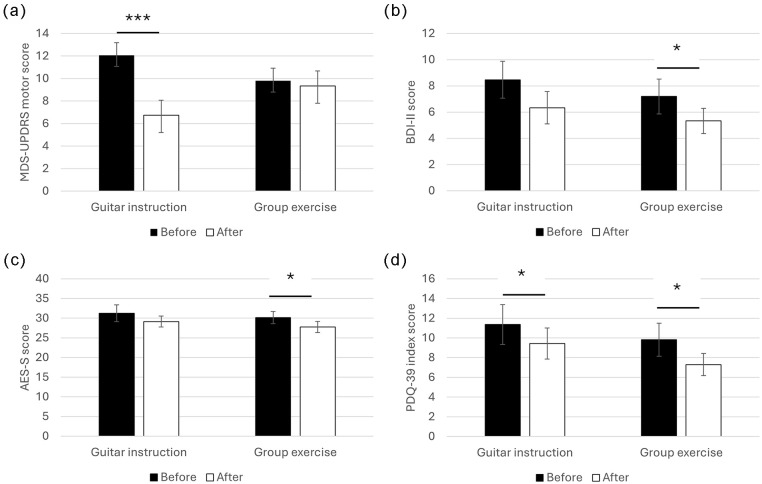
Results: MDS-UPDRS mean motor scores decreased compared to pre-test scores with group guitar instruction (-5.3 points, P < .001), but not group exercise (-0.47 points, P = .85). BDI-II mean scores decreased by 2.13 (P = .08) and 1.87 points (P = .02) with group guitar instruction and group exercise, respectively. PDQ-39 mean scores decreased by 1.93 (P = .02) and 2.52 (P = .02) points with group guitar instruction and group exercise, respectively. AES-S mean scores decreased with group exercise (-2.40 points, P = .03) but not group guitar instruction (-2.4 points, P = .26).
Conclusions: Group guitar instruction could potentially help with both motor and non-motor symptoms in PwPD. There appears to be a specific effect of group guitar instruction on MDS-UPDRS motor scores that is not due to regular meetings and general exercises. This unfunded study was registered at ClinicalTrials.gov (NCT05917704).





 京公网安备 11010802042870号
京ICP备2023020795号-1
京公网安备 11010802042870号
京ICP备2023020795号-1

 分享
分享
 求助内容:
求助内容: 应助结果提醒方式:
 扫码关注我们
