{"title":"InGSA: integrating generalized self-attention in CNN for Alzheimer's disease classification.","authors":"Faisal Binzagr, Anas W Abulfaraj","doi":"10.3389/frai.2025.1540646","DOIUrl":null,"url":null,"abstract":"<p><p>Alzheimer's disease (AD) is an incurable neurodegenerative disorder that slowly impair the mental abilities. Early diagnosis, nevertheless, can greatly reduce the symptoms that are associated with the condition. Earlier techniques of diagnosing the AD from the MRI scans have been adopted by traditional machine learning technologies. However, such traditional methods involve depending on feature extraction that is usually complex, time-consuming, and requiring substantial effort from the medical personnel. Furthermore, these methods are usually not very specific as far as diagnosis is concerned. In general, traditional convolutional neural network (CNN) architectures have a problem with identifying AD. To this end, the developed framework consists of a new contrast enhancement approach, named haze-reduced local-global (HRLG). For multiclass AD classification, we introduce a global CNN-transformer model InGSA. The proposed InGSA is based on the InceptionV3 model which is pre-trained, and it encompasses an additional generalized self-attention (GSA) block at top of the network. This GSA module is capable of capturing the interaction not only in terms of the spatial relations within the feature space but also over the channel dimension it is capable of picking up fine detailing of the AD information while suppressing the noise. Furthermore, several GSA heads are used to exploit other dependency structures of global features as well. Our evaluation of InGSA on a two benchmark dataset, using various pre-trained networks, demonstrates the GSA's superior performance.</p>","PeriodicalId":33315,"journal":{"name":"Frontiers in Artificial Intelligence","volume":"8 ","pages":"1540646"},"PeriodicalIF":4.7000,"publicationDate":"2025-03-12","publicationTypes":"Journal Article","fieldsOfStudy":null,"isOpenAccess":false,"openAccessPdf":"https://www.ncbi.nlm.nih.gov/pmc/articles/PMC11936934/pdf/","citationCount":"0","resultStr":null,"platform":"Semanticscholar","paperid":null,"PeriodicalName":"Frontiers in Artificial Intelligence","FirstCategoryId":"1085","ListUrlMain":"https://doi.org/10.3389/frai.2025.1540646","RegionNum":0,"RegionCategory":null,"ArticlePicture":[],"TitleCN":null,"AbstractTextCN":null,"PMCID":null,"EPubDate":"2025/1/1 0:00:00","PubModel":"eCollection","JCR":"Q2","JCRName":"COMPUTER SCIENCE, ARTIFICIAL INTELLIGENCE","Score":null,"Total":0}
引用次数: 0
Abstract
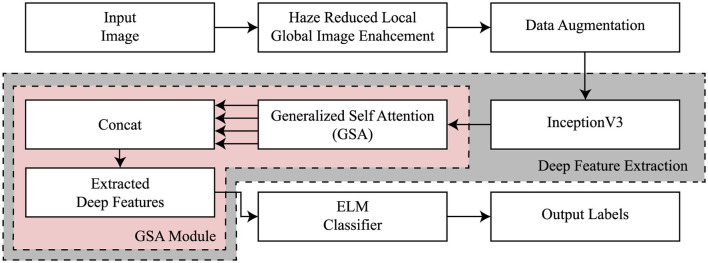
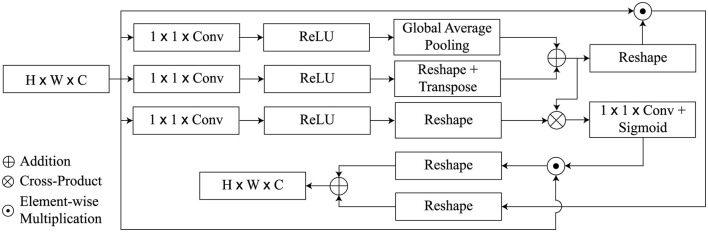
Alzheimer's disease (AD) is an incurable neurodegenerative disorder that slowly impair the mental abilities. Early diagnosis, nevertheless, can greatly reduce the symptoms that are associated with the condition. Earlier techniques of diagnosing the AD from the MRI scans have been adopted by traditional machine learning technologies. However, such traditional methods involve depending on feature extraction that is usually complex, time-consuming, and requiring substantial effort from the medical personnel. Furthermore, these methods are usually not very specific as far as diagnosis is concerned. In general, traditional convolutional neural network (CNN) architectures have a problem with identifying AD. To this end, the developed framework consists of a new contrast enhancement approach, named haze-reduced local-global (HRLG). For multiclass AD classification, we introduce a global CNN-transformer model InGSA. The proposed InGSA is based on the InceptionV3 model which is pre-trained, and it encompasses an additional generalized self-attention (GSA) block at top of the network. This GSA module is capable of capturing the interaction not only in terms of the spatial relations within the feature space but also over the channel dimension it is capable of picking up fine detailing of the AD information while suppressing the noise. Furthermore, several GSA heads are used to exploit other dependency structures of global features as well. Our evaluation of InGSA on a two benchmark dataset, using various pre-trained networks, demonstrates the GSA's superior performance.





 京公网安备 11010802042870号
京ICP备2023020795号-1
京公网安备 11010802042870号
京ICP备2023020795号-1

 分享
分享
 求助内容:
求助内容: 应助结果提醒方式:
 扫码关注我们
