{"title":"Real-time bioluminescence imaging of nitroreductase in breast cancer bone metastasis†","authors":"Kang Lu, Mengxi Zhang, Zuotong Tian and Han Xiao","doi":"10.1039/D4CB00310A","DOIUrl":null,"url":null,"abstract":"<p >Bone metastasis is a leading cause of mortality in breast cancer patients. Monitoring biomarkers for bone metastasis in breast cancer is crucial for the development of effective interventional treatments. Despite being a highly vascularized tissue, the bone presents a particularly hypoxic environment. Tumor hypoxia is closely linked to increased levels of various reductases, including nitroreductase (NTR). Currently, there are few probes available to detect NTR levels in breast cancer bone metastases. Although bioluminescent imaging is promising due to its specificity and high signal-to-noise ratio, many probes face challenges such as short emission wavelengths, reliance on complex conditions like external adenosine triphosphate, or lack of tissue specificity. In this study, through “caging” the luciferase substrate with an NTR-responsive aromatic nitro recognition group, we developed a highly sensitive and selective NTR-sensitive bioluminescent probe. The resulting probe effectively detects NTR in breast cancer cells and enables real-time monitoring of NTR in a mouse model of breast cancer bone metastasis. Additionally, it can differentiate between primary and bone tumors, and allow continuous monitoring of NTR levels, thus providing valuable insights into bone tumor progression. This work provides a powerful tool for further understanding the biological functions of NTR in breast cancer bone metastasis.</p>","PeriodicalId":40691,"journal":{"name":"RSC Chemical Biology","volume":" 5","pages":" 754-760"},"PeriodicalIF":3.9000,"publicationDate":"2025-03-14","publicationTypes":"Journal Article","fieldsOfStudy":null,"isOpenAccess":false,"openAccessPdf":"https://www.ncbi.nlm.nih.gov/pmc/articles/PMC11934263/pdf/","citationCount":"0","resultStr":null,"platform":"Semanticscholar","paperid":null,"PeriodicalName":"RSC Chemical Biology","FirstCategoryId":"1085","ListUrlMain":"https://pubs.rsc.org/en/content/articlelanding/2025/cb/d4cb00310a","RegionNum":0,"RegionCategory":null,"ArticlePicture":[],"TitleCN":null,"AbstractTextCN":null,"PMCID":null,"EPubDate":"","PubModel":"","JCR":"Q2","JCRName":"BIOCHEMISTRY & MOLECULAR BIOLOGY","Score":null,"Total":0}
引用次数: 0
Abstract
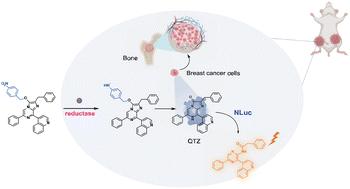
Bone metastasis is a leading cause of mortality in breast cancer patients. Monitoring biomarkers for bone metastasis in breast cancer is crucial for the development of effective interventional treatments. Despite being a highly vascularized tissue, the bone presents a particularly hypoxic environment. Tumor hypoxia is closely linked to increased levels of various reductases, including nitroreductase (NTR). Currently, there are few probes available to detect NTR levels in breast cancer bone metastases. Although bioluminescent imaging is promising due to its specificity and high signal-to-noise ratio, many probes face challenges such as short emission wavelengths, reliance on complex conditions like external adenosine triphosphate, or lack of tissue specificity. In this study, through “caging” the luciferase substrate with an NTR-responsive aromatic nitro recognition group, we developed a highly sensitive and selective NTR-sensitive bioluminescent probe. The resulting probe effectively detects NTR in breast cancer cells and enables real-time monitoring of NTR in a mouse model of breast cancer bone metastasis. Additionally, it can differentiate between primary and bone tumors, and allow continuous monitoring of NTR levels, thus providing valuable insights into bone tumor progression. This work provides a powerful tool for further understanding the biological functions of NTR in breast cancer bone metastasis.





 京公网安备 11010802042870号
京ICP备2023020795号-1
京公网安备 11010802042870号
京ICP备2023020795号-1

 分享
分享
 求助内容:
求助内容: 应助结果提醒方式:
 扫码关注我们
