Marshaun N Fitzpatrick, Lisa M Lombardo, Sandra K Hnat, Brian M Becker, Stephen M Selkirk, Musa L Audu, Ronald J Triolo, Roger D Quinn, Nathaniel S Makowski
{"title":"Combining neural stimulation and a powered exoskeletal knee to enhance walking after stroke.","authors":"Marshaun N Fitzpatrick, Lisa M Lombardo, Sandra K Hnat, Brian M Becker, Stephen M Selkirk, Musa L Audu, Ronald J Triolo, Roger D Quinn, Nathaniel S Makowski","doi":"10.1177/20556683251329256","DOIUrl":null,"url":null,"abstract":"<p><p><b>Introduction:</b> In this study, we developed a unilateral, hybrid exoskeleton designed to augment post-stroke mobility through integration of noninvasive neural stimulation and a motorized knee orthosis. We evaluated proof of concept for this hybrid exoskeleton in a stroke survivor by assessing whether: (1) the motor and transmission possess sufficient backdrivability to facilitate effective muscle-generated movements, (2) the motor can independently drive movement, and (3) the combined application of stimulation and motor generate kinematic improvements superior to either modality used in isolation. <b>Methods:</b> The device was evaluated on an ambulatory stroke survivor under four overground walking conditions: (1) without the device, (2) stimulation only while wearing the exoskeleton, (3) motor assistance only, and (4) hybrid stimulated and motorized assistance. A motion capture system was used to obtain lower limb joint angles to assess the differences in each walking condition. <b>Results:</b> Changes towards neurotypical hip, knee and ankle angles were found between the gait with no device compared to the assistive conditions. Hip-knee cyclograms suggest hybrid assistance most resembled neurotypical gait. <b>Conclusions:</b> Individually, neural stimulation and motor assistance resulted in improved gait kinematics and hybrid assistance provided greater improvement than each form of individual assistance.</p>","PeriodicalId":43319,"journal":{"name":"Journal of Rehabilitation and Assistive Technologies Engineering","volume":"12 ","pages":"20556683251329256"},"PeriodicalIF":2.0000,"publicationDate":"2025-03-24","publicationTypes":"Journal Article","fieldsOfStudy":null,"isOpenAccess":false,"openAccessPdf":"https://www.ncbi.nlm.nih.gov/pmc/articles/PMC11938448/pdf/","citationCount":"0","resultStr":null,"platform":"Semanticscholar","paperid":null,"PeriodicalName":"Journal of Rehabilitation and Assistive Technologies Engineering","FirstCategoryId":"1085","ListUrlMain":"https://doi.org/10.1177/20556683251329256","RegionNum":0,"RegionCategory":null,"ArticlePicture":[],"TitleCN":null,"AbstractTextCN":null,"PMCID":null,"EPubDate":"2025/1/1 0:00:00","PubModel":"eCollection","JCR":"Q3","JCRName":"ENGINEERING, BIOMEDICAL","Score":null,"Total":0}
引用次数: 0
Abstract
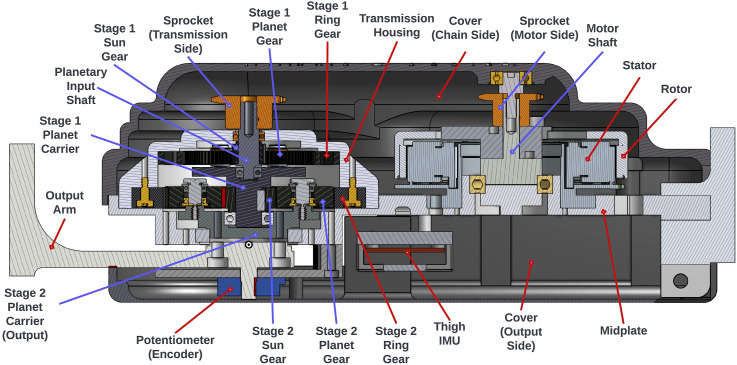
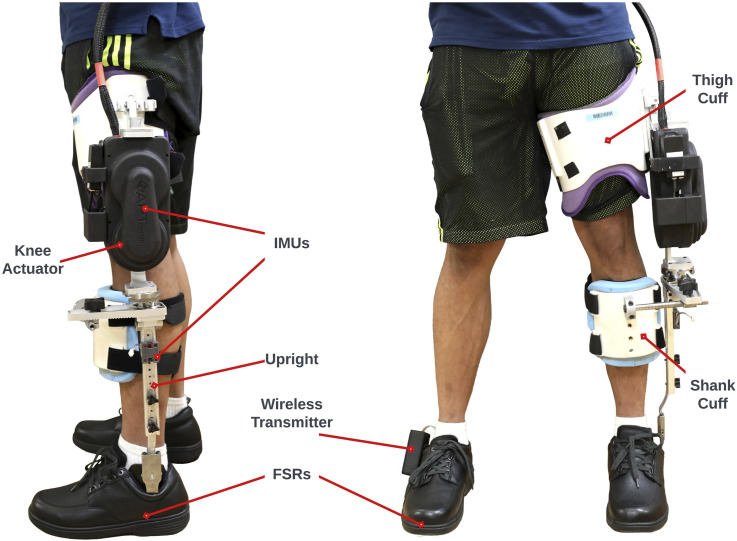
Introduction: In this study, we developed a unilateral, hybrid exoskeleton designed to augment post-stroke mobility through integration of noninvasive neural stimulation and a motorized knee orthosis. We evaluated proof of concept for this hybrid exoskeleton in a stroke survivor by assessing whether: (1) the motor and transmission possess sufficient backdrivability to facilitate effective muscle-generated movements, (2) the motor can independently drive movement, and (3) the combined application of stimulation and motor generate kinematic improvements superior to either modality used in isolation. Methods: The device was evaluated on an ambulatory stroke survivor under four overground walking conditions: (1) without the device, (2) stimulation only while wearing the exoskeleton, (3) motor assistance only, and (4) hybrid stimulated and motorized assistance. A motion capture system was used to obtain lower limb joint angles to assess the differences in each walking condition. Results: Changes towards neurotypical hip, knee and ankle angles were found between the gait with no device compared to the assistive conditions. Hip-knee cyclograms suggest hybrid assistance most resembled neurotypical gait. Conclusions: Individually, neural stimulation and motor assistance resulted in improved gait kinematics and hybrid assistance provided greater improvement than each form of individual assistance.




 京公网安备 11010802042870号
京ICP备2023020795号-1
京公网安备 11010802042870号
京ICP备2023020795号-1

 分享
分享
 求助内容:
求助内容: 应助结果提醒方式:
 扫码关注我们
