Lauren Abigail Scanlon, Catherine O'Hara, Matthew Barker-Hewitt, Jorge Barriuso
{"title":"Validation of a cancer population derived AKI machine learning algorithm in a general critical care scenario.","authors":"Lauren Abigail Scanlon, Catherine O'Hara, Matthew Barker-Hewitt, Jorge Barriuso","doi":"10.1007/s12094-025-03906-0","DOIUrl":null,"url":null,"abstract":"<p><strong>Purpose: </strong>Acute Kidney Injury (AKI) is the sudden onset of kidney damage. This damage usually comes without warning and can lead to increased mortality and inpatient costs and is of particular significance to patients undergoing cancer treatment. In previous work, we developed a machine learning algorithm to predict AKI up to 30 days prior to the event, trained on cancer patient data. Here, we validate this model on non-cancer data.</p><p><strong>Methods/patients: </strong>Medical Information Mart for Intensive Care (MIMIC) is a large, freely available database containing de-identified data from patients who were admitted to the critical care units of the Beth Israel Deaconess Medical Center. Data from 28,498 MIMIC patients were used to validate our algorithm, non-availability of Total Protein measure being the largest removal criterion.</p><p><strong>Results and conclusions: </strong>Applying our algorithm to MIMIC data generated an AUROC of 0.821 (95% CI 0.820-0.821) per blood test. Our cancer derived algorithm compares positively with other AKI models derived and/or tested on MIMIC, with our model predicting AKI at the longest time frame of up to 30 days. This suggests that our model can achieve a good performance on patient cohorts very different to those from which it was derived, demonstrating the transferability and applicability for implementation in a clinical setting.</p>","PeriodicalId":50685,"journal":{"name":"Clinical & Translational Oncology","volume":" ","pages":"3803-3810"},"PeriodicalIF":2.5000,"publicationDate":"2025-09-01","publicationTypes":"Journal Article","fieldsOfStudy":null,"isOpenAccess":false,"openAccessPdf":"https://www.ncbi.nlm.nih.gov/pmc/articles/PMC12399679/pdf/","citationCount":"0","resultStr":null,"platform":"Semanticscholar","paperid":null,"PeriodicalName":"Clinical & Translational Oncology","FirstCategoryId":"3","ListUrlMain":"https://doi.org/10.1007/s12094-025-03906-0","RegionNum":3,"RegionCategory":"医学","ArticlePicture":[],"TitleCN":null,"AbstractTextCN":null,"PMCID":null,"EPubDate":"2025/3/26 0:00:00","PubModel":"Epub","JCR":"Q2","JCRName":"ONCOLOGY","Score":null,"Total":0}
引用次数: 0
Abstract
Purpose: Acute Kidney Injury (AKI) is the sudden onset of kidney damage. This damage usually comes without warning and can lead to increased mortality and inpatient costs and is of particular significance to patients undergoing cancer treatment. In previous work, we developed a machine learning algorithm to predict AKI up to 30 days prior to the event, trained on cancer patient data. Here, we validate this model on non-cancer data.
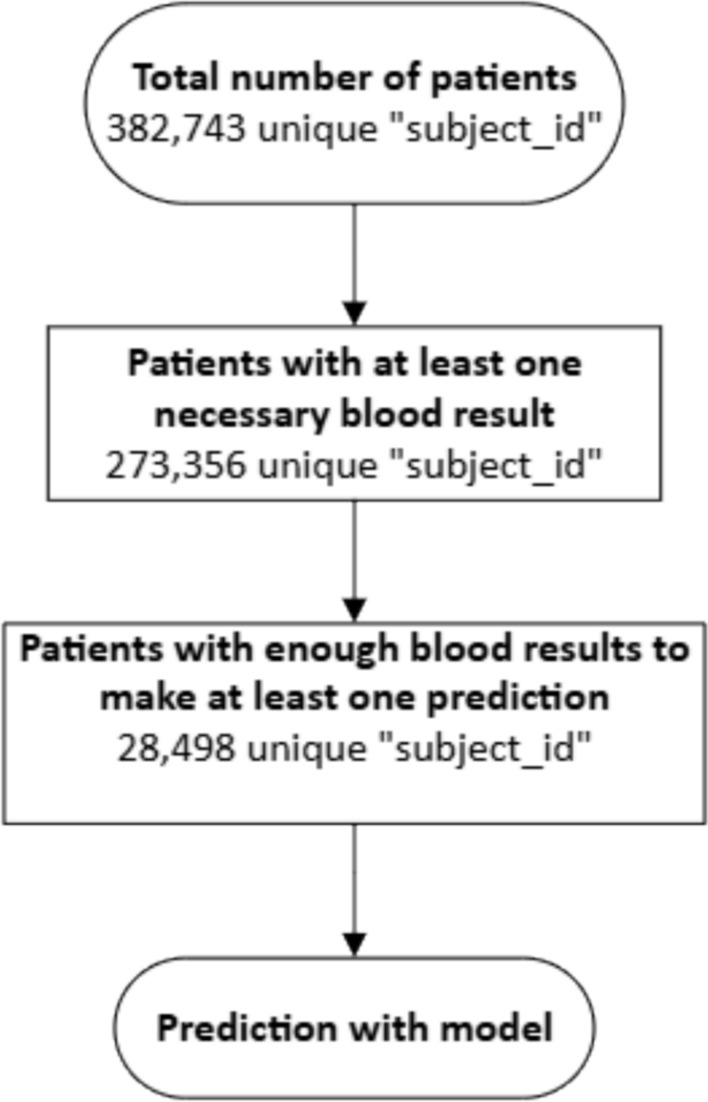
Methods/patients: Medical Information Mart for Intensive Care (MIMIC) is a large, freely available database containing de-identified data from patients who were admitted to the critical care units of the Beth Israel Deaconess Medical Center. Data from 28,498 MIMIC patients were used to validate our algorithm, non-availability of Total Protein measure being the largest removal criterion.
Results and conclusions: Applying our algorithm to MIMIC data generated an AUROC of 0.821 (95% CI 0.820-0.821) per blood test. Our cancer derived algorithm compares positively with other AKI models derived and/or tested on MIMIC, with our model predicting AKI at the longest time frame of up to 30 days. This suggests that our model can achieve a good performance on patient cohorts very different to those from which it was derived, demonstrating the transferability and applicability for implementation in a clinical setting.
期刊介绍:
Clinical and Translational Oncology is an international journal devoted to fostering interaction between experimental and clinical oncology. It covers all aspects of research on cancer, from the more basic discoveries dealing with both cell and molecular biology of tumour cells, to the most advanced clinical assays of conventional and new drugs. In addition, the journal has a strong commitment to facilitating the transfer of knowledge from the basic laboratory to the clinical practice, with the publication of educational series devoted to closing the gap between molecular and clinical oncologists. Molecular biology of tumours, identification of new targets for cancer therapy, and new technologies for research and treatment of cancer are the major themes covered by the educational series. Full research articles on a broad spectrum of subjects, including the molecular and cellular bases of disease, aetiology, pathophysiology, pathology, epidemiology, clinical features, and the diagnosis, prognosis and treatment of cancer, will be considered for publication.





 京公网安备 11010802042870号
京ICP备2023020795号-1
京公网安备 11010802042870号
京ICP备2023020795号-1

 分享
分享
 求助内容:
求助内容: 应助结果提醒方式:
 扫码关注我们
