Farahnaz Amini, Jing Ju Teh, Chung Keat Tan, Eugenie Sin Sing Tan, Edmond Siah Chye Ng
{"title":"A Pilot Randomized Controlled Trial (RCT) Evaluating the Efficacy of an Exosome-Containing Plant Extract Formulation for Treating Male Alopecia.","authors":"Farahnaz Amini, Jing Ju Teh, Chung Keat Tan, Eugenie Sin Sing Tan, Edmond Siah Chye Ng","doi":"10.3390/life15030500","DOIUrl":null,"url":null,"abstract":"<p><p><b>Background/Objectives</b>: Hair loss affects self-esteem, confidence, and psychological well-being. Exosomes, as molecular carriers of growth factors and active compounds, offer a promising treatment. This study evaluates the efficacy of an exosome formulation containing extracts from two known hair-regenerating plants, <i>Ecklonia cava</i> and <i>Thuja orientalis</i> (ECPE), for male pattern alopecia. <b>Methods</b>: A randomized controlled trial included 20 male participants with Norwood grade 2-3 androgenetic alopecia who were randomly assigned into two groups, placebo (0.9% sodium chloride) and ECPE, administered bi-weekly across four sessions. Evaluations included hair density measurements, adverse effect tracking, and self-assessments. <b>Results</b>: Most participants (55%) were aged 18 to 35, with 75% reporting hair loss for over a year and 80% noting scalp thinning. The hair counts showed no significant change in the placebo group from baseline to week 16 (Wilcoxon signed-rank test: V = 13.5, <i>p</i> = 0.163), while a significant increase was observed in the ECPE group (V = 0, <i>p</i> = 0.002). Between-group analysis revealed a significant difference in the hair count changes (Wilcoxon rank-sum test: W = 86.5, <i>p</i> = 0.006) with a large effect size (Cliff's Delta: & = 0.73, 95% CI: 0.41-0.89), with the ECPE group showing higher median hair growth (9.5, IQR = 16.88) compared to the placebo group (1.5, IQR = 3.00). A Bayesian ANCOVA, adjusted for covariates (the father's scalp hair condition, baseline hair count, and Norwood classification), showed no significant effect of these factors on the outcomes. <b>Conclusions</b>: These findings suggest that ECPE significantly improves hair regrowth compared to the placebo, with no notable adverse effects.</p>","PeriodicalId":56144,"journal":{"name":"Life-Basel","volume":"15 3","pages":""},"PeriodicalIF":3.4000,"publicationDate":"2025-03-20","publicationTypes":"Journal Article","fieldsOfStudy":null,"isOpenAccess":false,"openAccessPdf":"https://www.ncbi.nlm.nih.gov/pmc/articles/PMC11943915/pdf/","citationCount":"0","resultStr":null,"platform":"Semanticscholar","paperid":null,"PeriodicalName":"Life-Basel","FirstCategoryId":"99","ListUrlMain":"https://doi.org/10.3390/life15030500","RegionNum":3,"RegionCategory":"生物学","ArticlePicture":[],"TitleCN":null,"AbstractTextCN":null,"PMCID":null,"EPubDate":"","PubModel":"","JCR":"Q1","JCRName":"BIOLOGY","Score":null,"Total":0}
引用次数: 0
Abstract
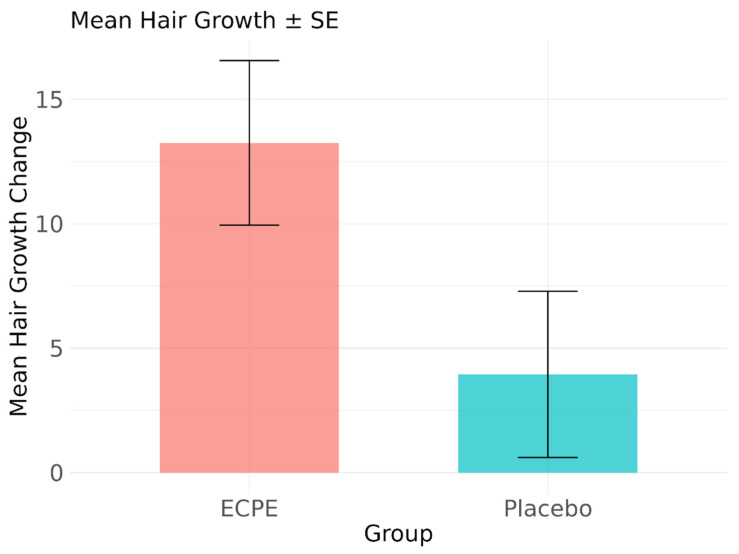
Background/Objectives: Hair loss affects self-esteem, confidence, and psychological well-being. Exosomes, as molecular carriers of growth factors and active compounds, offer a promising treatment. This study evaluates the efficacy of an exosome formulation containing extracts from two known hair-regenerating plants, Ecklonia cava and Thuja orientalis (ECPE), for male pattern alopecia. Methods: A randomized controlled trial included 20 male participants with Norwood grade 2-3 androgenetic alopecia who were randomly assigned into two groups, placebo (0.9% sodium chloride) and ECPE, administered bi-weekly across four sessions. Evaluations included hair density measurements, adverse effect tracking, and self-assessments. Results: Most participants (55%) were aged 18 to 35, with 75% reporting hair loss for over a year and 80% noting scalp thinning. The hair counts showed no significant change in the placebo group from baseline to week 16 (Wilcoxon signed-rank test: V = 13.5, p = 0.163), while a significant increase was observed in the ECPE group (V = 0, p = 0.002). Between-group analysis revealed a significant difference in the hair count changes (Wilcoxon rank-sum test: W = 86.5, p = 0.006) with a large effect size (Cliff's Delta: & = 0.73, 95% CI: 0.41-0.89), with the ECPE group showing higher median hair growth (9.5, IQR = 16.88) compared to the placebo group (1.5, IQR = 3.00). A Bayesian ANCOVA, adjusted for covariates (the father's scalp hair condition, baseline hair count, and Norwood classification), showed no significant effect of these factors on the outcomes. Conclusions: These findings suggest that ECPE significantly improves hair regrowth compared to the placebo, with no notable adverse effects.
Life-BaselBiochemistry, Genetics and Molecular Biology-General Biochemistry,Genetics and Molecular Biology
CiteScore
4.30
自引率
6.20%
发文量
1798
审稿时长
11 weeks
期刊介绍:
Life (ISSN 2075-1729) is an international, peer-reviewed open access journal of scientific studies related to fundamental themes in Life Sciences, especially those concerned with the origins of life and evolution of biosystems. Our aim is to encourage scientists to publish their experimental and theoretical results in as much detail as possible. There is no restriction on the length of the papers.






 京公网安备 11010802042870号
京ICP备2023020795号-1
京公网安备 11010802042870号
京ICP备2023020795号-1

 分享
分享
 求助内容:
求助内容: 应助结果提醒方式:
 扫码关注我们
