Esmee M Breddels, Yelyzaveta Snihirova, Ehsan Pishva, Sinan Gülöksüz, Gabriëlla Am Blokland, Jurjen Luykx, Ole A Andreassen, David Ej Linden, Dennis van der Meer
{"title":"Brain morphology mediating the effects of common genetic risk variants on Alzheimer's disease.","authors":"Esmee M Breddels, Yelyzaveta Snihirova, Ehsan Pishva, Sinan Gülöksüz, Gabriëlla Am Blokland, Jurjen Luykx, Ole A Andreassen, David Ej Linden, Dennis van der Meer","doi":"10.1177/25424823251328300","DOIUrl":null,"url":null,"abstract":"<p><strong>Background: </strong>Late-onset Alzheimer's disease (LOAD) has been associated with alterations in the morphology of multiple brain structures, and it is likely that disease mechanisms differ between brain regions. Coupling genetic determinants of LOAD with measures of brain morphology could localize and identify primary causal neurobiological pathways.</p><p><strong>Objective: </strong>To determine causal pathways from genetic risk variants of LOAD via brain morphology to LOAD.</p><p><strong>Methods: </strong>Mediation and Mendelian randomization (MR) analysis were performed using common genetic variation, T1 MRI and clinical data collected by UK Biobank and Alzheimer's Disease Neuroimaging Initiative.</p><p><strong>Results: </strong>Thickness of the entorhinal cortex and the volumes of the hippocampus, amygdala and inferior lateral ventricle mediated the effect of <i>APOE</i> ε4 on LOAD. MR showed that a thinner entorhinal cortex, a smaller hippocampus and amygdala, and a larger volume of the inferior lateral ventricles, increased the risk of LOAD as well as vice versa.</p><p><strong>Conclusions: </strong>Combining neuroimaging and genetic data can give insight into the causal neuropathological pathways of LOAD.</p>","PeriodicalId":73594,"journal":{"name":"Journal of Alzheimer's disease reports","volume":"9 ","pages":"25424823251328300"},"PeriodicalIF":2.8000,"publicationDate":"2025-03-24","publicationTypes":"Journal Article","fieldsOfStudy":null,"isOpenAccess":false,"openAccessPdf":"https://www.ncbi.nlm.nih.gov/pmc/articles/PMC11938454/pdf/","citationCount":"0","resultStr":null,"platform":"Semanticscholar","paperid":null,"PeriodicalName":"Journal of Alzheimer's disease reports","FirstCategoryId":"1085","ListUrlMain":"https://doi.org/10.1177/25424823251328300","RegionNum":0,"RegionCategory":null,"ArticlePicture":[],"TitleCN":null,"AbstractTextCN":null,"PMCID":null,"EPubDate":"2025/1/1 0:00:00","PubModel":"eCollection","JCR":"Q2","JCRName":"NEUROSCIENCES","Score":null,"Total":0}
引用次数: 0
Abstract
Background: Late-onset Alzheimer's disease (LOAD) has been associated with alterations in the morphology of multiple brain structures, and it is likely that disease mechanisms differ between brain regions. Coupling genetic determinants of LOAD with measures of brain morphology could localize and identify primary causal neurobiological pathways.
Objective: To determine causal pathways from genetic risk variants of LOAD via brain morphology to LOAD.
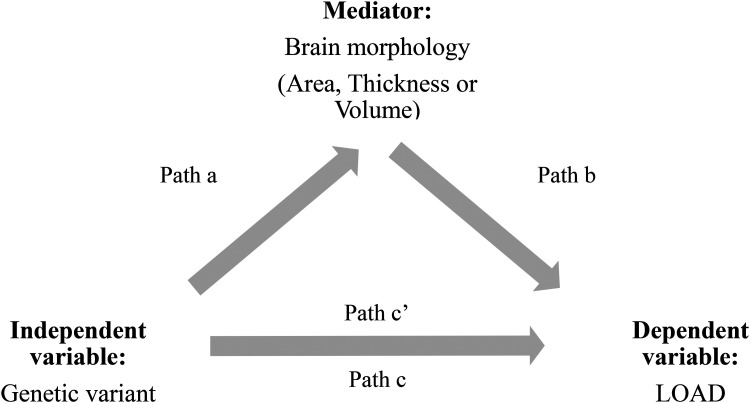
Methods: Mediation and Mendelian randomization (MR) analysis were performed using common genetic variation, T1 MRI and clinical data collected by UK Biobank and Alzheimer's Disease Neuroimaging Initiative.
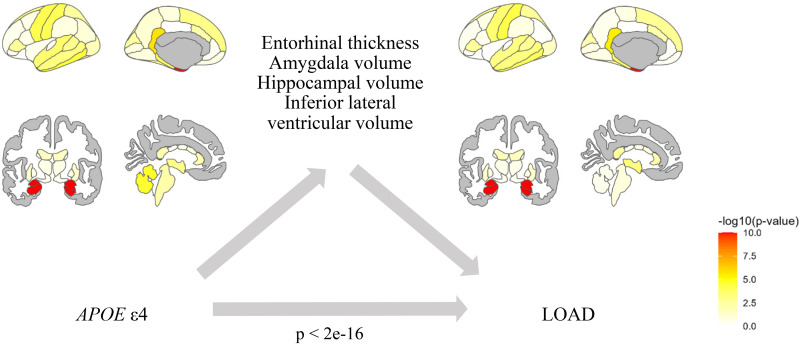
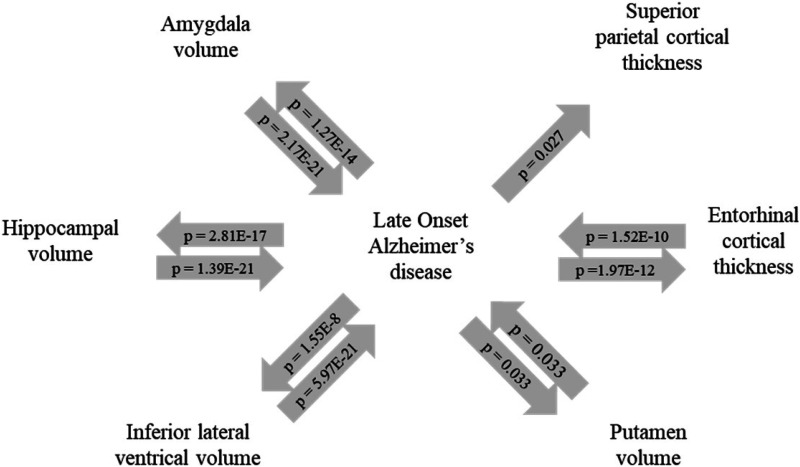
Results: Thickness of the entorhinal cortex and the volumes of the hippocampus, amygdala and inferior lateral ventricle mediated the effect of APOE ε4 on LOAD. MR showed that a thinner entorhinal cortex, a smaller hippocampus and amygdala, and a larger volume of the inferior lateral ventricles, increased the risk of LOAD as well as vice versa.
Conclusions: Combining neuroimaging and genetic data can give insight into the causal neuropathological pathways of LOAD.



 京公网安备 11010802042870号
京ICP备2023020795号-1
京公网安备 11010802042870号
京ICP备2023020795号-1

 分享
分享

 求助内容:
求助内容: 应助结果提醒方式:
 扫码关注我们
