Boris Botzanowski, Emma Acerbo, Sebastian Lehmann, Sarah L Kearsley, Melanie Steiner, Esra Neufeld, Florian Missey, Lyle Muller, Viktor Jirsa, Brian D Corneil, Adam Williamson
{"title":"Focal control of non-invasive deep brain stimulation using multipolar temporal interference.","authors":"Boris Botzanowski, Emma Acerbo, Sebastian Lehmann, Sarah L Kearsley, Melanie Steiner, Esra Neufeld, Florian Missey, Lyle Muller, Viktor Jirsa, Brian D Corneil, Adam Williamson","doi":"10.1186/s42234-025-00169-6","DOIUrl":null,"url":null,"abstract":"<p><p>Temporal interference (TI) is a method of non-invasive brain stimulation using transcutaneous electrodes which allows the targeting and modulation of deeper brain structures, not normally associated with non-invasive simulation, while avoiding unwanted stimulation of shallower cortical structures. The properties of TI have been previously demonstrated, however, the problem of decoupling stimulation focality from stimulation intensity has not yet been well addressed. In this paper, we provide a possible novel solution, multipolar TI (mTI), which allows increased independent control over both the size of the stimulated region and the stimulation intensity. The mTI method uses multiple carrier frequencies to create multiple overlapping amplitude-modulated envelopes, rather than using one envelope as in standard TI. The study presents an explanation of the concept of mTI along with experimental data gathered from Rhesus macaques and mice. We improved the focality at depth in anesthetized mice and monkeys, and using the new focality in awake monkeys, evoked targeted activity at depth in the superior colliculus. The mTI method could be an interesting and potentially useful new tool alongside other forms of non-invasive brain stimulation. Teaser Multipolar Temporal Interference Stimulation can produce a more focal brain stimulation at depth compared to Temporal Interference.</p>","PeriodicalId":72363,"journal":{"name":"Bioelectronic medicine","volume":"11 1","pages":"7"},"PeriodicalIF":0.0000,"publicationDate":"2025-03-27","publicationTypes":"Journal Article","fieldsOfStudy":null,"isOpenAccess":false,"openAccessPdf":"https://www.ncbi.nlm.nih.gov/pmc/articles/PMC11948895/pdf/","citationCount":"0","resultStr":null,"platform":"Semanticscholar","paperid":null,"PeriodicalName":"Bioelectronic medicine","FirstCategoryId":"1085","ListUrlMain":"https://doi.org/10.1186/s42234-025-00169-6","RegionNum":0,"RegionCategory":null,"ArticlePicture":[],"TitleCN":null,"AbstractTextCN":null,"PMCID":null,"EPubDate":"","PubModel":"","JCR":"","JCRName":"","Score":null,"Total":0}
引用次数: 0
Abstract
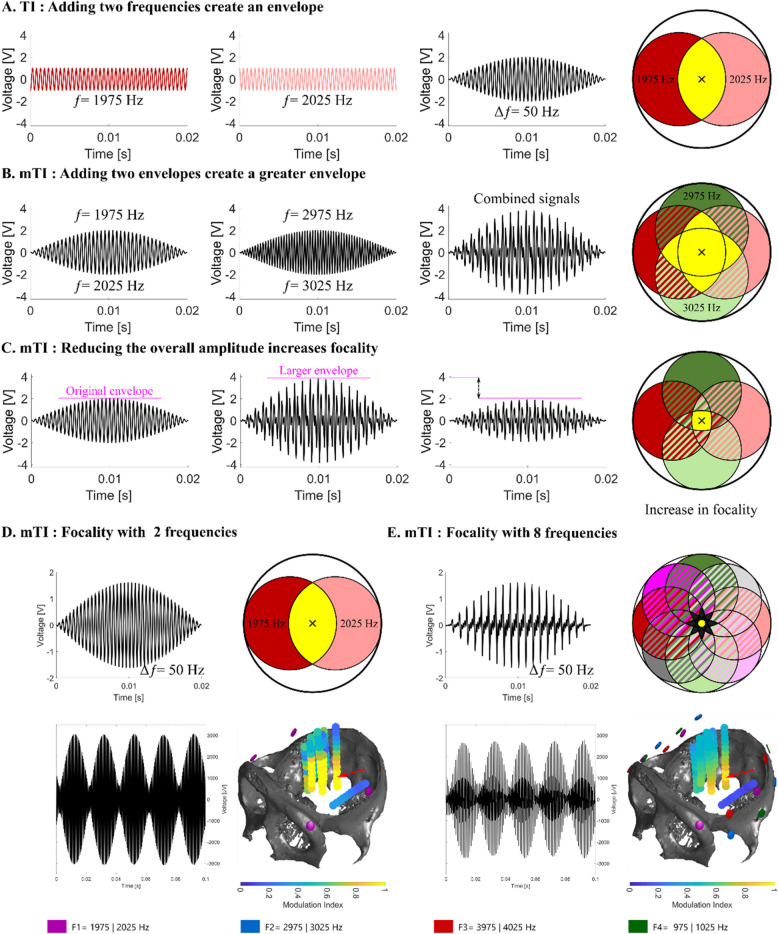
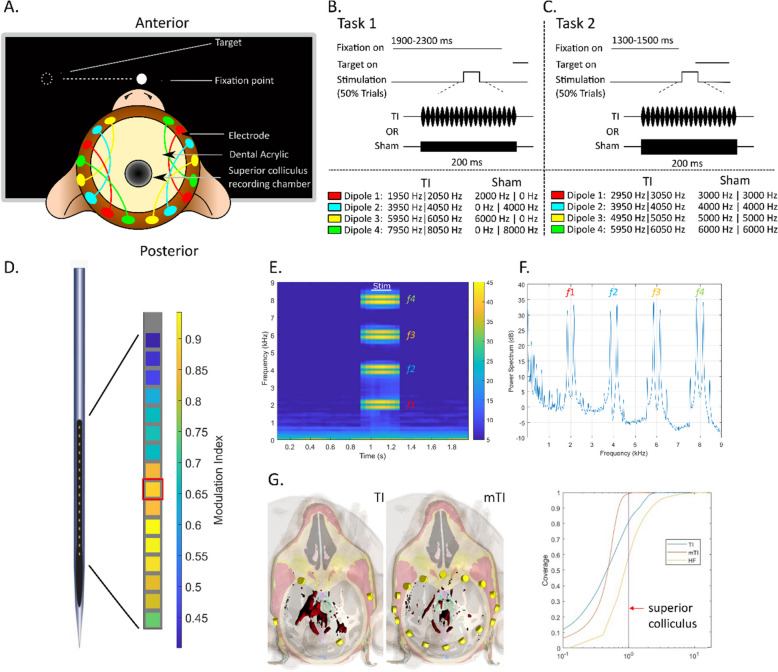
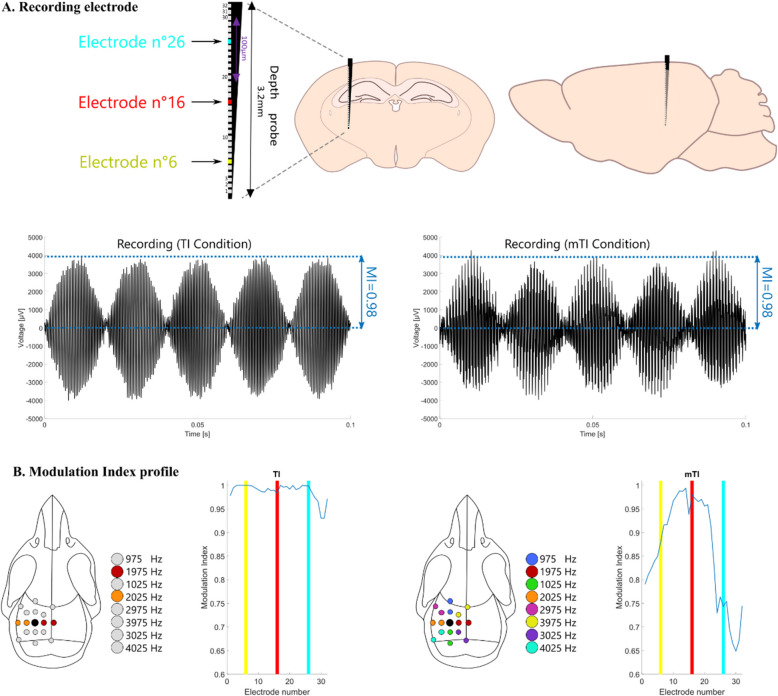
Temporal interference (TI) is a method of non-invasive brain stimulation using transcutaneous electrodes which allows the targeting and modulation of deeper brain structures, not normally associated with non-invasive simulation, while avoiding unwanted stimulation of shallower cortical structures. The properties of TI have been previously demonstrated, however, the problem of decoupling stimulation focality from stimulation intensity has not yet been well addressed. In this paper, we provide a possible novel solution, multipolar TI (mTI), which allows increased independent control over both the size of the stimulated region and the stimulation intensity. The mTI method uses multiple carrier frequencies to create multiple overlapping amplitude-modulated envelopes, rather than using one envelope as in standard TI. The study presents an explanation of the concept of mTI along with experimental data gathered from Rhesus macaques and mice. We improved the focality at depth in anesthetized mice and monkeys, and using the new focality in awake monkeys, evoked targeted activity at depth in the superior colliculus. The mTI method could be an interesting and potentially useful new tool alongside other forms of non-invasive brain stimulation. Teaser Multipolar Temporal Interference Stimulation can produce a more focal brain stimulation at depth compared to Temporal Interference.



 京公网安备 11010802042870号
京ICP备2023020795号-1
京公网安备 11010802042870号
京ICP备2023020795号-1

 分享
分享

 求助内容:
求助内容: 应助结果提醒方式:
 扫码关注我们
