Xiaowei Zhang, Luis S. Mille-Fragoso, K. Eerik Kaseniit, Arden P. Lee, Meng Zhang, Connor C. Call, Yixin Hu, Yunxin Xie, Xiaojing J. Gao
{"title":"Post-transcriptional modular synthetic receptors","authors":"Xiaowei Zhang, Luis S. Mille-Fragoso, K. Eerik Kaseniit, Arden P. Lee, Meng Zhang, Connor C. Call, Yixin Hu, Yunxin Xie, Xiaojing J. Gao","doi":"10.1038/s41589-025-01872-w","DOIUrl":null,"url":null,"abstract":"Inspired by the power of transcriptional synthetic receptors and hoping to complement them to expand the toolbox for cell engineering, we establish LIDAR (Ligand-Induced Dimerization-Activating RNA editing), a modular post-transcriptional synthetic receptor platform that harnesses RNA editing by adenosine deaminases acting on RNA. LIDAR is compatible with various receptor architectures in different cellular contexts and enables the sensing of diverse ligands and the production of functional outputs. Furthermore, LIDAR can sense orthogonal signals in the same cell and produce synthetic spatial patterns, potentially enabling the programming of complex multicellular behaviors. Lastly, LIDAR is compatible with compact encoding and can be delivered as synthetic mRNA. Thus, LIDAR expands the family of synthetic receptors, holding the promise to empower basic research and therapeutic applications. Zhang, Mille-Fragoso and colleagues developed a synthetic receptor platform named LIDAR (Ligand-Induced Dimerization-Activating RNA editing), which enables ligand-responsive gene regulation without the need of DNA promoters and is, thus, compatible with mRNA delivery.","PeriodicalId":18832,"journal":{"name":"Nature chemical biology","volume":"21 8","pages":"1250-1261"},"PeriodicalIF":13.7000,"publicationDate":"2025-03-28","publicationTypes":"Journal Article","fieldsOfStudy":null,"isOpenAccess":false,"openAccessPdf":"","citationCount":"0","resultStr":null,"platform":"Semanticscholar","paperid":null,"PeriodicalName":"Nature chemical biology","FirstCategoryId":"99","ListUrlMain":"https://www.nature.com/articles/s41589-025-01872-w","RegionNum":1,"RegionCategory":"生物学","ArticlePicture":[],"TitleCN":null,"AbstractTextCN":null,"PMCID":null,"EPubDate":"","PubModel":"","JCR":"Q1","JCRName":"BIOCHEMISTRY & MOLECULAR BIOLOGY","Score":null,"Total":0}
引用次数: 0
Abstract
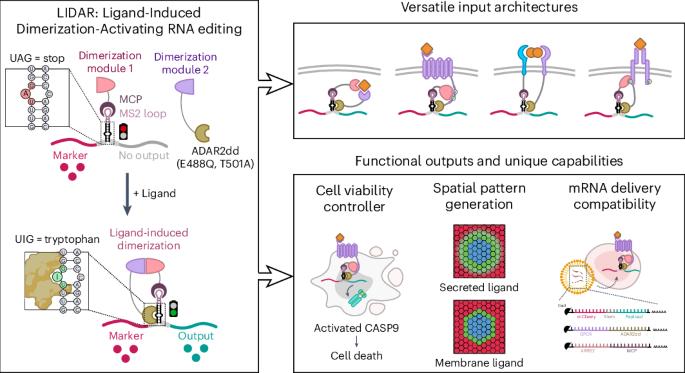
Inspired by the power of transcriptional synthetic receptors and hoping to complement them to expand the toolbox for cell engineering, we establish LIDAR (Ligand-Induced Dimerization-Activating RNA editing), a modular post-transcriptional synthetic receptor platform that harnesses RNA editing by adenosine deaminases acting on RNA. LIDAR is compatible with various receptor architectures in different cellular contexts and enables the sensing of diverse ligands and the production of functional outputs. Furthermore, LIDAR can sense orthogonal signals in the same cell and produce synthetic spatial patterns, potentially enabling the programming of complex multicellular behaviors. Lastly, LIDAR is compatible with compact encoding and can be delivered as synthetic mRNA. Thus, LIDAR expands the family of synthetic receptors, holding the promise to empower basic research and therapeutic applications. Zhang, Mille-Fragoso and colleagues developed a synthetic receptor platform named LIDAR (Ligand-Induced Dimerization-Activating RNA editing), which enables ligand-responsive gene regulation without the need of DNA promoters and is, thus, compatible with mRNA delivery.
期刊介绍:
Nature Chemical Biology stands as an esteemed international monthly journal, offering a prominent platform for the chemical biology community to showcase top-tier original research and commentary. Operating at the crossroads of chemistry, biology, and related disciplines, chemical biology utilizes scientific ideas and approaches to comprehend and manipulate biological systems with molecular precision.
The journal embraces contributions from the growing community of chemical biologists, encompassing insights from chemists applying principles and tools to biological inquiries and biologists striving to comprehend and control molecular-level biological processes. We prioritize studies unveiling significant conceptual or practical advancements in areas where chemistry and biology intersect, emphasizing basic research, especially those reporting novel chemical or biological tools and offering profound molecular-level insights into underlying biological mechanisms.
Nature Chemical Biology also welcomes manuscripts describing applied molecular studies at the chemistry-biology interface due to the broad utility of chemical biology approaches in manipulating or engineering biological systems. Irrespective of scientific focus, we actively seek submissions that creatively blend chemistry and biology, particularly those providing substantial conceptual or methodological breakthroughs with the potential to open innovative research avenues. The journal maintains a robust and impartial review process, emphasizing thorough chemical and biological characterization.




 京公网安备 11010802042870号
京ICP备2023020795号-1
京公网安备 11010802042870号
京ICP备2023020795号-1

 分享
分享
 求助内容:
求助内容: 应助结果提醒方式:
 扫码关注我们
