{"title":"AdamGraph: Adaptive Attention-Modulated Graph Network for EEG Emotion Recognition","authors":"C. L. Philip Chen;Bianna Chen;Tong Zhang","doi":"10.1109/TCYB.2025.3550191","DOIUrl":null,"url":null,"abstract":"The underlying time-variant and subject-specific brain dynamics lead to inconsistent distributions in electroencephalogram (EEG) topology and representations within and between individuals. However, current works primarily align the distributions of EEG representations, overlooking the topology variability in capturing the dependencies between channels, which may limit the performance of EEG emotion recognition. To tackle this issue, this article proposes an adaptive attention-modulated graph network (AdamGraph) to enhance the subject adaptability of EEG emotion recognition against connection variability and representation variability. Specifically, an attention-modulated graph connection module is proposed to explicitly capture the individual important relationships among channels adaptively. Through modulating the attention matrix of individual functional connections using spatial connections based on prior knowledge, the attention-modulated weights can be learned to construct individual connections adaptively, thereby mitigating individual differences. Besides, a deep node-graph representation learning module is designed to extract long-range interaction characteristics among channels and alleviate the over-smoothing problem of representations. Furthermore, a graph domain co-regularized learning module is imposed to tackle the individual distribution discrepancies in connection and representations across different domains. Extensive experiments on three public EEG emotion datasets, i.e., SEED, DREAMER, and MPED, validate the superior performance of AdamGraph compared with state-of-the-art methods.","PeriodicalId":13112,"journal":{"name":"IEEE Transactions on Cybernetics","volume":"55 5","pages":"2038-2051"},"PeriodicalIF":10.5000,"publicationDate":"2025-03-27","publicationTypes":"Journal Article","fieldsOfStudy":null,"isOpenAccess":false,"openAccessPdf":"","citationCount":"0","resultStr":null,"platform":"Semanticscholar","paperid":null,"PeriodicalName":"IEEE Transactions on Cybernetics","FirstCategoryId":"94","ListUrlMain":"https://ieeexplore.ieee.org/document/10943259/","RegionNum":1,"RegionCategory":"计算机科学","ArticlePicture":[],"TitleCN":null,"AbstractTextCN":null,"PMCID":null,"EPubDate":"","PubModel":"","JCR":"Q1","JCRName":"AUTOMATION & CONTROL SYSTEMS","Score":null,"Total":0}
引用次数: 0
Abstract
The underlying time-variant and subject-specific brain dynamics lead to inconsistent distributions in electroencephalogram (EEG) topology and representations within and between individuals. However, current works primarily align the distributions of EEG representations, overlooking the topology variability in capturing the dependencies between channels, which may limit the performance of EEG emotion recognition. To tackle this issue, this article proposes an adaptive attention-modulated graph network (AdamGraph) to enhance the subject adaptability of EEG emotion recognition against connection variability and representation variability. Specifically, an attention-modulated graph connection module is proposed to explicitly capture the individual important relationships among channels adaptively. Through modulating the attention matrix of individual functional connections using spatial connections based on prior knowledge, the attention-modulated weights can be learned to construct individual connections adaptively, thereby mitigating individual differences. Besides, a deep node-graph representation learning module is designed to extract long-range interaction characteristics among channels and alleviate the over-smoothing problem of representations. Furthermore, a graph domain co-regularized learning module is imposed to tackle the individual distribution discrepancies in connection and representations across different domains. Extensive experiments on three public EEG emotion datasets, i.e., SEED, DREAMER, and MPED, validate the superior performance of AdamGraph compared with state-of-the-art methods.
期刊介绍:
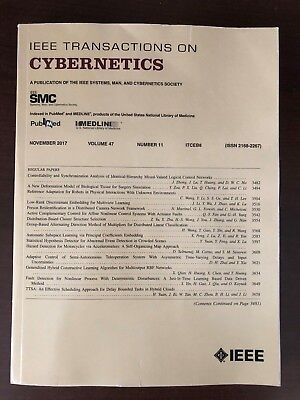
The scope of the IEEE Transactions on Cybernetics includes computational approaches to the field of cybernetics. Specifically, the transactions welcomes papers on communication and control across machines or machine, human, and organizations. The scope includes such areas as computational intelligence, computer vision, neural networks, genetic algorithms, machine learning, fuzzy systems, cognitive systems, decision making, and robotics, to the extent that they contribute to the theme of cybernetics or demonstrate an application of cybernetics principles.



 京公网安备 11010802042870号
京ICP备2023020795号-1
京公网安备 11010802042870号
京ICP备2023020795号-1

 分享
分享
 求助内容:
求助内容: 应助结果提醒方式:
 扫码关注我们
